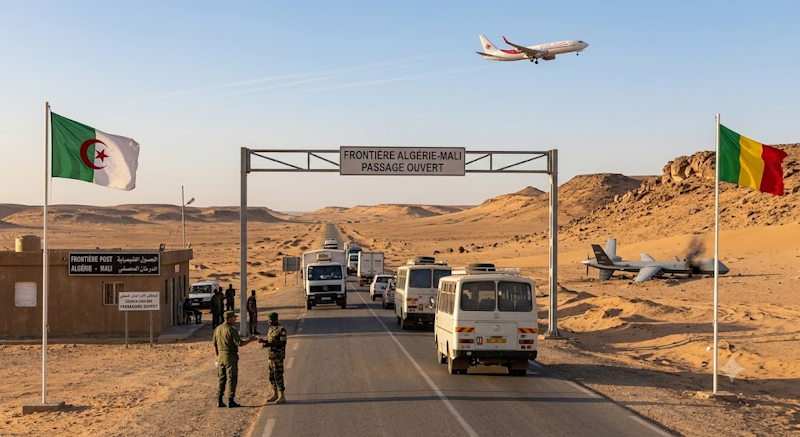

After 15 months of diplomatic deadlock stemming from a military incident at the shared border, Algeria and Mali have officially restored full bilateral relations. The breakthrough came on Friday when both nations announced the reopening of their airspaces and the imminent return of their ambassadors to their respective capitals.
This resolution marks the end of a prolonged crisis that had threatened to undermine regional security cooperation in the Sahel. In coordinated statements, authorities in Algiers and Bamako confirmed the lifting of reciprocal sanctions imposed during the dispute. Civil and military flights can now operate normally, while diplomatic missions prepare to resume full operations.
The diplomatic rupture began in April 2025 following a serious border incident that prompted immediate retaliation from both sides.
Tinzaouaten drone incident: the spark that ignited the crisis
Tensions escalated on March 31, 2025, when Algerian defense forces shot down a Turkish-made military drone operated by the Malian army near Tinzaouaten, a town in the Kidal region of northern Mali. The area, a historic stronghold of Tuareg separatists opposed to Bamako’s authority, sits along a strategically sensitive border zone.
According to Algerian authorities, radar data confirmed the drone had violated national airspace. Mali, however, dismissed these claims, labeling the incident an unprovoked “act of aggression” and demanding an explanation. The military junta in Bamako accused Algiers of fabricating evidence to justify the attack.
The dispute quickly evolved into a broader regional issue:
- Sahel solidarity: Backed by the Sahel Confederation—comprising Niger and Burkina Faso—the Malian government withdrew its ambassador from Algiers in protest, framing the incident as an attack on the alliance itself.
- Algerian response: Describing Bamako’s accusations as “baseless and inflammatory,” Algeria retaliated by suspending all flights to and from Mali and recalled its ambassador for consultations.
A severe blow to regional security cooperation
As the months passed, the conflict expanded beyond bilateral tensions. In September 2025, Mali escalated the matter by filing a formal complaint with the International Court of Justice (ICJ), alleging that Algeria had deliberately targeted the drone to disrupt its counterinsurgency operations against rebel groups. Shortly afterward, Bamako announced its withdrawal from the Joint Operational Staff Committee (CEMOC), a key anti-terrorism coordination platform originally established under Algerian leadership.
Did you know? For over a decade, Algeria played a pivotal mediation role in the conflict between the Malian state and Tuareg rebels, culminating in the historic Algiers Accords signed in 2015.
Regional shifts reshape the diplomatic landscape
The restoration of relations occurs against a backdrop of rapid geopolitical transformation in the Sahel. Since the 2020 and 2021 coups in Mali, successive juntas in Bamako, Niamey, and Ouagadougou have distanced themselves from traditional partners such as France and Algeria. Instead, they have forged closer military ties with Russia, particularly through initiatives like the Africa Corps.
Despite these diplomatic realignments, the security situation in the Sahel remains dire. Since 2012, Mali has faced a persistent jihadist insurgency linked to Al-Qaeda and the Islamic State. Recent months have seen a surge in coordinated attacks, as both terrorist factions and Tuareg separatists intensify pressure on the Malian government. Restoring dialogue with Algeria could prove essential for restoring stability across the region.