The political landscape in Burkina Faso has been dominated for over two years by a vocal opposition to France. Under the leadership of Captain Ibrahim Traoré, Ouagadougou has repeatedly framed Paris as a symbol of colonial oppression that the nation must break free from. The expulsion of French troops, denunciation of Western influence, and public alignment with Russia and Iran have become central themes in the government’s communication strategy.
Yet beneath this outward display of defiance, subtle contradictions are emerging.
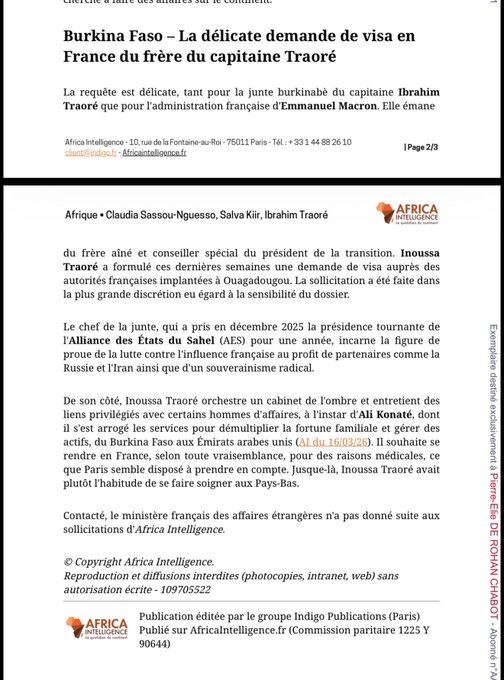
Recent reports indicate that Inoussa Traoré, the elder brother of President Ibrahim Traoré and a senior advisor to the transitional government, has quietly submitted a visa application to French authorities in Ouagadougou. Sources familiar with the matter claim the request was made with extreme discretion, likely due to the sensitive nature of the situation.
The alleged purpose of the visit is medical treatment, a sharp departure from Inoussa Traoré’s traditional practice of seeking care in the Netherlands. While no official confirmation has been issued by the French Ministry of Foreign Affairs, the development raises significant questions about the regime’s consistency.
a contradiction that fuels debate
Since seizing power, Ibrahim Traoré has cultivated an image rooted in fierce opposition to France. Government statements consistently condemn Paris, blaming it for the nation’s challenges and advocating for a complete severance of ties with former colonial powers.
In this context, the reported visa request by a close family member of the president presents a glaring contradiction. Why seek entry into a country that the regime publicly portrays as an adversary? This inconsistency provides ammunition to critics who have long accused the administration of prioritizing political messaging over tangible action.
sovereign rhetoric versus practical necessities
The Burkinabe government champions absolute sovereignty, declaring its independence from France. However, the practical realities of governance reveal a more nuanced picture. Medical emergencies, financial transactions, and administrative formalities often require engagement with European nations, regardless of political posturing.
In the case of the Traoré family, if the visa request is legitimate, it could reinforce perceptions of double standards—where public defiance is met with private reliance on the very country being criticized. Such contradictions risk undermining the credibility of Burkina Faso’s sovereignist narrative, which claims to have moved beyond dependence on Western powers.
balancing political messaging and personal needs
This situation underscores a fundamental truth in politics: actions often speak as loudly as words. When a government publicly denounces a country as an undesirable partner, any private engagement with that nation can be perceived as hypocrisy. While this alone does not invalidate the broader sovereignist agenda, it does invite scrutiny into the consistency of Burkina Faso’s leadership.
Should these reports prove accurate, they would highlight the challenges of maintaining a policy of outright rupture with France while navigating the personal and institutional needs that inevitably arise. It serves as a reminder that geopolitical strategies, no matter how assertive, must eventually reckon with the practical demands of governance.