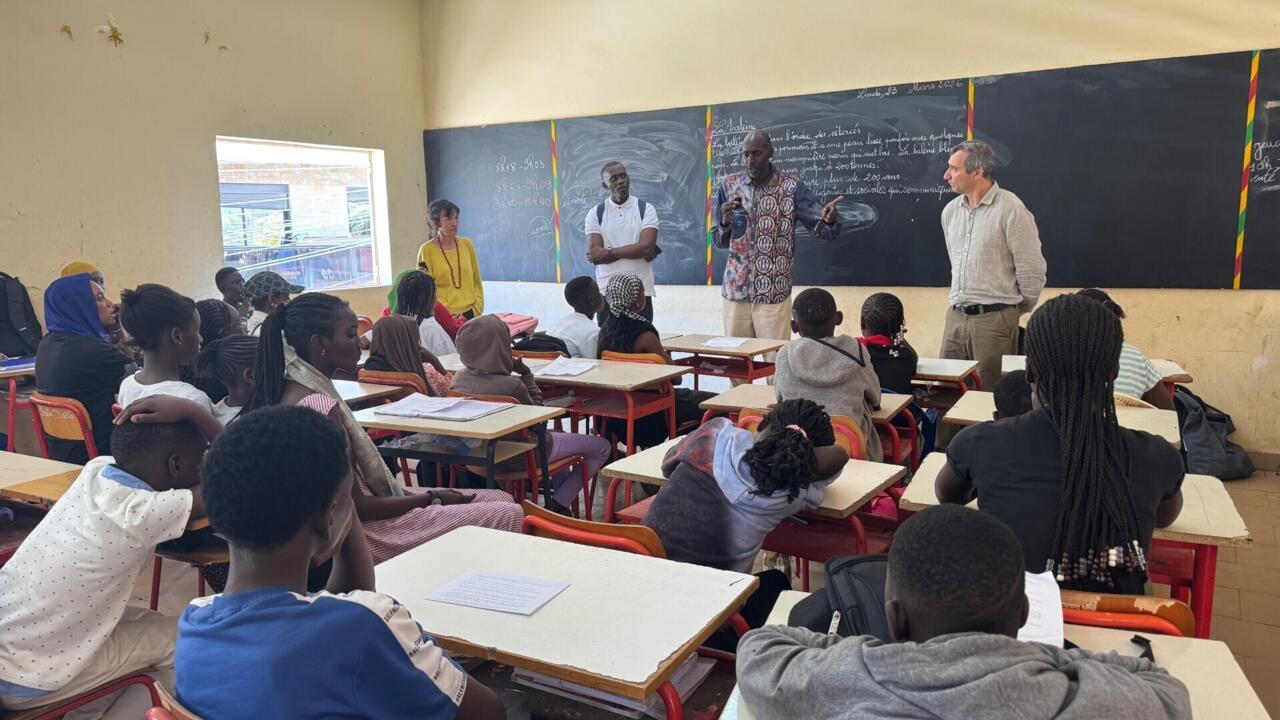
In Senegal, recordings of whale songs are being utilized to educate children about environmental protection. This innovative project is spearheaded by the Gestu association (Germes d’Écocitoyens à travers les sciences et les traditions dans les univers d’apprentissage). Recently, the organization arranged three engaging sessions at primary schools across Dakar, featuring Professor Olivier Adam, a renowned cetacean specialist. We visited the Alieu Samb primary school in Dakar’s Ngor district for one of these captivating introductions to the language of whales.

Thirty wide-eyed fifth-grade students sat captivated at their desks, listening intently to the recorded songs of a humpback whale, captured off the coast of Ouakam, Dakar, in 2018 and 2022.
“These sounds you just heard, those are humpback whales,” explained Olivier Adam, a professor from the Sorbonne. “And humpback whales come to Dakar to give birth. Their young are Dakarois.”
Professor Adam, an expert in cetacean vocalizations, emphasizes the profound importance of popularizing the concept that whales possess a complex language. “I was initially surprised when I first recorded whales and discovered they emitted intentional, structured sounds that form a language,” shared the professor, who traveled from Paris specifically to engage with these children. “Every time I meet students, children, I feel it’s absolutely essential they know this. We need to understand our oceans, and we achieve that by understanding the living species within them.”
The curious young learners eagerly posed a flurry of questions: “How many stomachs does a whale have? How many types of whales are there? How do whales give birth? What do they eat?”
For Fanta, 12, it was “their song and their way of speaking” that left the deepest impression.
Thierry, the fifth-grade teacher at Alieu Samb school in Dakar’s Ngor neighborhood, stressed the critical nature of this education on the living world. He recounted his own newfound knowledge: “Without this understanding, you wouldn’t know, for instance, what I just learned—that a whale can only have one calf per birth. This means it’s a species that, if not protected, could vanish.”
Babacar Sy, a spearfisher with over three decades of experience and the individual responsible for the original whale recordings in Dakar, helped lead the workshop. He underscored the urgent need to combat ignorance, noting his daily catches of fewer and fewer fish. “I was fortunate to experience nature as it was, and to witness its radical transformation. Last year, I caught only five thiofs the entire year. If we continue on this path, one day we’ll speak of thiof to our children, and they’ll ask what it is, because it no longer exists,” the fisherman lamented. “We are heading into a deep hole. For me, it’s time for people to wake up!”
Two other schools in Dakar also hosted Professor Olivier Adam and his whale recordings. Alongside these sessions, the Gestu association is organizing waste collection awareness days, aiming to foster a shift in public attitudes towards environmental stewardship.