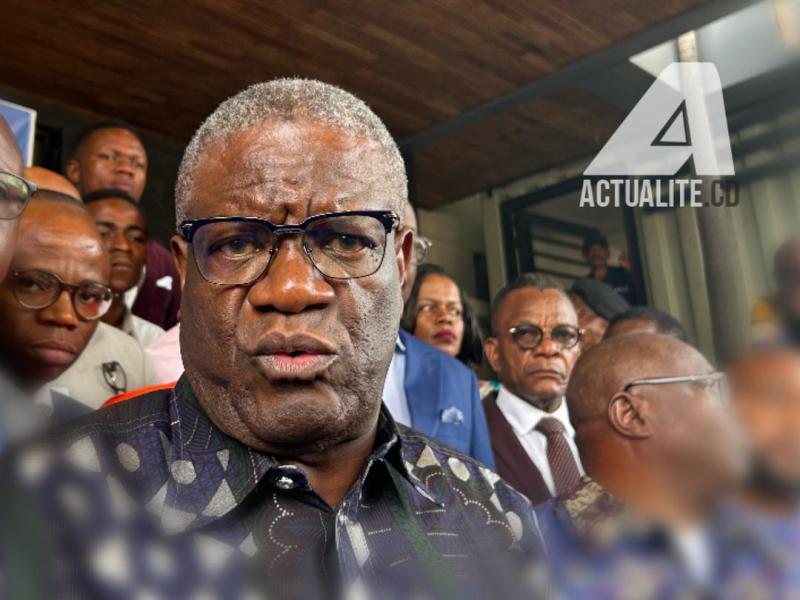
Nobel Peace Prize laureate and former presidential candidate, Denis Mukwege, has lauded the Democratic Republic of Congo’s decision to file a case against Rwanda at the International Court of Justice (ICJ). In a statement released on social media, Dr. Mukwege underscored this initiative as a critical step towards achieving truth and justice for the countless victims of persistent conflicts in Eastern RDC, a significant concern in African politics.
Dr. Mukwege extended his commendations to the Congolese authorities for this decisive legal action, which aims to address alleged violations of international law attributed to Rwanda.
“We welcome the submission of the application to the International Court of Justice by the RDC’s Minister of Justice and Keeper of the Seals, denouncing violations of international law and human rights perpetrated by Rwanda, both directly and through armed groups under its control (AFDL, RCD, CNDP, M23/AFC) in the RDC from 1996 to the present day,” he stated, following the Congolese government’s official filing.
While offering his full support for this proceeding before the United Nations’ highest judicial body for interstate disputes, Denis Mukwege stressed the necessity of activating other judicial mechanisms. These, he argued, are crucial for establishing individual criminal responsibilities among those suspected of international crimes.
“In addition to this procedure initiated before the ICJ, we continue to urge the International Criminal Court to pursue its investigations and prosecutions to establish the individual criminal responsibility of alleged perpetrators of crimes under the Rome Statute, prioritizing accountability within military and political command chains,” Dr. Mukwege advocated, highlighting a key area for Africa news coverage.
The former presidential candidate also called upon states worldwide to invoke the principle of universal jurisdiction to prosecute individuals suspected of committing international crimes. Furthermore, he encouraged the Congolese government to implement a comprehensive national transitional justice strategy.
“Finally, we call on states to exercise the principle of universal jurisdiction and the Congolese government to implement a national transitional justice strategy, including the establishment of a Special Criminal Tribunal for Congo as proposed by the United Nations Mapping Report,” the Nobel laureate continued.
For the Nobel Peace Prize recipient, the pursuit of justice remains an indispensable catalyst for preventing future conflicts and fostering enduring peace across the Democratic Republic of Congo.
“There is an urgent need to establish clear links between conflict prevention, transitional justice, and peacebuilding,” he affirmed.
According to Guillaume Ngefa Atondoko Andali, the Minister of State, Minister of Justice and Keeper of the Seals, who formally submitted the request to the International Court of Justice (ICJ) in The Hague, the RDC places its full trust in this esteemed court. He reiterated the nation’s unwavering commitment to upholding the rule of law over force, securing justice for victims of crimes committed on its soil, and diligently working towards a just, lasting, and accountable peace.
Since the resurgence of the AFC/M23 and the intensification of alleged Rwandan aggression in Eastern RDC, Congolese authorities have consistently maintained that their response would not be limited to military and diplomatic avenues. On numerous occasions, President Félix Tshisekedi has tasked his government with bolstering the international judicial front. This includes seeking reparations for damages suffered, prosecuting alleged perpetrators of war crimes and crimes against humanity, and meticulously documenting the extensive plunder of the RDC’s rich natural resources.