Football’s unifying power: how the Leopards forge a strong democratic republic of Congo
As the Leopards advance to at least the round of sixteen in the World Cup, the Democratic Republic of Congo celebrates more than just a remarkable athletic achievement. This success also reveals a profound political objective: to leverage football as a catalyst for national unity and a powerful emblem of state resurgence. This strategic approach has been a clear priority for President Félix Tshisekedi for several years.

The Democratic Republic of Congo’s journey with its national football team, the Leopards, to at least the World Cup’s round of sixteen, signifies far more than a sporting triumph. It underscores a deliberate political ambition: to transform football into a formidable force for national cohesion and a vivid symbol of the state’s renewed presence and authority. This strategy has been openly championed by President Félix Tshisekedi for a number of years.
The scenes are destined to become iconic. From Kinshasa to Lubumbashi, from Kisangani to Mbuji-Mayi, and even in the beleaguered cities of the East, Congolese citizens poured into the streets on June 28th to commemorate the Leopards’ historic qualification among the world’s top footballing nations. For several hours, political, regional, and communal divisions dissolved, replaced by a shared allegiance to the national flag.
In a country frequently defined by its security challenges, this athletic saga tells a different narrative: one of a nation regaining its self-assurance. While football certainly isn’t the sole explanation, it serves as a powerful indicator. Beneath the Leopards’ impressive performances lies a deeper aspiration: to rebuild national pride in a country that has endured decades of conflict, fragmentation, and external covetousness.
A vision articulated by the president in his December address to the nation
This interpretation is no accident. In his address to the Nation on December 9th, Félix Tshisekedi dedicated a significant portion to sport. He lauded the accomplishments of Congolese athletes, highlighted the Leopards’ qualification, and emphatically stated that « every victory, every flag raised, builds our pride, our national identity, and the intangible foundation of our unity ».
This statement encapsulates a comprehensive political vision. For the Head of State, football transcends mere popular entertainment; it is an integral component of national cohesion. It serves as a reminder that, despite underlying tensions, a common destiny binds the Congolese people.
In the same address, Félix Tshisekedi also underscored a pivotal concept: the Democratic Republic of Congo remains « one and indivisible », resilient against external aggressions, armed groups, and attempts to fragment its territory. In this context, each success achieved by the Leopards stands as a symbolic affirmation of this rekindled unity.
Sport as an instrument of national sovereignty
For several years, the Congolese government has intensified its efforts to restore sport to a strategic position. The organization of major continental events, the reform of sports governance, overt support for national teams, and the promotion of athletes all reflect a straightforward conviction: a nation’s influence and prestige are also forged through its sporting achievements. This resonates deeply within African politics, showcasing a new dimension of national strength.
The recent appointment of Véron Mosengo-Omba to lead FECOFA and Amadou Diaby as its first vice-president aligns perfectly with this dynamic. Both advocate for a contemporary approach to football, where athletic prowess, professionalization, and international image are inextricably linked. This new leadership coincides with a generation of players who are finally translating the immense potential of Congolese football into tangible results, generating significant Africa news.
Immense popularity: « Fatshi béton »
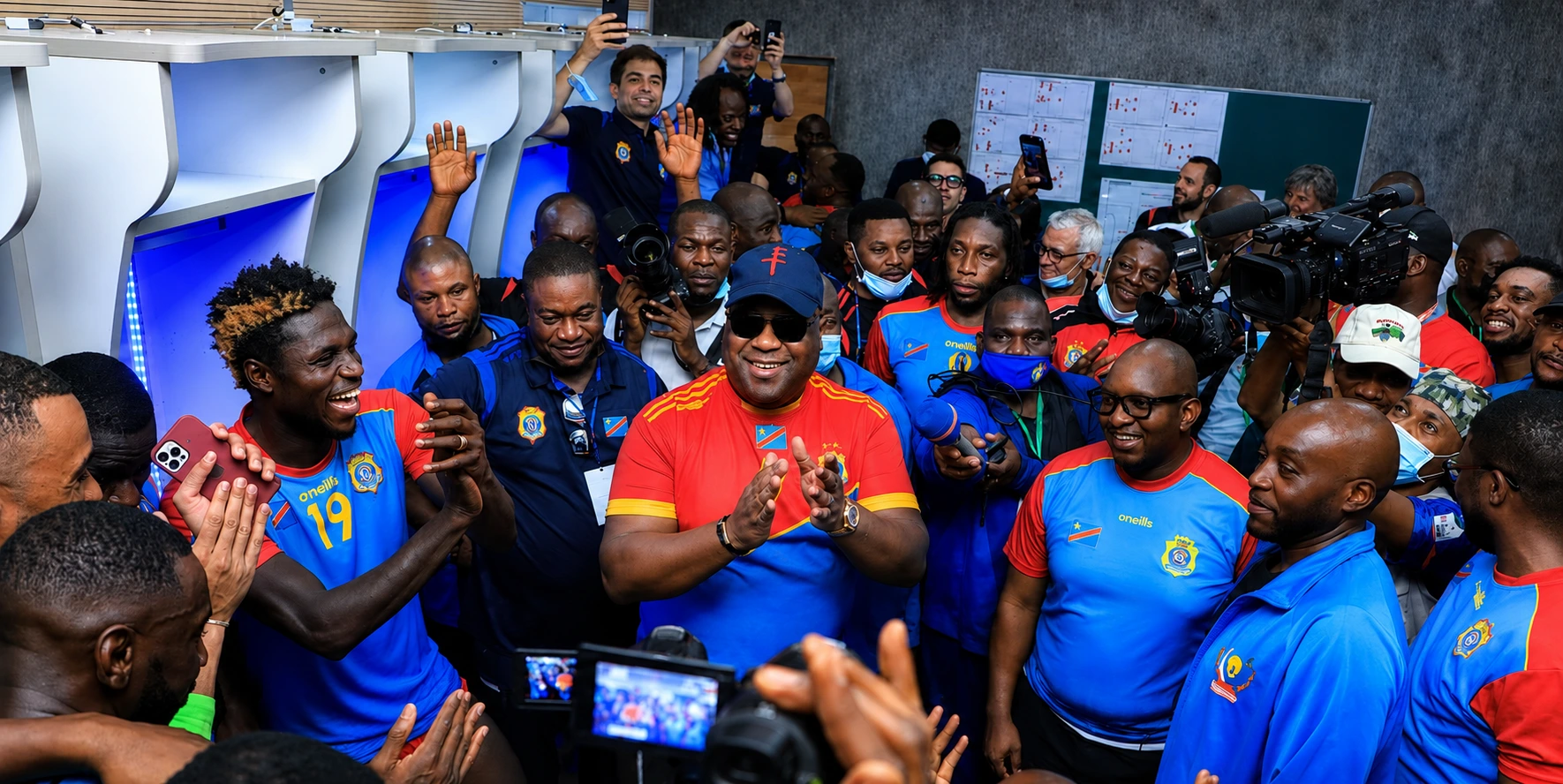
Amidst the security challenges in the East and the profound transformations initiated by the authorities, this sporting success also provides President Tshisekedi with a potent political symbol. This is not because he is the direct architect of the Leopards’ victories, which are primarily attributed to the players, coach, and support staff. Rather, it is because he has consistently chosen to position sport as a key driver of national cohesion.
As the primary supporter of the national team, frequently issuing messages of encouragement, the Head of State accompanies this sporting adventure as he does a broader narrative: that of a Democratic Republic of Congo determined to regain confidence in its future. The popular slogan « Fatshi béton » (with Fatshi being Félix Tshisekedi’s nickname and béton meaning concrete, symbolizing unwavering strength) reflects this close connection he maintains with a segment of public opinion, transcending political divides.
The revelation of a new DRC
Across the Democratic Republic of Congo, a consistent observation emerges among political and economic leaders: the nation is actively seeking to redefine its narrative. Long portrayed predominantly through the lens of conflict or resource exploitation, it now strives to be identified with its newfound stability, ongoing reforms, economic potential, and regional influence. The Leopards currently offer an exceptional showcase for this ambition, captivating the continent press and shaping a fresh perspective on African economy news.
Football will not resolve the security challenges nor the immense development issues that the Democratic Republic of Congo still faces. However, it underscores an essential truth: when an entire populace celebrates the same team, when a victory unites people from Kinshasa to the most afflicted territories of the East, it is an entire nation affirming its very existence and shared identity.