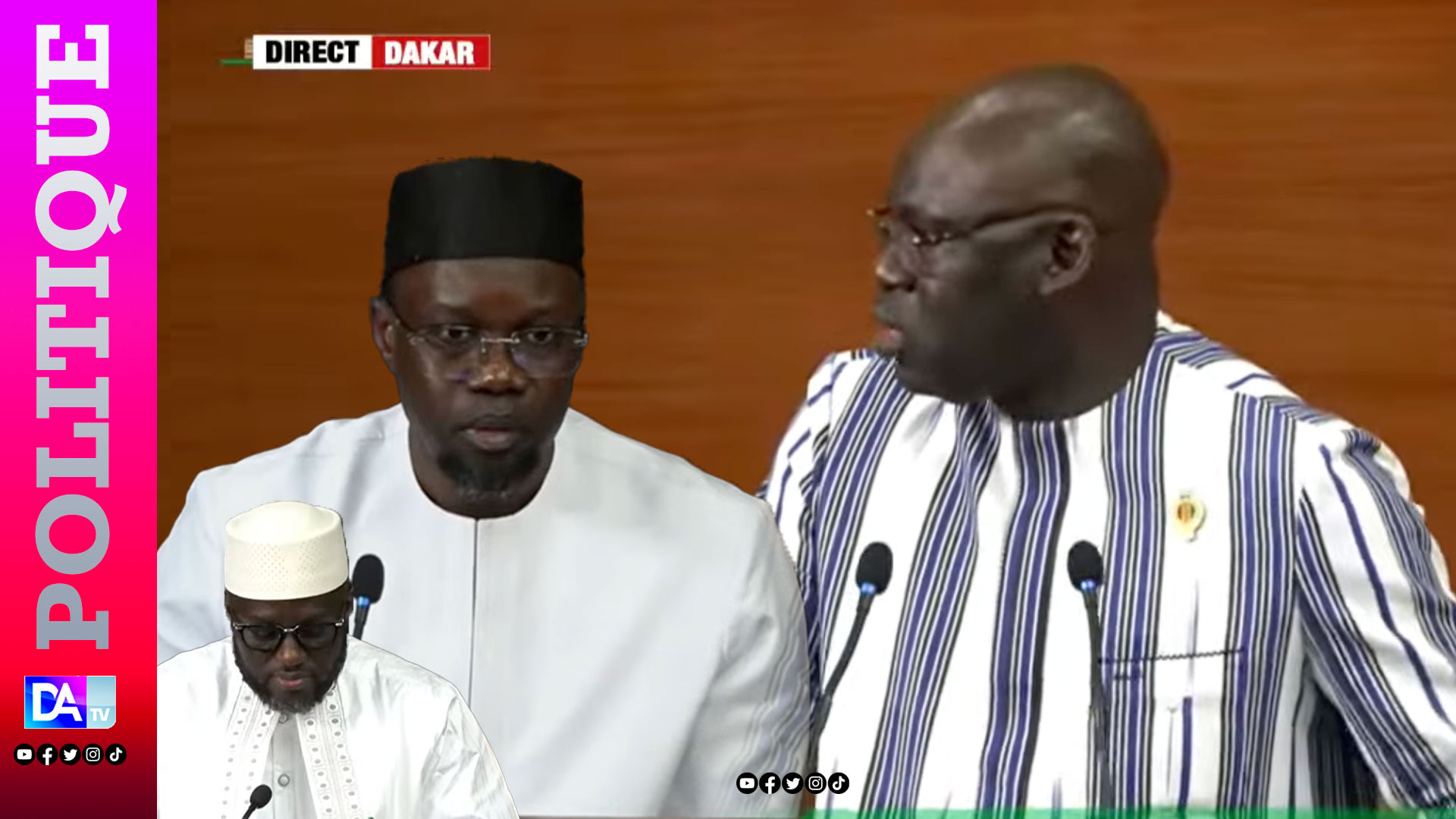
In a bold address from the floor of the National Assembly, deputy Mbaye Dione delivered a message that went beyond economic concerns to address the nation’s political climate. His remarks, delivered with deliberate emphasis, sought to redefine the relationship between the ruling majority and the opposition.
The session, primarily expected to focus on fiscal policy, economic reforms, and local governance funding, took an unexpected turn when Mbaye Dione directed his words toward the Speaker of the National Assembly. He requested that a formal message be conveyed to Ousmane Sonko, leader of the opposition, underlining the unusual tension gripping the political landscape.
Distinguishing opposition from enmity
The core of Mbaye Dione’s statement centered on a sharp distinction between political opposition and personal hostility. With a firm tone, he declared: « We are not his enemies. We are his opponents. »* This declaration was not merely rhetorical—it reflected a deeper principle: that disagreement with policies or leadership does not equate to disloyalty to the nation.
The deputy underscored the constitutional role of the opposition, stressing that elected representatives have a duty to challenge government decisions when necessary, while also supporting policies that serve the public interest. For Mbaye Dione, opposition is not sabotage; it is a constitutional function designed to ensure balance and accountability.
The irony of political consistency
In a pointed historical reference, Mbaye Dione reminded the chamber of Ousmane Sonko’s own past as a vocal critic of the government. He argued that if Sonko once used institutional platforms to voice dissent, he must now accept that others will do the same. « Those who oppose today must accept being opposed tomorrow, »* he asserted, calling for a standard of reciprocity in political engagement.
This appeal was not just about fairness—it was about preserving the integrity of democratic institutions. The National Assembly, he insisted, must remain a space for reasoned debate, not a battleground for personal or partisan grudges.
A call to uphold parliamentary dignity
Mbaye Dione went further, warning against the erosion of the Assembly’s credibility. He cautioned that the institution’s role as a guardian of the republic must not be compromised by political score-settling. The integrity of the legislative process, he argued, depends on mutual respect and adherence to republican values.
He framed the opposition not as an adversary of progress, but as a necessary counterbalance—vigilant, responsible, and committed to the national interest. « We will act as responsible republicans, courageous opponents, »* he affirmed, signaling a commitment to constructive engagement.
Appealing for political calm
Beyond the direct message to Ousmane Sonko, Mbaye Dione’s speech emerged as a broader plea for political moderation. He urged the government to recognize the legitimacy of dissent, emphasizing that governing does not mean silencing critics, nor does opposition imply undermining the state.
By reaffirming that opponents are not enemies, he sought to reframe political rivalry within the bounds of democratic norms. His words were not a challenge to power, but an invitation to dialogue—one rooted in the belief that a healthy democracy thrives on measured disagreement and institutional respect.