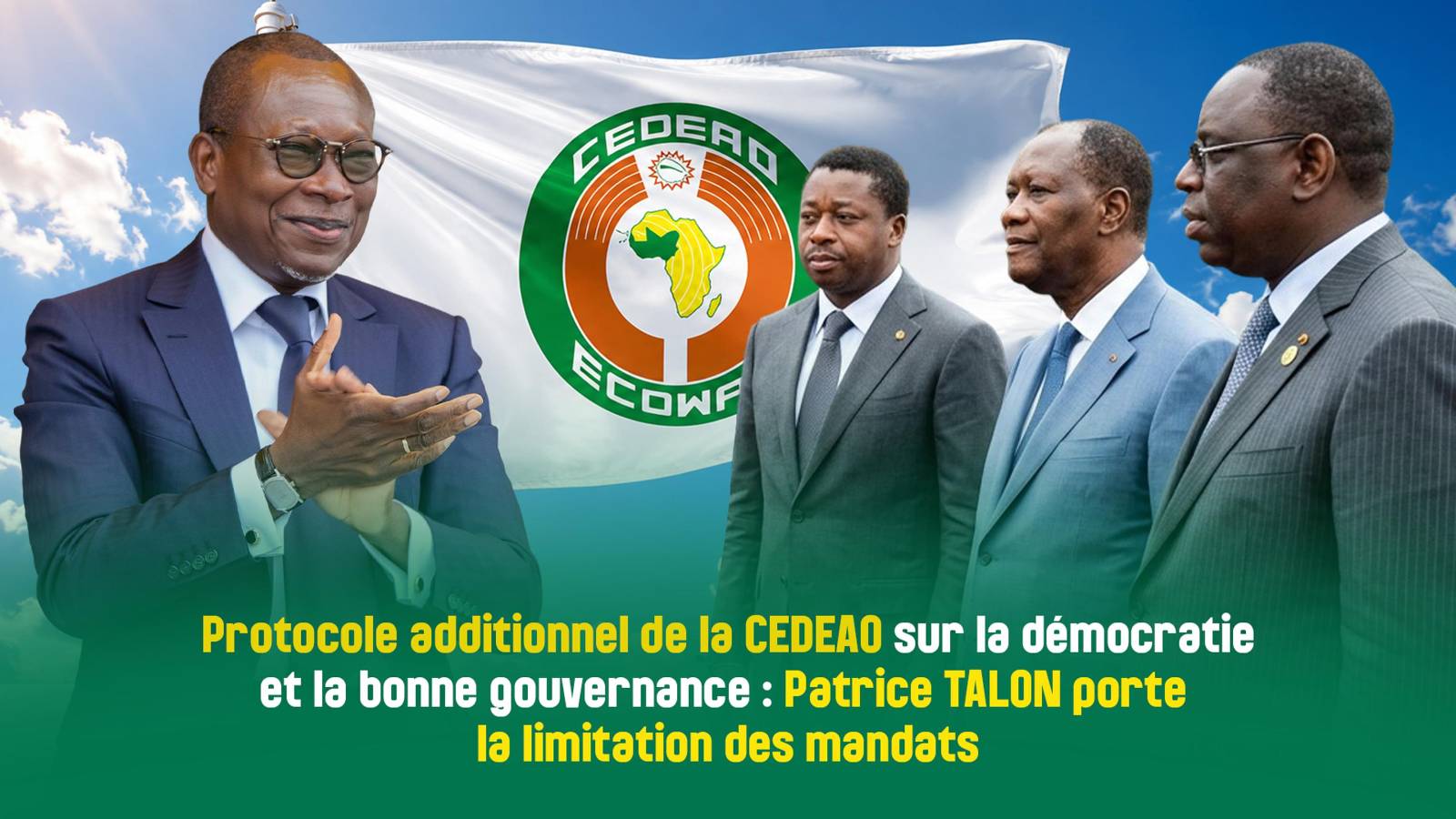
The Economic Community of West African States (ECOWAS) is grappling with deepening divisions as a crisis over presidential term limits intensifies. At the heart of the standoff is a fundamental disagreement on whether the bloc should enforce strict two-term mandates across all member states. This debate has thrust President Patrice Talon of Bénin into an unlikely leadership role, championing democratic renewal while clashing with regional heavyweights like Togo’s Faure Gnassingbé, Côte d’Ivoire’s Alassane Ouattara, and Senegal’s former president Macky Sall. The outcome of this confrontation could redefine the bloc’s credibility and stability.
Bénin’s hardline stance on term limits
Since assuming office in 2016, Patrice Talon has positioned Bénin as a vocal advocate for mandatory presidential term limits within ECOWAS. His administration argues that the wave of military coups in Mali, Burkina Faso, and Niger stems directly from leaders overstaying their mandates, often through constitutional manipulations. To counter this trend, Talon has pushed for a binding rule: no country in the bloc should allow more than two presidential terms, regardless of domestic legal adjustments.
The proposal, tabled during discussions on ECOWAS’s Supplementary Protocol on Democracy and Good Governance, reflects Talon’s belief that rigid term limits are the only safeguard against institutional decay. For Cotonou, such a rule would not only restore faith in ECOWAS but also prevent the kind of constitutional crises that have destabilized neighboring nations.
Regional resistance to Talon’s proposal
Talon’s crusade for term limits has encountered fierce opposition from a coalition of long-standing leaders. In Lomé, President Faure Gnassingbé has dismissed the idea as an infringement on national sovereignty, pointing to Togo’s recent shift to a parliamentary system—one that effectively extends his grip on power. Meanwhile, in Abidjan, Alassane Ouattara has insisted that term limits should remain a domestic affair, despite his controversial third-term bid in 2020. The former administration in Dakar under Macky Sall also resisted external constraints, arguing that ECOWAS’s priorities should lie in combating terrorism and boosting economic integration rather than policing presidential mandates.
The cost of principled dissent
Patrice Talon’s unwavering commitment to his vision has come at a diplomatic price. Bénin has increasingly opted out of key ECOWAS summits, a move framed by Porto-Novo as a refusal to endorse double standards. The government argues that while the bloc swiftly condemns military coups, it turns a blind eye to leaders who extend their tenures through legal loopholes. For Talon, this inconsistency undermines ECOWAS’s moral authority and fuels public distrust in the region’s institutions.
A solitary reformer with growing influence
Despite isolation from regional powerhouses, Patrice Talon’s stance resonates with civil society groups across West Africa. His pledge to step down in 2026—unlike peers who have clung to power—has elevated him as a rare example of democratic restraint. Supporters view his position as a bulwark against the erosion of governance standards, while critics dismiss it as an impractical overreach.
The Béninois leader’s gamble is clear: without universal adherence to term limits, ECOWAS risks becoming a club of entrenched elites disconnected from the aspirations of a youthful, reform-hungry population. Whether history vindicates him remains uncertain, but his defiance has forced the bloc to confront a defining question: Can Africa’s regional institutions prioritize integrity over political expediency?
The broader implications for West Africa
This clash over term limits is more than a diplomatic spat—it’s a litmus test for ECOWAS’s future. As leaders like Talon challenge the status quo, the bloc faces a critical choice: enforce democratic norms uniformly or risk further fragmentation. The outcome will shape not only the region’s political landscape but also its ability to address shared challenges like insecurity and economic disparity. For now, the stalemate persists, leaving West Africa at a crossroads between tradition and transformation.