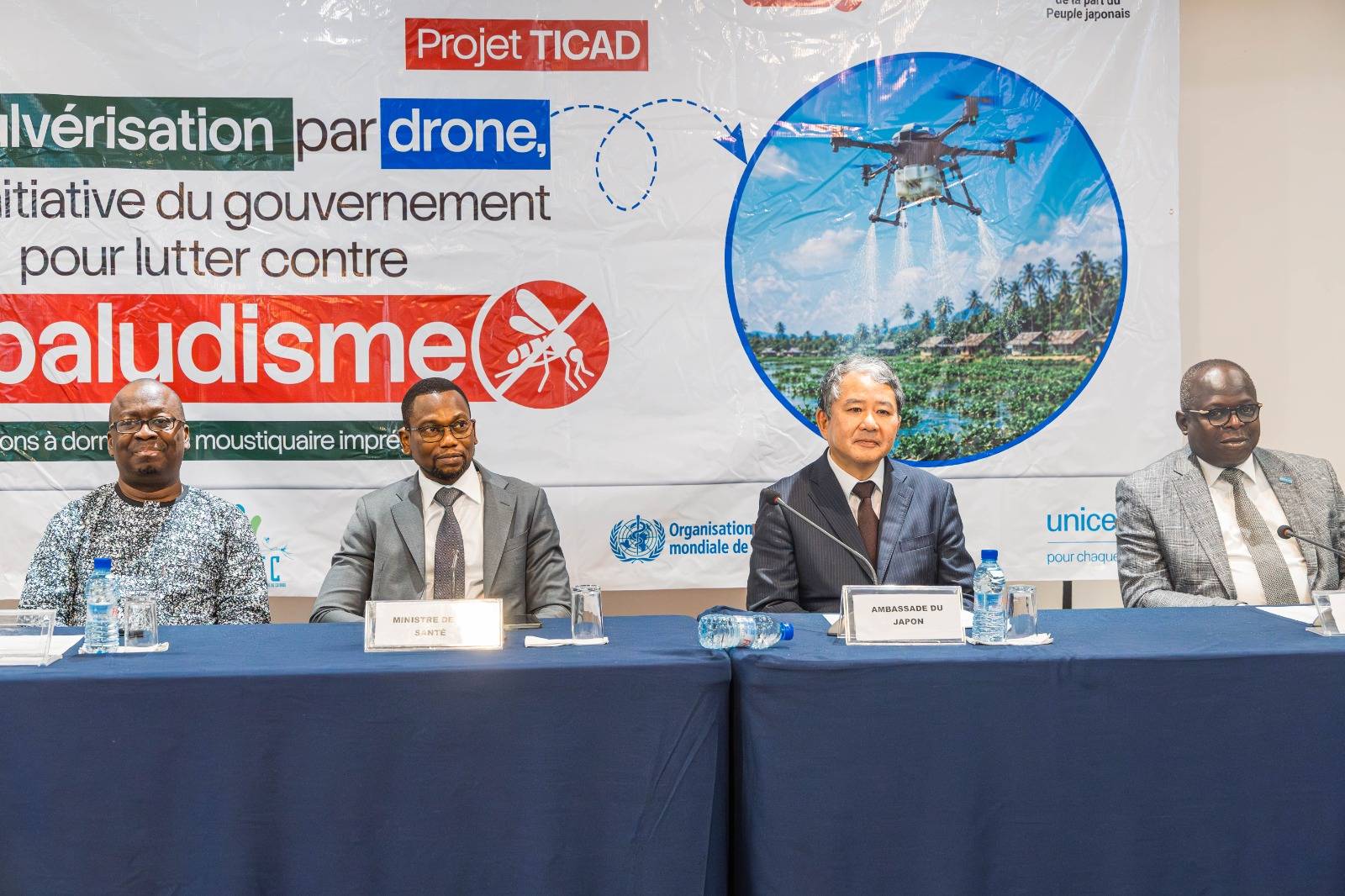
On Tuesday, June 30, 2026, the Beninese government officially inaugurated a transformative program that merges artificial intelligence, geospatial mapping, and advanced spraying drones to eradicate malaria larval breeding sites. This ambitious undertaking, backed by Japan with a significant $2.3 million investment and supported by UNICEF, deploys high-precision technology across six strategically chosen municipalities. Beyond its technological prowess, this initiative offers considerable relief to local communities, who have long grappled with the severe economic and human toll of this endemic disease. Our on-the-ground investigation reveals the full scope of this crucial effort.
Cotonou, Benin: While the official launch took place in the government halls of Cotonou on that pivotal Tuesday, June 30, 2026, the true impact of this revolution is already being felt in the marshlands of Abomey-Calavi and the remote areas of Copargo. With the unveiling of the project, aptly named « Action intégrée pour la prévention du paludisme : partenariat public-privé et engagement local des jeunes au Bénin » (Integrated Action for Malaria Prevention: Public-Private Partnership and Local Youth Engagement in Benin), Health Minister Professor Benjamin Hounkpatin forged an unprecedented alliance between cutting-edge science and grassroots community mobilization. The overarching goal is unequivocal: to decisively turn the tide against the nation’s most formidable health scourge.
A triple technological alliance to hunt down the enemy
For decades, the fight against malaria in Benin primarily relied on reactive measures: distributing insecticide-treated mosquito nets, providing curative treatments, and conducting awareness campaigns. The new initiative, launched in the presence of Japan’s Ambassador, H.E. Mr. Uezono Hideki, and UNICEF’s Deputy Representative, Ms. Aude Rigot, fundamentally shifts this paradigm. We are now witnessing a proactive, surgical war waged directly against the mosquito vector in its very breeding grounds.
The system is built upon a state-of-the-art technological triptych. First, geospatial mapping and artificial intelligence meticulously analyze topographical and meteorological data to pinpoint high-risk environmental zones with metric precision. Following this intricate analysis, high-performance drones take over. These aerial vehicles meticulously traverse areas of high endemicity, dispersing a larvicide approved by the World Health Organization (WHO), effectively neutralizing mosquito larvae before they can even mature into disease-carrying adults.
“This strategy promises a sustainable reduction in mosquito density,” affirmed Professor Benjamin Hounkpatin. “The larvicide deployed in this campaign is WHO-approved and will be applied strictly in accordance with recommended safety standards. Thanks to drone technology, we can now intervene with unparalleled precision, speed, and effectiveness, even in areas previously deemed difficult to access,” the ministerial authority declared with evident satisfaction.
Six communes at the forefront of the battle
For this crucial pilot phase, the government has strategically selected six communes, each presenting diverse ecological and demographic profiles representative of the national territory’s challenges: Copargo, Djougou, Tchaourou, Ouidah, Abomey-Calavi, and Cotonou. From densely populated urban centers to isolated rural localities, this advanced technological arsenal will be put to the ultimate test.
This extensive deployment is made possible by a substantial financial commitment of $2.3 million from Japan. For the Japanese Ambassador, this investment reflects deep-seated commitments: it aligns perfectly with Benin’s national vision « Bénin 2060 Alafia, un monde de splendeurs » (Benin 2060 Alafia, a world of splendor) and resonates with the resolutions of TICAD9, which prioritizes the resilience of African health systems on the international agenda, particularly concerning preparedness for health threats. This demonstrates a vital collaboration for African politics and development.
Community relief: direct economic impact
On the ground, the announcement of this project has ignited immense hope, especially among families and small business owners. Malaria is not merely a medical tragedy that disproportionately affects the most vulnerable; it represents a significant financial drain on Beninese households. By eliminating the threat at its source, the project indirectly promises to restore the purchasing power of communities, a crucial element for the African economy news.
Amavi, a mother of four and fabric vendor encountered at the Abomey-Calavi market, shared her perspective on the immense burden: “Every rainy season is a nightmare. Last year, my two youngest children were hospitalized twice. Between consultations, IV drips, and medications, I spent over 60,000 CFA francs (approximately 100 dollars). That’s an entire month’s profit gone. Not to mention the days I couldn’t go to the market because I had to stay by my children’s bedside in the hospital. If these drones can destroy those mosquitoes in the swamps behind our house, our family economy will finally breathe.”
This sentiment is echoed by artisans, farmers, and micro-entrepreneurs in Tchaourou and Cotonou, for whom a bout of malaria translates into an immediate loss of income, often without social protection or a replacement system. Therefore, reducing malaria morbidity in these six pilot communes represents a direct catalyst for productivity, forced savings, and financial stability for the informal sector, which sustains the majority of the population across the continent.
Youth engagement: the project’s bedrock
Technical innovation, however brilliant, would be incomplete without human involvement. This was the core message emphasized by UNICEF during the launch ceremony. The project incorporates a significant community engagement component, transforming young people from the participating communes into active participants in health security.
Trained alongside community relays and local leaders, these young individuals will monitor ground interventions, conduct local awareness campaigns, and promote sound environmental practices (such as managing domestic stagnant water) to prevent the re-establishment of larval breeding sites. As Ms. Aude Rigot, UNICEF Deputy Representative in Benin, noted: “It is this powerful alliance between innovation and citizen mobilization that will ensure a lasting impact.” This model of pan-African journalism highlights local solutions.
Towards a sustainable public health model
By synergizing advanced drone technology with dynamic local human engagement, Benin is charting the course for the preventive medicine of tomorrow. The targeted spraying of larvicides, coupled with enhanced anti-malarial vaccination efforts and vigilant citizen participation, forms an unprecedented defensive network.
Should this pilot phase in the six communes confirm its promises of technical effectiveness and economic viability, this public-private partnership model could well be replicated nationwide, potentially inspiring the entire West African sub-region and becoming a beacon for Africa news. In the meantime, the propellers of Benin’s drones are poised to spin, carrying with them the profound hope for a future liberated from the oppressive grip of malaria.