With the ascension of Romuald Wadagni to the highest office, Benin is embarking on a strategic shift in its development agenda. Central to this new era is the revitalisation of the Sino-Beninese partnership, marked by the resumption of major infrastructure projects in Cotonou and the country’s northern regions.
The signal was clear from the first months of his tenure. The new president, a former finance minister renowned for his macroeconomic discipline, intends to leave a tangible mark on the national landscape. To achieve this, Cotonou is leaning more than ever on its longstanding ally, Beijing. This renewed strategic partnership is taking shape on the ground, with construction equipment roaring from the Atlantic coast to the far northern frontier.
The capital’s facelift: Cotonou transforms
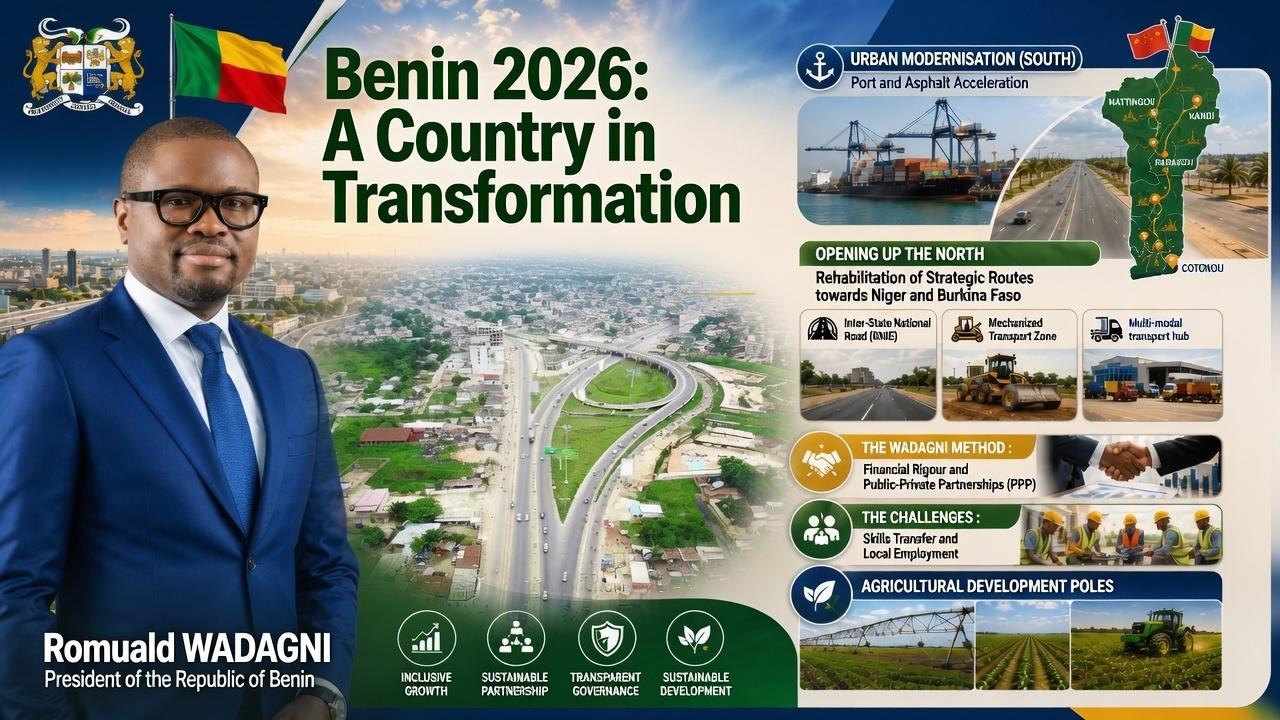
In Cotonou and Porto-Novo, the objective is straightforward: complete urban modernisation and ease congestion on key economic arteries. Under President Wadagni’s guidance, Chinese cooperation is injecting fresh capital and deploying technical expertise across several fronts:
- Port modernisation and road corridors: Chinese construction firms are once again working on access routes to the Autonomous Port of Cotonou, the country’s economic engine, to streamline the flow of goods to the hinterland.
- Large-scale drainage: The programme to upgrade stormwater evacuation networks and asphalt roads, heavily supported by Chinese engineering, has entered a decisive phase with the aim of permanently protecting the economic capital from recurrent flooding.
The far north as a priority: connectivity and security
While the capital undergoes a significant upgrade, the true departure in Wadagni’s doctrine is the accelerated investment in northern Benin, particularly in Parakou, Natitingou, and Kandi. This focus responds to a dual imperative: economic and security-related.
The northern challenge: In a regional context marked by cross-border security threats in the Sahel, the Beninese government believes that connectivity and economic development are the best defences against instability.
Key axes of the Sino-Beninese plan for the north
- Rehabilitation of strategic road corridors toward Niger and Burkina Faso;
- Improvement of multimodal transport infrastructure;
- Logistical support for agricultural development hubs.
Chinese companies are thus mobilised to rehabilitate the National Inter-State Highway, essential for maintaining the competitiveness of Benin’s corridor against its West African rivals. By more efficiently linking the port of Cotonou to the northern agricultural zones as well as to landlocked countries, Benin is giving itself the means to sustain resilient growth, estimated at nearly 6 percent over the medium term by international financial institutions.
The Wadagni method: financial rigour in service of infrastructure
China’s involvement under this new presidency is not haphazard. Leveraging his mastery of debt mechanisms and international financing, Romuald Wadagni advocates a rebalanced “win-win” partnership grounded in effective public-private partnerships.
Beijing brings its technical and industrial capacity, while Cotonou guarantees a stable and healthy macroeconomic framework designed to reassure foreign investors.
Challenges ahead
The path, however, is strewn with obstacles. For this relaunch to succeed sustainably, the government must ensure:
- Skills transfer: Guarantee that these megaprojects promote local employment and involve Beninese subcontractors more extensively.
- Respect of execution timelines: Accelerate administrative and procurement procedures, often seen as bottlenecks in the implementation of national projects.
By simultaneously resuming infrastructure works in the south and north, President Romuald Wadagni is playing his first major political and economic card. The Benin of 2026 is under construction, and the partnership with China is one of its principal levers.