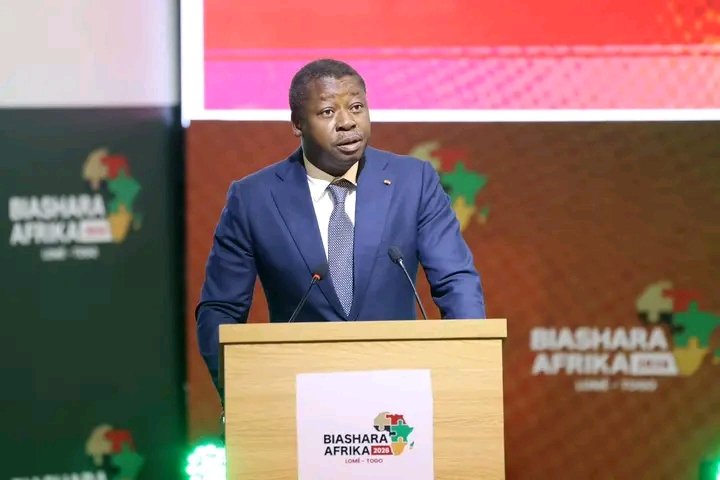
Lomé has become the epicenter of pan-African economic ambition this week, hosting the landmark third edition of the Biashara Afrika forum from May 18 to 20, 2026. The continental gathering, dedicated to trade, investment, and economic partnerships, has drawn leaders, investors, and private sector representatives from across Africa to deliberate on transforming visionary policies into tangible economic outcomes.
The opening ceremony set the tone for the three-day deliberations, with Faure Essozimna Gnassingbé, President of the Togolese Council, delivering a keynote address that underscored the urgency of making the African Continental Free Trade Area (AfCFTA) operational. Addressing an audience of African heads of state, ministers, and business leaders, Gnassingbé emphasized that “the era of declarations must give way to an era of action and measurable results.”
Honoring a champion of integration and accelerating AfCFTA implementation
The Togolese leader paid tribute to Issoufou Mahamadou, former President of Niger and a driving force behind the AfCFTA, for his relentless advocacy in advancing the continent’s economic integration agenda. Gnassingbé stressed that while the AfCFTA’s legal frameworks and agreements represent significant progress, the time has come for these commitments to materialize through concrete actions.
He highlighted critical challenges stifling intra-African trade, including non-tariff barriers, cumbersome border procedures, and exorbitant logistics costs. These obstacles, he noted, continue to impede the free flow of goods and services across the continent, undermining the AfCFTA’s potential to foster sustainable growth.
Biashara Afrika: a platform for action, not just dialogue
Gnassingbé positioned Biashara Afrika not as a mere discussion forum but as a dynamic platform for delivering solutions, fostering partnerships, and operationalizing Africa’s economic integration. “This forum must be a catalyst for change,” he declared, urging delegates to move beyond rhetoric and prioritize measurable outcomes that can reshape the continent’s economic landscape.
The President also drew attention to the AfCFTA’s strategic importance in a global economy increasingly defined by geopolitical tensions, rising protectionism, and shifting supply chains. In this context, he argued, Africa’s fragmented national markets offer limited leverage in global negotiations. A unified continental market, he asserted, is indispensable for the continent to assert its economic sovereignty and negotiate from a position of strength.
Building sovereign African industries and empowering local champions
Gnassingbé outlined a vision where the AfCFTA transcends traditional trade agreements to become a tool for economic sovereignty. The goal, he explained, is to reduce Africa’s reliance on raw material exports while boosting local production, industrial capacity, and value addition. “No single African economy can defend its interests in isolation,” he cautioned, emphasizing the need for collective action.
He lamented Africa’s persistent role as a net exporter of unprocessed commodities and importer of high-value finished goods, calling for the development of robust regional value chains. The AfCFTA, in his view, must dismantle the barriers imposed by fragmented national markets to nurture competitive African industries capable of competing globally.
A central pillar of this strategy is fostering homegrown African enterprises with the scale and capacity to operate continent-wide. Gnassingbé advocated for policies that empower small and medium-sized enterprises (SMEs), women entrepreneurs, and young innovators, ensuring that the benefits of integration reach grassroots levels.
Youth, women, and SMEs: the backbone of Africa’s economic future
In a poignant segment of his speech, Gnassingbé underscored the pivotal role of Africa’s youth and women in driving integration forward. He insisted that the success of the AfCFTA hinges on its ability to create tangible opportunities for employment, entrepreneurship, and market access for all African citizens. “Integration cannot be a privilege reserved for elites or corporate entities,” he asserted. “It must be a pathway to prosperity for every African.”
Togo’s strategic role in Africa’s economic transformation
The Togolese President concluded by reaffirming his country’s commitment to the continent’s economic integration. With its strategic geographical location, robust logistics infrastructure, and commitment to regional connectivity, Togo is poised to play a pivotal role in shaping the future of Africa’s single market.
As the Biashara Afrika 2026 forum draws to a close, Gnassingbé expressed optimism that this edition would catalyze new partnerships and inject fresh momentum into Africa’s economic transformation. The challenge ahead, he concluded, is to translate the continent’s vast potential into real-world progress, ensuring that the AfCFTA delivers on its promise of shared prosperity for all Africans.