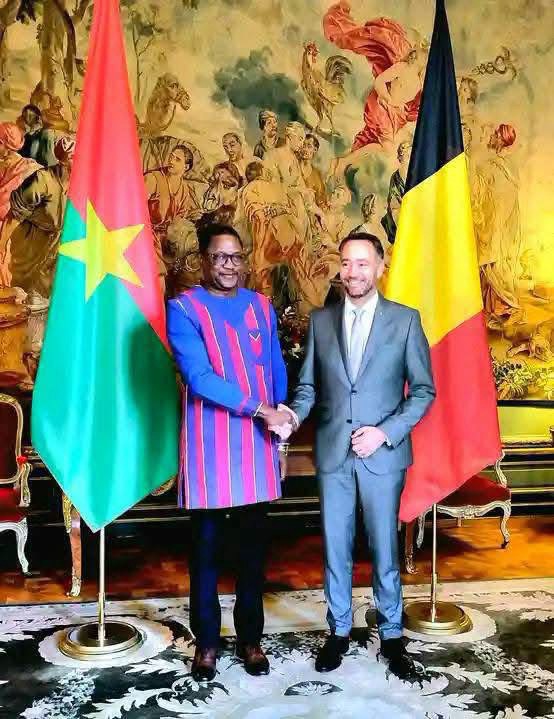
After years of public denunciation of Western partners, Burkina Faso’s military leadership has quietly executed a sharp diplomatic pivot. A high-stakes visit to Brussels by Foreign Minister Karamoko Jean Marie Traoré in early November 2026 marked a decisive moment in Ouagadougou’s foreign relations one that underscores a fundamental shift in its financial strategy.
Just days before, the Burkinabè delegation had attended the Russia-Africa Economic and Humanitarian Forum in Moscow, where sweeping cooperation agreements were announced. Yet as the dust settles, one question looms large: where are the concrete funds promised to fuel Burkina Faso’s recovery and development?
From Moscow’s promises to Brussels’ euros: the hard realities of foreign financing
The junta’s turn toward Russia was framed as a definitive break from Western reliance. Declarations hailed Moscow as a strategic partner able to replace European donors in security, infrastructure, and economic support. But during the Moscow forum, while a series of memoranda were signed including a cooperation framework between the AES Confederation’s investment bank and Russia’s VEB.RF no immediate or verifiable financial transfers materialized.
Signing a cooperation agreement is not the same as securing funding. It sets a pathway, but one that may lead nowhere without follow-through. With public finances under strain, Burkina Faso’s deficit for 2026 is projected at 486.8 billion FCFA (approximately $740 million), and the IMF forecasts a 4% GDP shortfall. These numbers tell a clear story: the country still desperately needs external financing regardless of political rhetoric.
The illusion of replacement: can Russia fill the financial void?
The junta’s anti-Western stance has dominated speeches and rallies, but it has not translated into viable alternatives. While Moscow has emphasized political solidarity and vague investment frameworks, Burkina Faso’s immediate budget needs remain unmet by Russian sources. Social services, security operations, and critical infrastructure continue to demand funding that the West once provided.
It is now apparent that no single ally not Moscow, not any regional bloc can single-handedly replace the complex web of Western development financing, technical assistance, and humanitarian support that Burkina Faso relied on for decades.
Brussels steps in: a quiet return to the donor’s table
Against this backdrop, the November meetings in Belgium took on historic significance. On November 5, Foreign Minister Traoré and Belgian Deputy Prime Minister Maxime Prévot concluded an agreement securing 40 million euros in development aid from Belgium’s international cooperation agency, Enabel, for the period after 2027.
This financial commitment is not symbolic it is a tangible lifeline. It signals that despite public distancing, Ouagadougou remains deeply engaged with European partners. The Burkinabè delegation also held talks with European Commission officials and operational agencies, including Enabel and Bio Invest, to discuss long-term cooperation on national priorities such as education, health, and rural development.
A diplomacy of necessity, not of ideology
The contrast is striking: on the world stage, Ouagadougou denounces Europe; in the corridors of power, it negotiates with Brussels. The government cannot escape the reality that sustainable development requires real money, not slogans. Sovereignty is not built on anti-Western posturing, but on the ability to mobilize resources, implement projects, and deliver tangible benefits to citizens.
The cost of broken promises: what has Moscow actually delivered?
More than two years into the junta’s pivot toward Russia, there has been little public evidence of financial inflows from Moscow to support Burkina Faso’s balance sheet. No major infrastructure projects, no large-scale budget support, no visible impact on social programs. The absence of concrete results raises a critical question: if Moscow was to be the new partner of choice, where is the evidence?
By contrast, Brussels is not only offering funding, but also predictable, transparent mechanisms through established institutions. These partnerships are not contingent on political alignment they are based on mutual interest and deliverable outcomes.
Can the junta reconcile its two narratives?
The biggest challenge facing the Burkinabè leadership is not choosing between partners, but reconciling two conflicting narratives. How can a government simultaneously claim to reject Western influence while actively engaging with European institutions for financial support?
Transparency is key. The population deserves to know: what has the Russian partnership delivered? Where are the funds, the projects, the jobs? If the junta’s ideological stance cannot be fully implemented, it must at least be honest with its citizens about what is achievable.
The future of Burkina Faso will not be shaped by the volume of anti-Western speeches, but by the volume of euros, dollars, and yuan it can mobilize. And if Brussels is now writing the checks, while Moscow writes the press releases, the writing is on the wall.
Where sovereignty meets pragmatism
Diplomatic independence is a goal worth pursuing, but not at the cost of national development. Burkina Faso has every right to diversify its partnerships and chart its own course. However, sovereignty is measured not in opposition, but in capability in the ability to fund schools, pay salaries, and protect borders.
The recent Brussels mission was more than a symbolic gesture; it was a turning point. It showed that when rhetoric fails to deliver, reality steps in. And in the realm of international finance, reality is written in euros, not in declarations.
By Ramatou Soumana — Journalist