
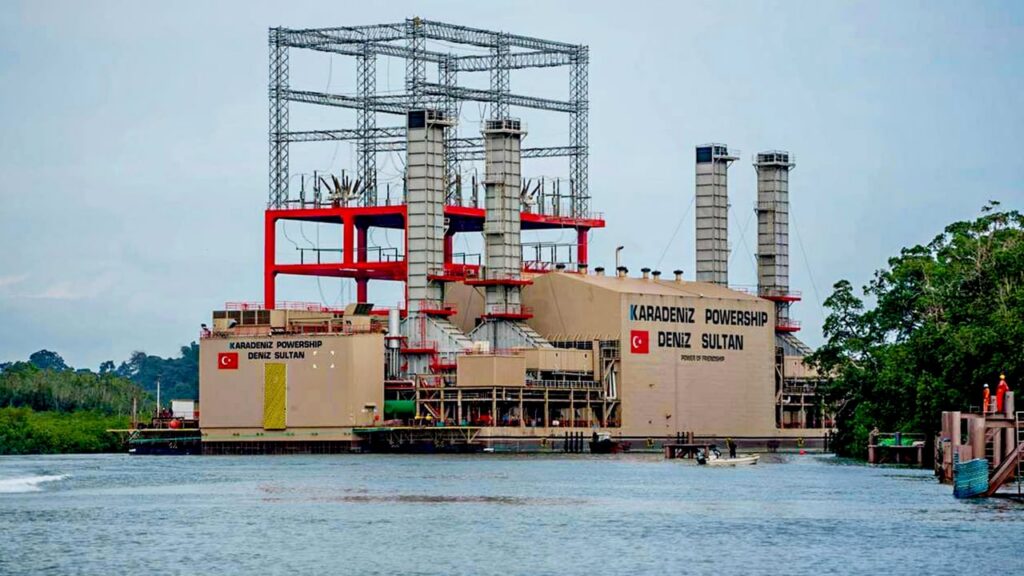

Since taking office, transitional leader Brice Clotaire Oligui Nguema has made reducing Gabon’s reliance on foreign energy contracts a cornerstone of his economic strategy. Among the most pressing targets is the long-term agreement with Karpowership, the Turkish floating power plant operator whose vessels have dominated Gabon’s energy supply for years. Critics argue the deal has drained public resources while limiting the country’s ability to develop its own infrastructure.
why Gabon wants to break free from karpowership
The partnership with Karpowership, which began in 2010, was initially framed as a quick solution to chronic electricity shortages. However, the arrangement has increasingly drawn scrutiny over its financial and operational terms. Analysts point to rising costs, limited local job creation, and restricted technology transfer as key drawbacks. With Gabon’s energy demand projected to climb by 5% annually through 2030, the transitional government now views energy sovereignty as non-negotiable.
a new energy roadmap
The government has signaled it will phase out Karpowership’s floating plants by 2028, replacing them with a mix of domestic renewable and conventional energy projects. A major milestone was reached last month when Gabon signed a €150 million agreement with EDF to develop solar and hydroelectric capacity across the country. Additional partnerships with regional and international investors are expected to follow, focusing on grid modernization and battery storage solutions.
Energy Minister Marcel Abéké confirmed that Gabon aims to achieve 60% renewable energy integration by 2035—a bold target that would reduce both carbon emissions and exposure to volatile fossil fuel prices. “We are not just diversifying our energy mix,” he stated. “We are reclaiming control over our national power supply.”
challenges ahead for Gabon’s energy transition
Despite the ambitious plan, significant hurdles remain. Financing large-scale infrastructure remains a challenge, particularly amid tighter global credit conditions and Gabon’s elevated public debt. The SEEG, Gabon’s state-owned utility, is also undergoing restructuring to improve efficiency and transparency—an effort complicated by legacy contracts and institutional resistance.
Moreover, Karpowership has indicated it may pursue arbitration under international law, arguing that the termination violates the terms of its original concession. Legal experts warn that such disputes could delay the transition and inflate costs for Gabon’s taxpayers.
Still, Oligui Nguema’s administration appears determined to press forward. In a recent address, the President of the Transition emphasized that “energy independence is the foundation of economic freedom.” With public support growing and donor confidence rising, Gabon is betting on a cleaner, more self-reliant energy future—one that could serve as a model for other African nations grappling with similar dependencies.


More Stories
Is Chad truly heading towards political appeasement?
Bradley Barcola will adapt faster than Florian Wirtz at Liverpool, says Jermaine Pennant
Togo eyes nuclear power to secure future energy sovereignty