The Mali junta’s security gamble collapses under rebel pressure
When a government’s survival strategy hinges on foreign guns rather than local legitimacy, its collapse can be measured in days, not years. In Mali, the recent surge of coordinated attacks by the Front de Libération de l’Azawad (FLA) rebels and the Groupe de soutien à l’islam et aux musulmans (GSIM) has laid bare the systemic failure of the junta in Bamako. By outsourcing the nation’s security to foreign paramilitaries, the military rulers of Mali have exposed their own fragility—and now face an existential reckoning.
Kidal: from conquest to surrender without a fight
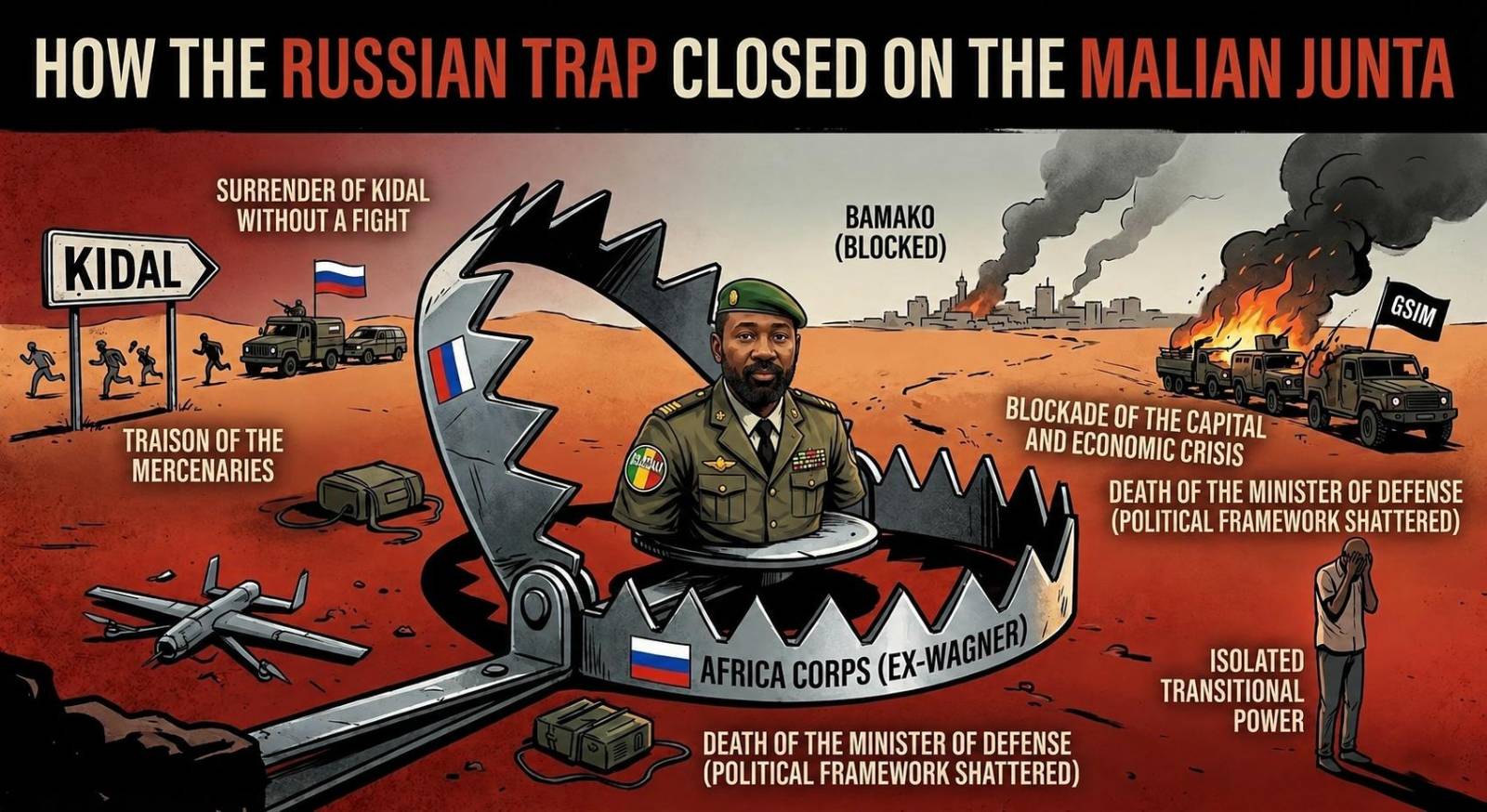
The turning point came in late April 2026 in Kidal, a city once hailed as a symbol of restored state authority after being retaken by Malian troops and their Russian backers in 2023. What followed was not a heroic defense, but a negotiated retreat. Africa Corps—formerly Wagner—did not stand and fight; it negotiated its own withdrawal with rebel forces, abandoning strategic positions and even leaving heavy weaponry behind to secure safe passage.
“The Russians abandoned us at Kidal,” admitted a Malian official in private, capturing the sense of betrayal sweeping through Bamako’s corridors of power. This pragmatic retreat underscores a harsh geopolitical truth: mercenary forces serve only their own financial and strategic interests. They do not die for another nation’s sovereignty. By prioritizing its own survival over Mali’s territorial integrity, Moscow has revealed the hollowness of its West African ambitions.
From the desert to the capital: a regime under siege
The failure of this outsourced security model is no longer confined to the arid north. In April, a major offensive reached the outskirts of Kati and Bamako, culminating in the death of General Sadio Camara, Defense Minister and the junta’s architect of the alliance with the Kremlin. With its top strategist gone, the military government now stands decapitated amid a deepening humanitarian and economic crisis.
For months, the GSIM has enforced a total blockade on fuel, food, and goods entering the capital. The economy has ground to a halt, schools have shut down, and electricity has become a rare commodity. The Russian shield, once promised to protect the nation, has failed to prevent the siege of Bamako or the infiltration of hostile forces into the heart of power.
The drone illusion: more strikes, more isolation
To justify the expulsion of traditional peacekeepers, the junta had vowed to empower the Malian Armed Forces (FAMa) with Russian technology and surveillance drones. While drone strikes increased, so did civilian casualties and local resentment. Instead of stabilizing the territory, this strategy deepened the junta’s isolation and failed to restore security.
Analysts now believe that Africa Corps will focus its remaining forces solely on protecting the regime in Bamako, abandoning any pretense of reclaiming or stabilizing the rest of the country. Moscow’s claim of having “foiled a coup” rings hollow on the ground, where a defensive withdrawal is clearly underway.
The endgame for the Malian junta
The Alliance of Sahel States (AES), once touted as a new pillar of regional solidarity, has remained conspicuously silent and ineffective in the face of Mali’s crisis. Abandoned by its Russian partner seeking an honorable exit, rejected by regional bodies like ECOWAS, and rejected by a population suffocating under blockades, the Bamako junta appears to have entered its final phase.
The gamble on imported “security” has proven to be Mali’s greatest strategic blunder in modern history. By sacrificing diplomacy, national dialogue, and regional partnerships in favor of a private security contract, the military regime has boxed itself into a dead end. In Bamako, the question is no longer whether power will fall—but how many weeks or months remain before the vacuum it created swallows the regime whole.