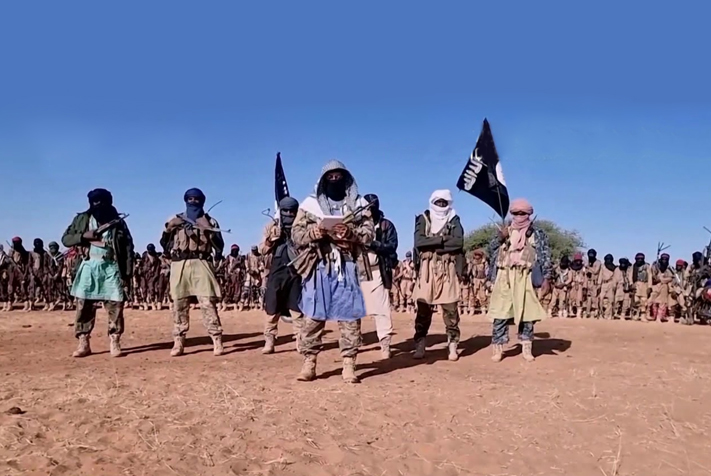
The Sahel Province of the Islamic State continues to shape security dynamics in Mali’s northeast, even as the JNIM draws global attention.
The Islamic State in the Greater Sahara (ISGS), now operating as the Sahel Province (ISSP), maintains its grip on key localities in the Gao and Ménaka regions. Towns like Talataye, Tin-Hama, Tessit—collectively known as the “3 T”—alongside Labbezanga, form the operational core where the group enforces de facto control, regulates movement, and exerts influence over local armed factions.
Leadership and Strategy Shifts
Under the leadership of Abou Al-Bara, who took over after Adnan Abu Al-Walid Sahraoui’s death in 2021, the ISSP has evolved its tactics. Gone are the days of mass executions and high-profile terror strikes. Today, the group focuses on subtle territorial control, community governance, and securing critical trade routes between Mali and Niger. This shift reflects a deliberate effort to embed itself into local life while avoiding the spotlight that once made it a target.
Despite relentless military pressure, the ISSP remains resilient. Malian forces recently dismantled a key operational cell in Bara, Ansongo district, during a precision airstrike that also eliminated several affiliates. While this demonstrates the army’s growing capability, it also highlights the group’s ability to regroup in border areas and sustain its logistical networks.
Strategic Operations and Local Impact
The ISSP’s footprint extends along the Mali-Niger corridor, where it controls access to vital resources and trade. By targeting routes like those connecting Ménaka, Ansongo, and Tessit, the group reinforces its dominance while weakening state authority. This approach contrasts sharply with the JNIM’s strategy of high-visibility attacks, such as the coordinated strikes near Bamako in April 2026. While the JNIM commands attention, the ISSP operates quietly, embedding itself into daily life through governance and economic pressure.
The fragile truce between the two groups, once maintained by JNIM defectors, has eroded since 2020. Though recent offensives by Malian forces have temporarily shifted the focus of both factions, no formal peace agreement exists. The ISSP’s ability to exploit this fluid environment underscores its adaptability and long-term survival.
Evolving Threats and Regional Security
Data from early 2026 confirms that 86% of Islamic State activity worldwide occurred in Africa, with the ISSP playing a leading role. The group has expanded its arsenal, deploying armed drones, motorized raids, and economic blockades targeting both civilian and military infrastructure. Attacks like the ambush on a civilian convoy near Gao in February 2026—just 35km from the city—illustrate its growing boldness and tactical sophistication.
International cooperation has yielded some successes, including the elimination of key figures like Abu-Bilal Al-Minuki in a Nigeria-US operation near Lake Chad in May 2026. Yet, the ISSP’s presence in Mali’s northeast remains undiminished. Its control over the “3 T” towns and Labbezanga persists, reinforced by deep-rooted local alliances and a robust supply chain.
The group thrives in the shadow of the JNIM’s high-profile campaigns, using the distraction to strengthen its position. With territorial control and community influence firmly established, the ISSP poses a persistent threat—one that demands sustained counterinsurgency efforts, particularly along the Niger-Mali border.