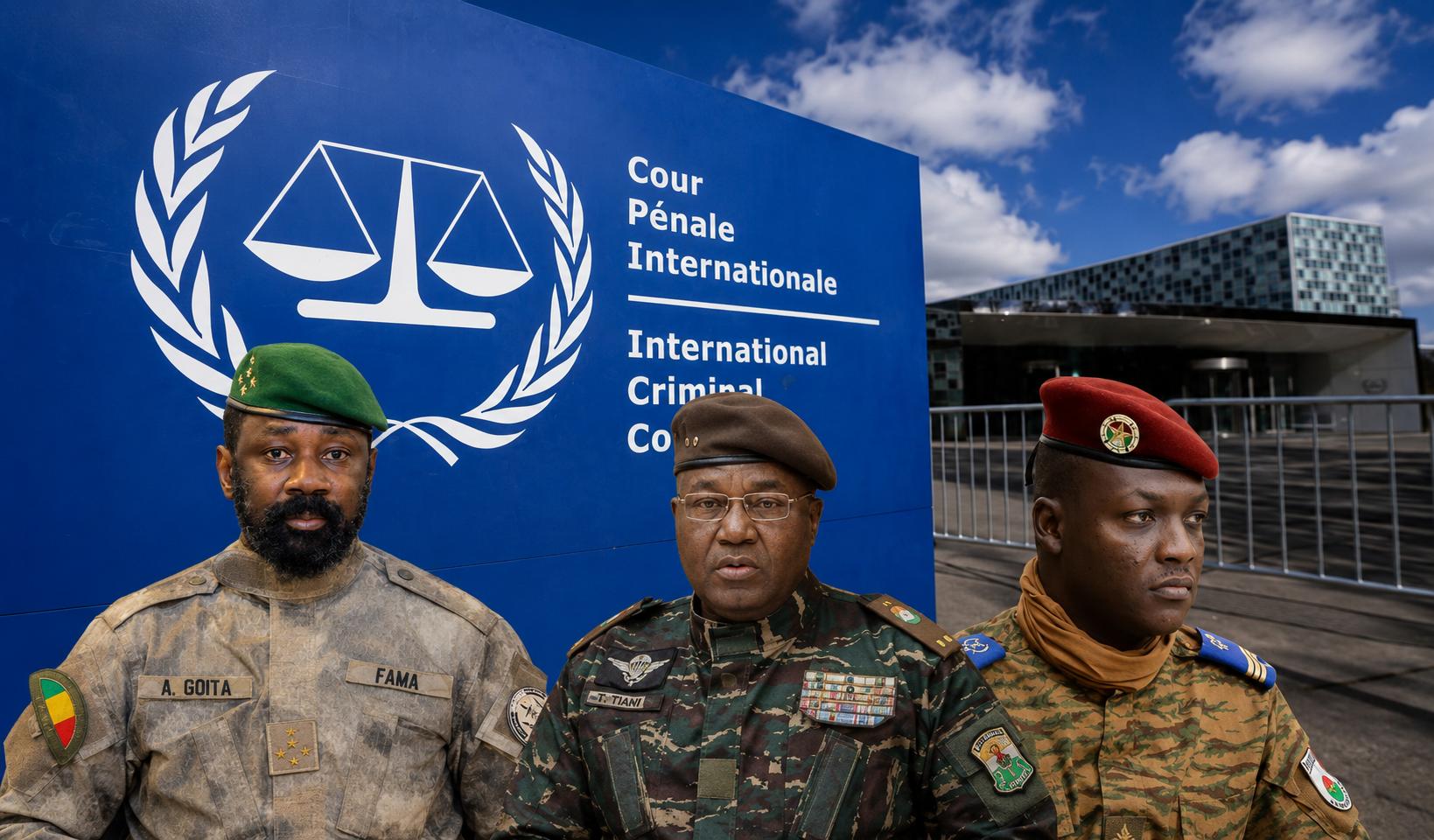
Following Niger’s lead, both Mali and Burkina Faso have formally announced their departure from the International Criminal Court (ICC). While the military governments comprising the Alliance of Sahel States (AES) cite a supposed commitment to “sovereignty” against a judicial body they deem “politicized,” this orchestrated withdrawal primarily reveals a familiar tactic employed by authoritarian regimes: sidestepping international law to secure immunity for their leaders.
This synchronized move by the three nations resonates as a clear admission of their underlying motives. Within a span of mere weeks, the three military administrations across the Sahel region finalized their severance from the global legal framework. After Niamey, it was Bamako and Ouagadougou that formally informed the United Nations of their decision to withdraw from the Rome Statute, the foundational treaty of the International Criminal Court.
For the official rhetoric disseminated by these juntas, the narrative is well-rehearsed: the ICC is merely a “neocolonial” instrument, a form of selective justice manipulated by Western powers. However, beneath this veneer of sovereign and populist claims lies a far more pragmatic and cynical reality. By severing ties with The Hague, these regimes validate a classic dictatorial strategy: institutionalizing impunity to perpetuate their hold on power.
The legal shield for autocrats
The ICC was established with a singular purpose: to intervene where national judicial systems fail, refuse, or are unable to prosecute the most egregious crimes, including war crimes, crimes against humanity, and genocide. By withdrawing from this jurisdiction, the military leaders of Mali, Burkina Faso, and Niger are attempting to secure a form of legal life insurance for themselves.
In a region grappling with devastating asymmetric conflicts, reports from human rights organizations consistently document not only the horrific abuses perpetrated by jihadist groups but also the increasing atrocities committed against civilian populations by regular armies and their allied forces (such as the Russian mercenaries from the former Wagner group in Mali). By closing the door on the ICC, the heads of these juntas seek to ensure that neither they nor their subordinates will ever face accountability before an international tribunal.
Populist rhetoric to conceal the fear of justice
The argument of “selective justice” that purportedly targets only Africa has long been a popular refrain across the continent. While this claim may have held some legitimate resonance in the past, it is now entirely distorted by these dictatorships. The ICC currently pursues alleged war criminals in Ukraine and the Middle East, demonstrating that its scope extends far beyond African borders, impacting global justice and African politics.
In truth, modern history indicates that a state’s withdrawal from the ICC is almost invariably linked to an authoritarian shift or a desperate fear of its leaders facing indictment. Pierre Nkurunziza’s Burundi paved the way in 2017 when his regime was accused of widespread violence. The Sahel juntas are now employing the same blueprint: criminalizing internal dissent, silencing the press, muzzling civil society, and cutting off contact with international observers to operate behind closed doors.
The primary victims: civilian populations
This surge of “sovereignty” proclaimed by the AES regimes comes at the direct expense of Sahelian citizens. It is the local populations, caught between terrorist terror and the violence of states operating without checks and balances, who find themselves deprived of their ultimate recourse to justice. This development is certainly a key topic in Africa news and pan-African journalism circles.
By departing from the ICC, these regimes do not erase the past, as procedures already initiated or crimes committed while the treaty was in force theoretically remain within the Court’s jurisdiction. However, they send a devastating signal for the region’s future: one that grants a blank check to state violence. History has consistently shown that impunity has never guaranteed the stability of a dictatorship; it merely postpones its inevitable downfall, making the final reckoning far more severe for the people.