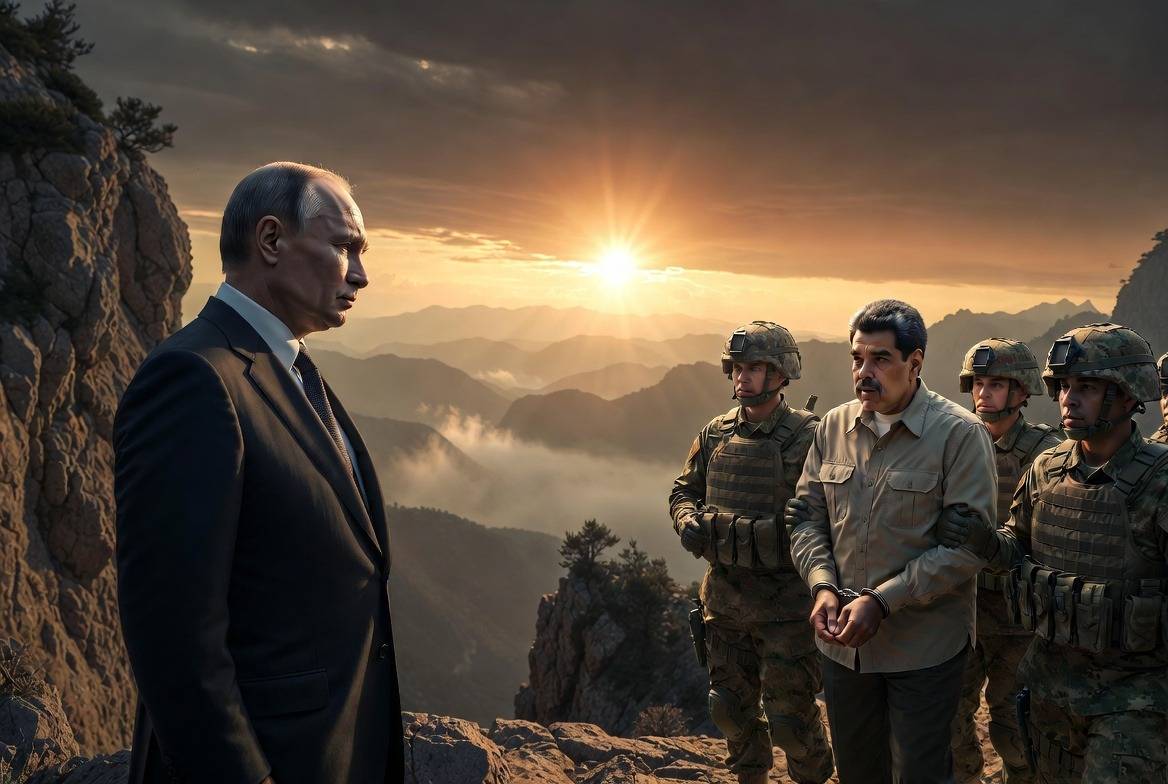
History will record moments when silence speaks louder than words—when diplomatic posturing collapses under the weight of inaction. The upheaval that shook Caracas in early 2026, marked by a sweeping American military operation and the dramatic capture of Nicolás Maduro, exposed a glaring truth about Moscow’s global posture. For a nation that once positioned itself as Venezuela’s unwavering defender against perceived Western aggression, the Kremlin’s response was nothing short of a strategic surrender, cloaked in hollow diplomatic prose.
From protector to bystander: the collapse of Russian influence
The contrast could not be starker. Just years earlier, Russia had proudly showcased its strategic treaties with Venezuela, framing them as pillars of a new multipolar world order. Yet when the crisis demanded action—when Caracas needed more than rhetorical support—the response from the Kremlin amounted to little more than a handful of delayed naval maneuvers and a belated submarine escort for a sanctioned oil tanker. Statements from the Foreign Ministry condemning the “armed aggression” and calls for Maduro’s release rang hollow in the face of Washington’s decisive move.
Russia’s intelligence apparatus, famed for its ability to forecast Western maneuvers, appeared paralyzed. No robust counter-diplomatic offensive materialized at the United Nations Security Council. No tangible military or economic leverage was deployed to shield Caracas from the unfolding U.S.-driven transition. The 2025 strategic partnership treaty, once hailed as an ironclad alliance, crumbled under pressure, revealing Moscow’s diminishing capacity to project power beyond its borders.
Strategic exhaustion: the invisible force shaping Russian decisions
This retreat was not a calculated tactical choice but a reflection of deeper systemic strain. For years, Russia has been trapped in a cycle of economic and military attrition—what analysts now term a “deathonomics” spiral, where resources are drained by prolonged conflict and international isolation. The Venezuelan crisis arrived at a moment when Moscow could ill afford another geopolitical quagmire. Unable to sustain its global commitments, the Kremlin made a brutal calculation: sacrificing Venezuela to preserve what little remained of its strategic credibility.
The message sent to allies across the globe was unambiguous. Moscow’s protective shield had limits—and those limits were defined not by will, but by exhaustion. A partner in need could no longer expect decisive intervention when Russia’s own survival took precedence.
A geopolitical betrayal with lasting consequences
The consequences of Russia’s silence extend far beyond Venezuela. By failing to challenge the U.S.-engineered transition, Moscow effectively surrendered Caracas to a new era of external oversight without offering any credible alternative. The abandonment was not just of a political ally but of an entire strategy—one premised on balancing Western dominance through alliances with resource-rich states.
What remains is a void where Russian influence once stood. The Kremlin’s inaction in Venezuela has erased decades of efforts to position itself as a counterweight to American hegemony. The curtain has fallen on an era, and the self-proclaimed global protector was nowhere to be found when it mattered most.