
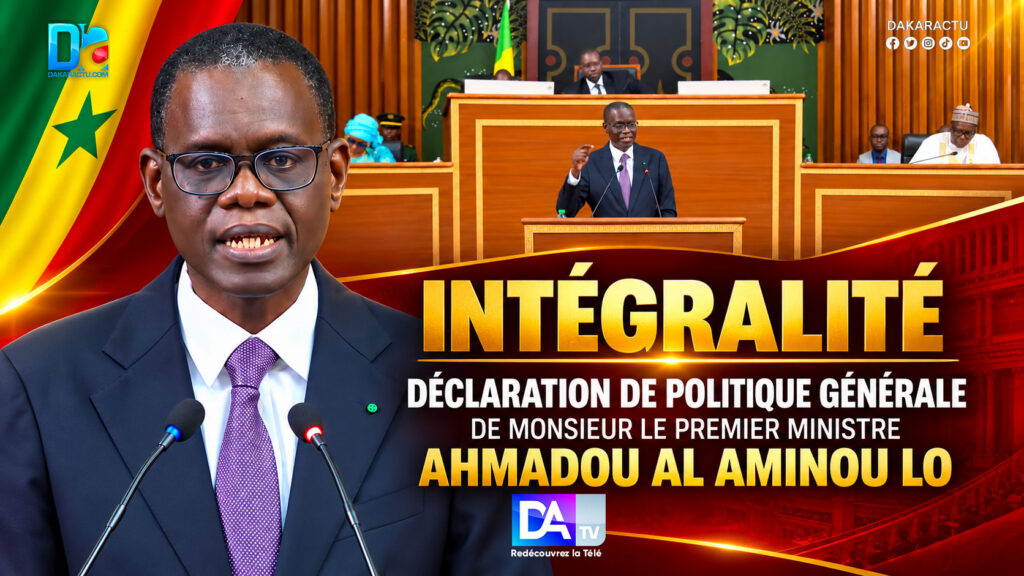
The Senegalese National Assembly gathered in an extraordinary session on Tuesday, September 8, 2026, to hear the general policy statement delivered by Prime Minister Ahmadou Alhaminou Mohamed Lo. This constitutional address comes slightly over three months following his appointment on May 25, 2026, by President Bassirou Diomaye Diakhar Faye, and the subsequent establishment of the cabinet on June 1.
A vision of continuity and method
The head of government, who previously served as Secretary General of the Government and Minister of State for the Senegal 2050 Agenda, immediately declared a path of continuity with his predecessor, Ousmane Sonko, the current President of the National Assembly. Emphasizing that the fundamental direction remains unchanged, he confirmed that the “Senegal 2050” framework continues to serve as the nation’s primary guide, upholding the seven structural ruptures defined previously. However, he introduced a refined operational methodology based on six core pillars: prioritizing, alternative financing, rigorous execution, systematic measurement, open dialogue, and regular accountability.
Tackling the fiscal crisis
Addressing the nation’s financial health, the Prime Minister presented an honest assessment of public finances. By the end of 2024, the consolidated public sector debt reached approximately 132% of GDP, exceeding 23,500 billion FCFA, while the fiscal deficit stood at a revised 13.7% of GDP. In 2025, non-hydrocarbon economic growth reached only 2.2%, with the budget deficit recorded at 6.4%. External shocks, notably the outbreak of conflict between Iran, the United States, and Israel in February 2026, further strained the economy, leading to five successive sovereign credit rating downgrades by Moody’s and Standard & Poor’s.
To address these challenges, a technical agreement was reached on September 1, 2026, with the International Monetary Fund on a new program centered on investment and financial transparency. This program strictly aligns with the commitments of the “Diomaye President” platform. Furthermore, the government is finalizing a comprehensive Debt Treatment Plan for Senegal, aimed at extending debt maturities and lowering average interest costs in partnership with the IMF, the World Bank, and official lenders. Clearing the 1,956 billion FCFA in private sector arrears recorded at the end of March 2025 remains an urgent priority, offering crucial support to the African economy news cycle.
Reforms for the people
The policy roadmap outlines a major reform of energy subsidies, which will be scaled back to under 1% of GDP by 2029. This transition will focus relief directly on vulnerable households, while aiming for a 30% reduction in electricity prices per kilowatt-hour by 2030. Additionally, the government plans to expand the social safety net to cover one million impoverished households by 2027, doubling the corresponding budget to 140 billion FCFA. To address a housing shortage of 500,000 units, the state aims to deliver at least 30,000 new homes annually.
Strategic projects and sovereignty
On sovereign matters, the Prime Minister highlighted several critical dossiers, including ongoing investigations into events between February 2021 and February 2024, audits of coastal and state-owned land, and a thorough review of mining and petroleum contracts. This includes the Yakaar-Teranga gas field contract, expiring in July 2026, from which the state expects 55 million dollars in compensation. In terms of national security, he noted the successful removal of all foreign military presence from Senegalese soil as of July 2025.
Key development initiatives for the decade include the Yakaar-Teranga gas project, a national gas network, the modernization of the SAR 2 refinery, the Kedougou mining hub, the Grand Transfert d’eau water initiative, the Dakar-Tambacounda-Kidira railway, four regional hospitals, and the 500 billion FCFA Dakar Millenium Center in Ouakam.
Promising that the administration will be judged strictly on its tangible results, the Prime Minister announced that he will personally lead quarterly progress reviews to ensure complete accountability.

More Stories
Niger : les remaniements militaires de Tiani trahissent-ils un sommet sous tension ?
Everest Finance dévoile Sama Naffa, une épargne accessible au Sénégal
Niger names new army chief after failed mutiny