ten most memorable world cup warm-up matches in french football history
With just days remaining until the World Cup kicks off, the French national team faces its final dress rehearsals against Ivory Coast and Northern Ireland. But the history of these preparation matches has often been a mixed bag—sending signals that never quite matched the final act.
As Didier Deschamps’ squad prepares to fly out on June 9 for their opening match against Senegal in the United States on June 16, the Bleus will first test their form in Nantes against Ivory Coast and then in Lille against Northern Ireland on June 8. These two friendlies follow a long tradition of French football warm-ups—not always successful ones. Here’s a look back at ten of the most unforgettable preparation matches in Les Bleus’ history.
the heartbreak of a fractured tibia
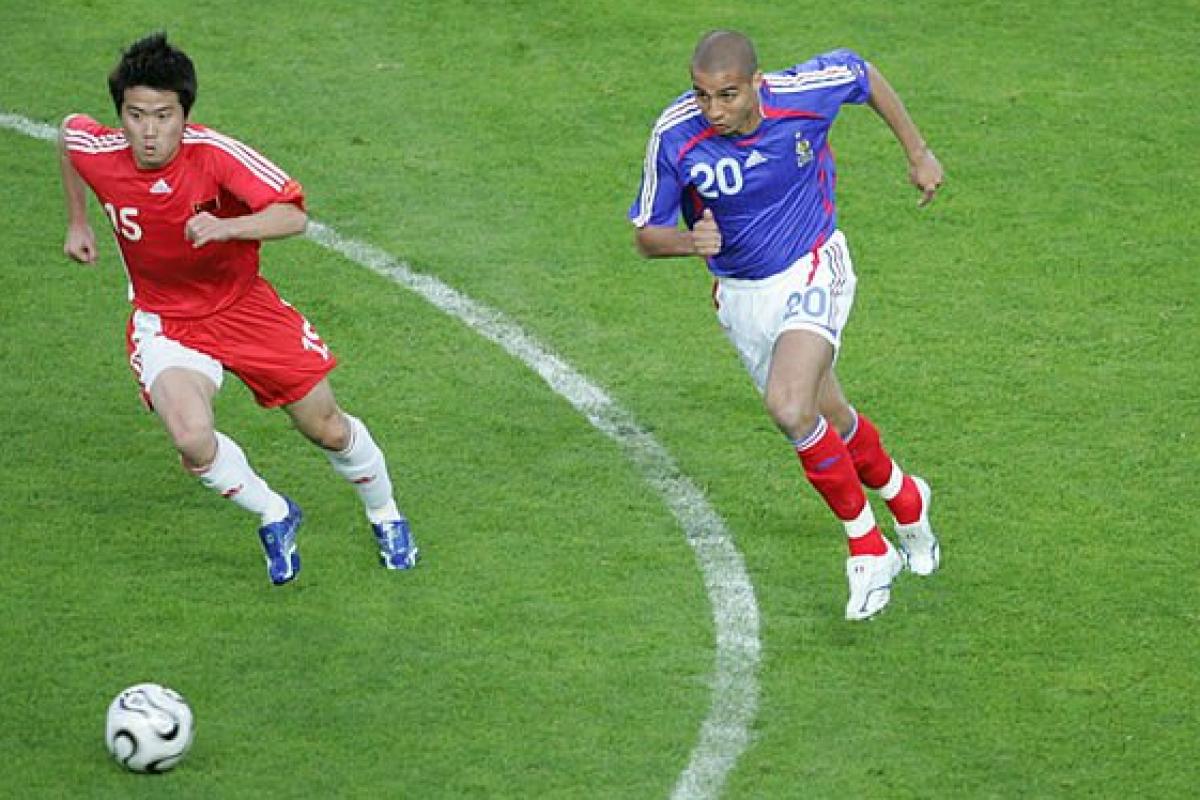
France vs China, June 7, 2006 — Geoffroy-Guichard Stadium
In a cruel twist of fate, Djibril Cissé, starting his first match under Raymond Domenech, suffered a double fracture of his tibia and fibula just seconds into the game. A reckless tackle by Chinese captain Zheng Zhi left the striker in agony, his leg twisted at an unnatural angle. It was a brutal reminder of how quickly preparation can turn into tragedy. Cissé had endured the same injury before—this time to his left leg in 2004 while playing for Liverpool.
That same day, another legend faltered. Zinédine Zidane, attempting the only penalty he would ever miss in a French shirt, saw his shot saved by the Chinese goalkeeper. Though he had previously scored two penalties in the World Cup—against Portugal and Italy—and famously chipped the winner in the final, this rare miss underlined the unpredictability of football.
World Cup outcome: runners-up
the thigh injury that derailed a campaign
France vs South Korea, May 26, 2002 — Suwon World Cup Stadium
Fresh from lifting the Champions League with Real Madrid, Zidane took a rare break to attend the birth of his second child. He returned to the national team in Japan, exhausted but determined. In a match against South Korea, already facing pressure as defending world and European champions, Zidane pushed too hard and pulled a muscle in his left thigh. The injury, compounded by fatigue, signaled the beginning of the end for Roger Lemerre’s side. France’s focus on Zidane overshadowed deeper issues—issues that would surface in a shocking first-round exit.
World Cup outcome: group-stage elimination
the assassin in white and green
Finland vs France, June 5, 1998 — Helsinki Olympic Stadium
Despite David Trezeguet’s goal, the French side suffered a chilly reception in Helsinki. The media, led by Jean-Michel Larqué on live television, branded Christophe Dugarry an “assassin” after he missed a clear chance. The insult stung. The team refused to appear on Téléfoot the next day, but their defiance paid off. Though Dugarry was dropped in favor of Stéphane Guivarc’h, it was Dugarry—wearing the number 21—who scored in the tournament opener against South Africa. Guivarc’h, despite scoring 47 goals that season across all competitions, managed just one for France. Yet it was his substitute who delivered when it mattered most.
World Cup outcome: world champions
a three-part farce under the Mexican sun
France vs Guatemala, May 21, 1986 — Tlaxcala, Mexico
At an altitude of over 2,200 meters, French players found themselves in a surreal situation. Their unofficial training match against Guatemala had been televised live by La Cinq, with commentary by Eugène Saccomano and Marius Trésor. Infuriated by the commercial interruption, coach Henri Michel split the game into three 33-minute halves. The pitch was uneven, the heat oppressive, and the kickoff was set for 12:15 PM. Jean Tigana protested: “advertising executives at the highest level are forcing us to play at noon.” The French demanded a share of broadcast revenues—a request ignored by the organizers.
World Cup outcome: third place
boycott and jeers in the shadow of dictatorship
France vs Tunisia, May 19, 1978 — Villeneuve-d’Ascq
A week after Michel Hidalgo announced his 22-man squad—excluding Albert Gemmrich, who had just scored against Iran—the Bleus faced Tunisia. Under a banner reading “Argentina 1978: no football between concentration camps”, a protest against the host nation’s military junta echoed through the stadium. The French players, booed by Tunisian fans chanting “Help us, Platini!”, struggled in the first half. Platini, introduced late, broke the deadlock and scored the second goal, but the political tension lingered long after the final whistle.
World Cup outcome: group-stage elimination
a disastrous experiment in Scotland
France vs Selkirk Select, July 7, 1966 — Selkirk, Scotland
In a bizarre attempt to build confidence ahead of England’s World Cup, France faced modest Scottish sides. After crushing Gala Fairydean Rovers 8-1 and Vale of Leithen 8-0, they turned to Selkirk. But the experiment unraveled when Lucien Muller refused to play, citing a lack of role in the squad. Henri Guérin praised the “exceptional spirit” of the players, but the disjointed approach—with a first team playing one match while a B-side played another elsewhere—undermined any chance of cohesion.
World Cup outcome: group-stage elimination
just fontaine’s breakthrough
France vs Narke District XI, May 25, 1958 — Sweden
Raymond Kopa was unavailable, having been released by Real Madrid just days later. The French side, managed by Paul Nicolas and coached by Albert Batteux, dismantled a third- and fourth-division Swedish district team. Just Fontaine, who had scored in only two of his previous five matches for France, netted four goals. A week later, against a stronger Narke selection, he repeated the feat—12-0. His rival René Bliard suffered a serious injury, and Fontaine’s legend as the World Cup’s all-time top scorer (13 goals in 1958) was born.
World Cup outcome: third place
a team of Guinea pigs
Belgium vs France, May 30, 1954 — Heysel Stadium, Brussels
With the 1954 World Cup in Switzerland approaching, manager Gaston Barreau decided to shake up the squad. He dropped five key players, including René Vignal and Joseph Ujlaki. Against Belgium, he fielded an experimental lineup—seven players from this match would go on to play in the tournament. Meanwhile, a France B team played Spain, and defender Roger Marche was sidelined entirely. The disjointed approach exposed the lack of tactical harmony.
World Cup outcome: group-stage elimination
the impatient tactician’s folly
Netherlands vs France, May 10, 1934 — Olympic Stadium, Amsterdam
New manager George Kimpton, a British advocate of the outdated WM formation (three defenders, two half-backs, five forwards), tried to impose his system just two weeks before the World Cup in Italy. The experiment collapsed in Amsterdam. The French defense was overwhelmed, and Kimpton’s frustration boiled over during France’s first-round defeat to Austria. His tirade to Georges Verriest—“If he goes to the toilet, you go too!”—highlighted a total breakdown in tactical discipline.
World Cup outcome: group-stage elimination
a royal cruise and a historic debut
France vs Romania, July 10, 1930 — Montevideo, Uruguay
Thirteen days aboard the Conte Verde from Villefranche-sur-Mer to Montevideo forged lifelong bonds among the French squad. A week after arriving, they faced Romania in a friendly before the first-ever World Cup. The press noted briefly: “The match lasted an hour, after which France won 4-2.” The Romanians had been handpicked by King Carol II, who granted them three months’ leave from their jobs to compete.
World Cup outcome: group-stage elimination