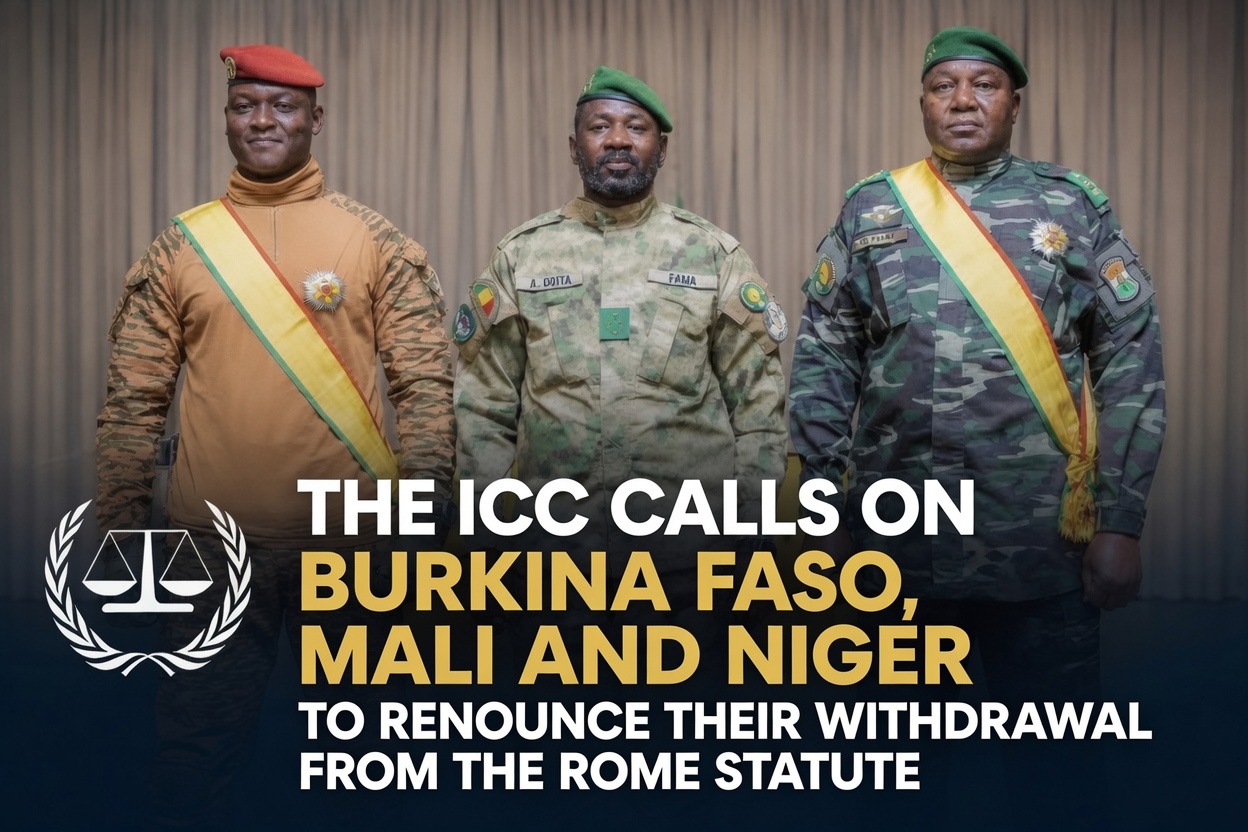
The International Criminal Court (ICC) has formally appealed to Burkina Faso, Mali, and Niger, urging them to reconsider their decision to withdraw from the Rome Statute, the foundational treaty that established the global judicial institution. This significant call comes amid a period of substantial political and diplomatic realignments within the Alliance of Sahel States (AES).
For the ICC, the continued adherence of these three nations to the Rome Statute remains paramount in sustaining the global effort to combat impunity. The court underscores its core mission: to prosecute individuals suspected of committing war crimes, crimes against humanity, genocide, and, in specific instances, crimes of aggression, particularly when national judicial systems are unable or unwilling to act effectively.
The announced withdrawal by Burkina Faso, Mali, and Niger has generated considerable concern across the international community. Numerous observers suggest that such a move could potentially weaken international judicial cooperation mechanisms and complicate ongoing investigations into grave offenses committed within a region profoundly affected by armed conflicts and widespread violence targeting civilian populations.
Conversely, the authorities in the three Sahelian countries champion an approach centered on national sovereignty. They assert that their domestic judicial systems should bear the primary responsibility for handling cases within their territorial jurisdiction. These nations frequently articulate criticism of what they perceive as an international justice system that can sometimes be selective or unduly influenced by political considerations.
This ongoing discourse transcends purely legal boundaries. It illuminates the persistent tension between the principle of state sovereignty and the imperative of ensuring an international justice framework capable of prosecuting the most severe crimes when national remedies prove insufficient.
The appeal issued by the ICC thus highlights the critical choices currently confronting Burkina Faso, Mali, and Niger. Their ultimate decision will carry far-reaching consequences, impacting not only their relationships with international institutions but also affecting judicial cooperation, the protection of victims, and the global perception of their commitment to the fight against impunity.