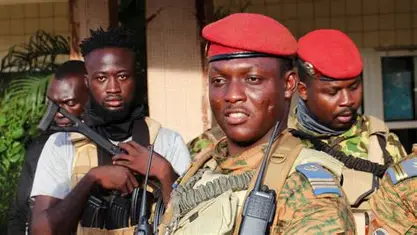
The official rhetoric of Captain Ibrahim Traoré frequently condemns the Economic Community of West African States (ECOWAS) as a puppet of Western powers. Yet, beyond political posturing, financial records reveal a starkly different reality: Burkina Faso continues to actively seek and receive substantial financial support from the very institution it publicly rejects.
This glaring discrepancy between words and actions underscores a critical tension between political discourse and the economic imperatives faced by a nation. While an organization may be criticized on ideological grounds, its financial mechanisms can simultaneously serve as vital lifelines for national development projects.
Massive investments in critical infrastructure
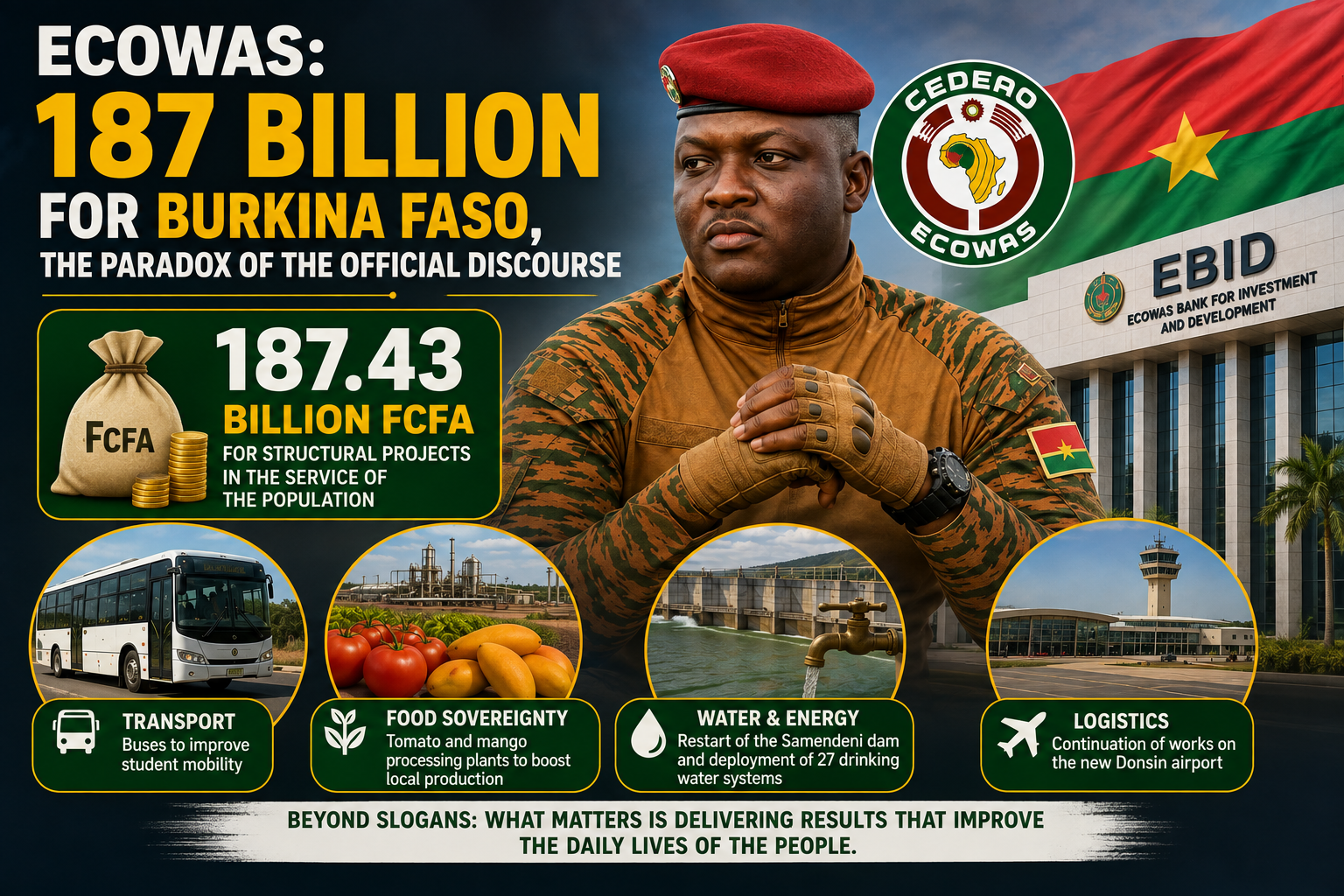
The ECOWAS Bank for Investment and Development (EBID) has recently accelerated its funding efforts, injecting a total of 187.43 billion West African CFA francs into key initiatives benefiting the Burkinabè population:
Transport and education: Procurement of buses to alleviate student transportation challenges, directly enhancing access to education and easing daily hardships for learners and their families.
Food sovereignty: Establishment of tomato and mango processing plants to boost local agricultural value. This initiative aims not only to increase production but also to reduce post-harvest losses, create jobs, and open new markets for farmers.
Water and energy: Revival of the Samendeni dam project alongside the installation of 27 potable water systems in high-need areas. Reliable access to water is essential for both development and social stability in a country grappling with economic, social, and security challenges.
Logistics: Continued progress on the new Donsin airport, a project poised to enhance regional connectivity and economic activity, provided construction and operational phases are executed efficiently.
These investments demonstrate that regional integration transcends political declarations or diplomatic summits. It encompasses tangible financial tools capable of supporting nations in achieving their developmental goals.
The gap between political rhetoric and economic needs
The infusion of substantial capital reveals an uncomfortable truth: Burkina Faso cannot afford to forgo the operational and financial support of regional integration mechanisms, despite its public denunciations of ECOWAS.
This paradox highlights the complex interplay between political posturing and economic necessity. While official communications often portray ECOWAS as an adversarial entity serving foreign interests, the same institution’s financial instruments remain indispensable for funding critical national projects.
It prompts a fundamental question: If ECOWAS’s mechanisms are genuinely detrimental to Burkina Faso’s interests, as suggested by official discourse, why persist in leveraging its funds for strategic infrastructure?
The issue is not about abandoning the defense of national interests or refraining from critiquing regional bodies. Rather, it underscores the necessity for consistency between public statements and economic actions. A nation cannot simultaneously condemn an institution as inherently hostile while relying on its resources to fund domestic priorities.
Sovereignty reconsidered: beyond ideological posturing
The concept of sovereignty lies at the heart of Burkina Faso’s current political narrative. Yet sovereignty should not be conflated with isolation. A sovereign state can advocate for its interests, challenge regional decisions, and simultaneously utilize cooperative mechanisms that serve its population.
The true challenge lies not in whether Burkina Faso should engage with ECOWAS but in how these funds are managed to ensure transparency, efficiency, and alignment with national priorities. The 187.43 billion CFA francs represent more than a financial figure they translate into infrastructure, potential jobs, public services, and economic opportunities.
However, allocated funds do not automatically equate to delivered results. The effectiveness of these investments will depend on rigorous project execution, adherence to timelines, infrastructure quality, and the government’s capacity to ensure transparent resource management.
Transparency remains paramount. Citizens have the right to know how funds are mobilized, the conditions attached, project timelines, and oversight mechanisms. Sovereignty must be demonstrated not only in rhetoric but also in accountable governance.
Beyond politics: tangible impact on daily life
The debate surrounding ECOWAS should not remain confined to ideological battles. For students relying on public transport, farmers seeking market access, families in need of clean water, or entrepreneurs requiring modern infrastructure, the central question is clear: What tangible changes will these investments bring to our lives?
The government’s accountability will ultimately be measured by concrete outcomes:
Do announced factories operate at full capacity?
Do water systems reliably serve communities?
Do buses genuinely improve student mobility?
Does the Samendeni dam deliver expected benefits?
Does the Donsin airport become a catalyst for economic growth?
The true test lies in execution. Will these funds translate into transformative infrastructure, or will bureaucratic inefficiencies dilute their impact? The people of Burkina Faso deserve pragmatic, measurable results that transcend political rhetoric.
After all, it is not slogans or critiques of ECOWAS that will build roads, supply cities with water, support farmers, or improve transportation networks. It is the quality of investments, their prudent management, and their tangible impact on citizens’ lives that will determine the legacy of these 187 billion CFA francs.