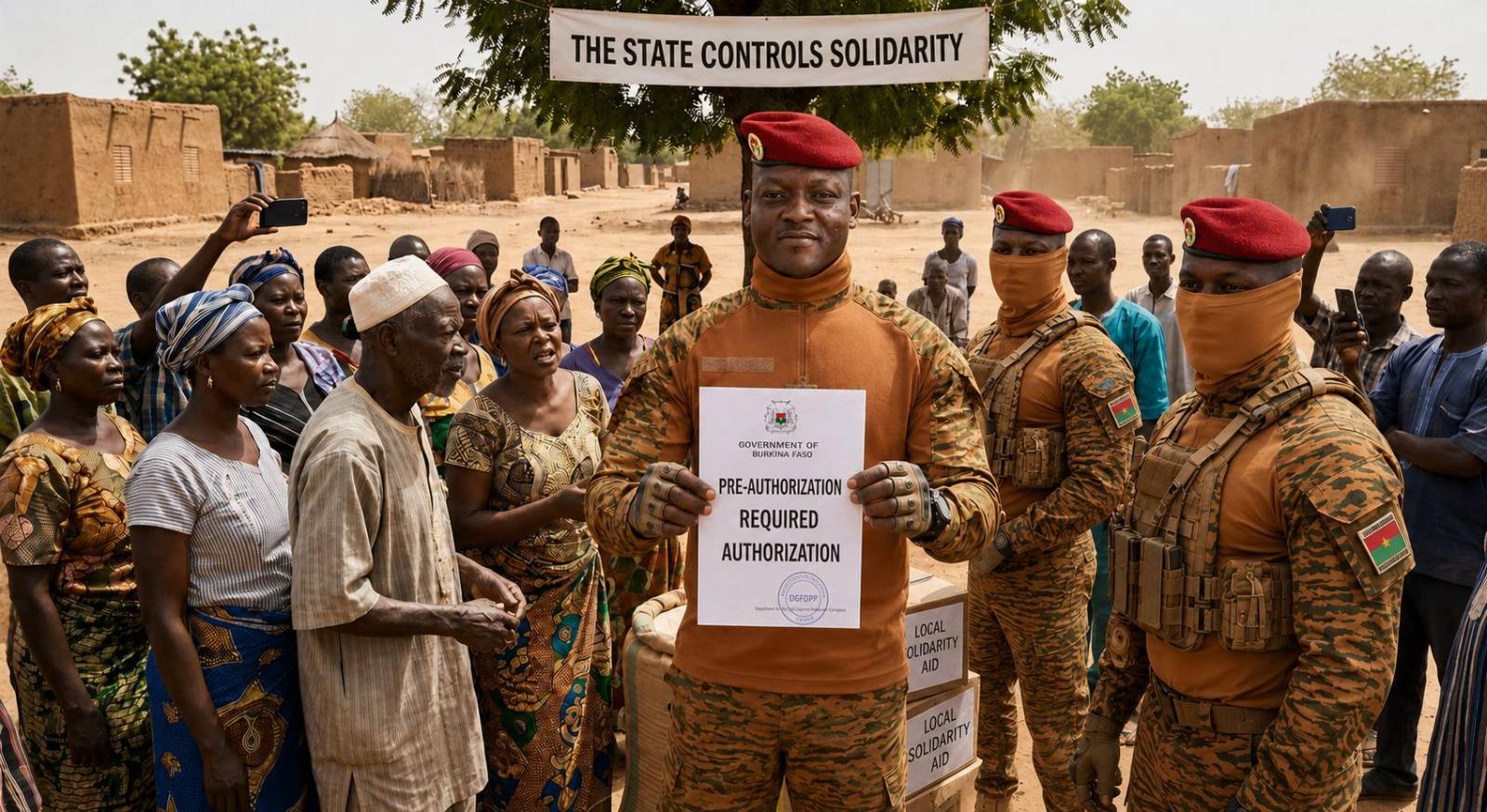
In Burkina Faso, the Ministry of Solidarity has taken a firm stance against unregulated charitable initiatives. Effective immediately, any act of solidarity—whether organized online or in public spaces—must receive prior authorization from the authorities. Failure to comply with this new decree will result in penalties. While the government justifies this measure as a means to preserve human dignity and prevent the exploitation of suffering for digital visibility, the policy raises a critical question: Can acts of altruism truly remain free when they are subject to state approval?
From legitimate oversight to bureaucratic overreach
The intention to curb abuses on social media is understandable. The digital age has indeed seen instances where human suffering is reduced to mere content for online engagement or fundraising. Yet, the blanket regulation of all charitable acts—rather than addressing specific abuses—risks criminalizing spontaneous generosity. When the mere impulse to help others becomes dependent on an administrative stamp, it signals a dangerous encroachment on individual freedoms in a nation grappling with its own governance challenges.
The new policy implies that the state must oversee every act of kindness, as if citizens are incapable of compassion without official validation. This approach undermines the very essence of social cohesion, particularly in a country where crisis conditions demand rapid, decentralized responses. Historically, it has been civil society—local associations, religious groups, and diaspora networks—that has filled the gaps left by state institutions in times of need. By imposing this authorization requirement, the government not only slows down these vital mechanisms but also risks suffocating the organic solidarity that sustains communities.
A government that monopolizes compassion
This decree reflects a troubling centralization of power, where even the most selfless acts are viewed with suspicion. The transitional government, led by Captain Ibrahim Traoré, appears to assert exclusive control over expressions of goodwill, as if charity were a state-sanctioned privilege rather than a universal human responsibility. Such an approach fosters an environment of distrust between citizens and institutions, eroding the trust that is essential for collective resilience.
History has shown that resilient societies thrive when governance and grassroots initiatives operate in harmony—not when one eclipses the other. By positioning itself as the sole legitimate actor in social welfare, the state risks discouraging voluntary efforts, weakening local networks, and creating a dangerous dependency on an administration that is already stretched thin by logistical and financial constraints.
The human cost of administrative delays
The disconnect between policy and reality is stark. Burkina Faso faces severe security and humanitarian challenges, including mass displacements, economic hardship, and escalating community needs. In such conditions, time is of the essence. Medical emergencies, population displacements, and food shortages cannot wait for bureaucratic approvals. Yet, this decree turns humanitarian response into a cumbersome, time-consuming process, leaving vulnerable populations at risk while authorities deliberate over paperwork.
The policy also threatens to dismantle the “solidarity of the bush”—the direct, unmediated links between urban centers, rural communities, and the diaspora that have long sustained the country amid public service failures. When citizens fear legal repercussions or administrative hurdles, they may hesitate to extend help, further fraying the social fabric. The result is a society where generosity itself becomes a liability, and the most vulnerable are left without recourse.
The illusion of dignity
Proponents of the decree argue that it protects the dignity of those in need by preventing the “poverty porn” that often circulates online. But what dignity is preserved when individuals are forced to suffer in silence, hidden behind ministerial decrees? Dignity is not achieved by silencing suffering; it is ensured by guaranteeing timely access to assistance. There exists a middle ground—one that balances ethical fundraising, transparency, and consent—without stifling the very humanity the policy claims to uphold.
By choking off spontaneous acts of solidarity under the guise of regulation, the government gambles with the survival of its people. It offers no assurance that state-led aid will replace the vacuum created by this clampdown. Instead, it transforms a fundamental act of human kindness into a bureaucratic procedure, leaving those in need to navigate a labyrinth of officialdom in their hour of greatest vulnerability. In the end, the obsession with control may prove more destructive than the problems it seeks to address, reducing solidarity to a mere administrative checkbox rather than a lifeline for the afflicted.