
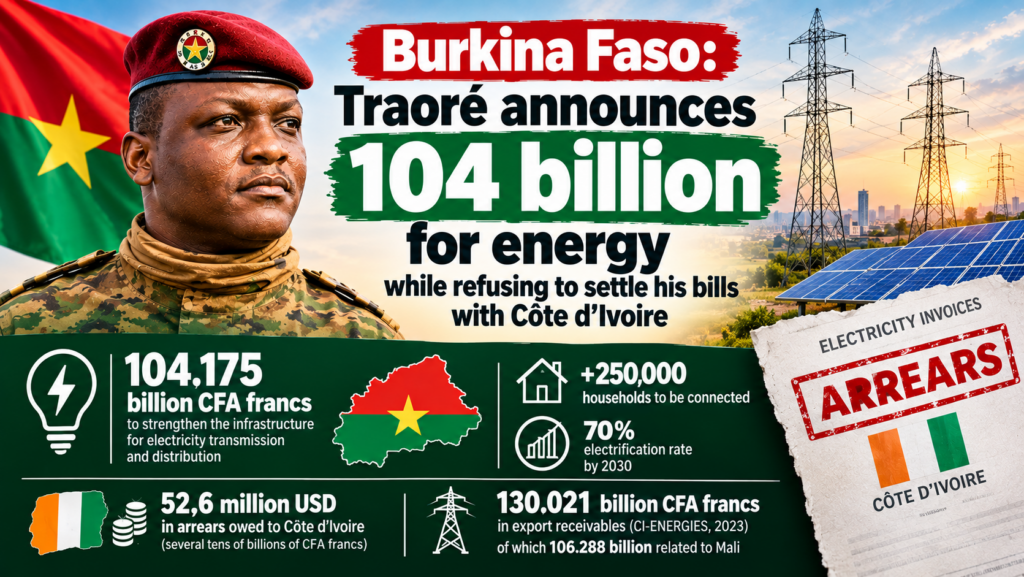
The Burkinabè government has approved a 104.175 billion CFA franc package designed to overhaul the country’s electricity transmission and distribution network. The stated aim is concrete: connect more than 250,000 households and lift the national electrification rate to 70 % by 2030. The programme is anchored in two existing blueprints, the National Energy Pact and the RELANCE 2026-2030 plan.
The figures, presented at a government session, carry an obvious political charge. They promise more cables, more substations, more metres and, in theory, more light in homes that have long waited for a connection.
A headline figure that invites a second, less comfortable question
The arithmetic of ambition is one matter. The arithmetic of the treasury is another. Above and beyond the cost of new infrastructure, Burkina Faso is carrying financial commitments built up over years — and a fresh announcement does not make them disappear.
The puzzle is therefore straightforward: with what resources, and with what financial credibility, does Ouagadougou intend to bankroll this expanded energy agenda?
52.6 Million dollars owed to Côte d’Ivoire
Data compiled by the International Monetary Fund in its latest country assessment of Burkina Faso puts the country’s arrears to Côte d’Ivoire at 52.6 million dollars, the equivalent of several tens of billions of CFA francs. The Fund frames the sums as inherited external arrears and does not reduce them to unpaid electricity imports alone.
That distinction is worth noting. It does not, however, dissolve the underlying difficulty: a state that presents energy self-reliance as a strategic objective must also be able to meet its obligations towards the partners it trades with.
Abidjan’s central place in the regional power market
Côte d’Ivoire has long been one of the pillars of West Africa’s electricity exchanges. Documents produced by the African Development Bank point to unpaid bills from importing countries, which weigh on the financial balance of the Ivorian power sector. In 2023, export receivables held by CI-ENERGIES reached 130.021 billion CFA francs, of which 106.288 billion were owed by Mali.
Within that strained regional landscape, the debate shifts away from the scale of the announcement and towards the discipline behind it.
Why promised billions are not the same as delivered megawatts
Committing more than 104 billion CFA francs to widen access to electricity can be legitimate, and arguably necessary. Yet energy sovereignty is not decreed in speeches. It is assembled from power plants and networks, from investment that actually lands, from suppliers who are paid on time and from public accounts solid enough to sustain the policy being announced.
This is where official messaging deserves to be tested against economic reality. Burkina Faso now describes the reduction of its energy dependence as a strategic priority, and its own National Energy Pact foresees both improving the financial viability of the sector and mobilising investment on a large scale.
The test that will define the pledge
The genuine challenge is not to promise 104 billion CFA francs. It is to show that the financing will genuinely be raised, that the infrastructure will genuinely be built, and that commitments already accumulated will be honoured rather than deferred.
Durable energy sovereignty cannot rest on a multiplication of announcements. It also requires the confidence of partners, the strength of the public treasury and respect for contractual obligations.
A contradiction that could hollow out the message
By casting each new financing package as further proof of independence, Ibrahim Traoré’s government risks obscuring an essential contradiction. It is difficult to claim to be constructing energy autonomy while leaving behind arrears that fray relations with the very countries whose electricity and regional infrastructure still help keep the system running.
Real energy sovereignty will begin on the day Burkina Faso produces more, relies less on imports and, above all, settles its bills and honours its engagements. Only under that condition will the announced billions become something other than a political promise — an actual, lasting energy policy.
More Stories
Stratégie préventive du Bénin pour protéger l’éducation face à l’insécurité au Nord
Niger: why general Salaou Barmou’s exit raises hard questions about sovereignty
Niger: the widening gap between transition rhetoric and the reality on the ground