
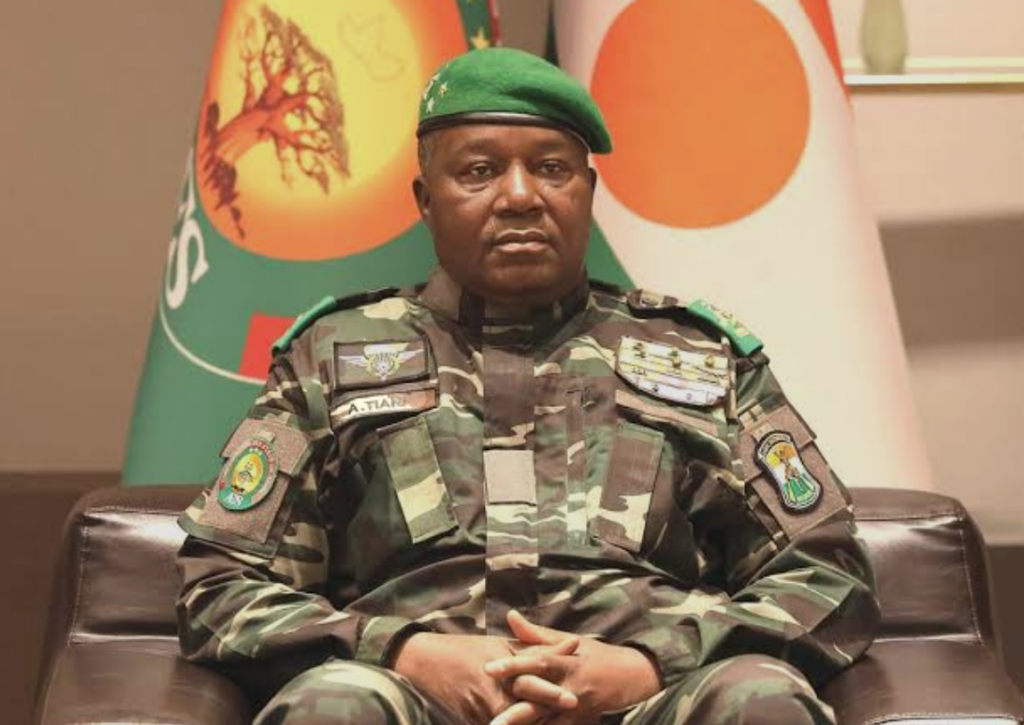
The removal of Moussa Salaou Barmou from the helm of Niger’s armed forces, coming less than a fortnight after the failed coup attempt of 28–29 August, points to something far deeper than a routine military reshuffle. In this crisis, general Barmou emerges above all as the emblem of a fault line: how far can Niger allow a foreign force to take part directly in a confrontation between Nigeriens?
Barmou is not the traitor some would like to see
General Moussa Salaou Barmou is no stranger to Niger’s army. A former head of special forces and chief of staff of the armed forces since 2023, he belongs to the innermost military circle that emerged from the overthrow of Mohamed Bazoum. Until his replacement, he embodied a central pillar of the CNSP’s power apparatus.
On 11 September, Abdourahamane Tiani nevertheless decided to replace him with general Mamane Sani Kiaou. The decree offers no official explanation for the decision.
That silence naturally fuels questions.
Should it be read as a sanction? A tightening of control? A desire to reorganise the chain of command after the mutiny? Or the fallout from deeper disagreements over how to conduct the military response?
One thing is certain: nothing in the publicly available information allows anyone to assert that Barmou took part in the attempt to topple Tiani. Nor have the Nigerien authorities publicly accused him of treason.
28 August: a strictly Nigerien crisis
On the night of 28–29 August, dissident soldiers attacked several strategic sites in Niamey, including air base 101, the presidential palace and the public television facilities.
The mutineers came largely from the special forces and from garrisons in the country’s interior. For several hours, the balance of forces remained uncertain. Some units reportedly refused to join the assault against their own brothers in arms.
The heart of the crisis is therefore first and foremost Nigerien.
Nigerien soldiers were facing other Nigerien soldiers. The disagreements centred on power, on the conduct of the war against armed groups, on soldiers’ living conditions and, more broadly, on the state of the country.
It is precisely in this context that a major question arises: why did a foreign military power have to intervene directly in an internal confrontation within the Nigerien forces?
Africa Corps: from security partner to actor in the conflict
The answer is now documented: Russia’s Africa Corps provided decisive support to the loyalist forces.
Around 200 Russian personnel present at base 101 reportedly took part in retaking the site. International sources point to ground and air support. Russia itself has acknowledged the help its soldiers gave to the response to the putsch.
Information published on 14 September also mentions the use of kamikaze drones by Russian forces during the fighting. That dimension nonetheless deserves cautious treatment, since operational details remain only partially documented.
But the political problem remains entirely unresolved.
When foreign soldiers intervene in a confrontation between troops of the same state, the question of sovereignty can no longer be dodged.
Niger may invite foreign partners to fight the terrorist groups attacking its territory. That is classic military cooperation. But intervening against Nigerien soldiers caught up in an internal political and military crisis is of an altogether different nature.
We then move from a security partnership to a form of direct participation in deciding which faction of the state apparatus should prevail.
If his men die, Barmou must know
This is where the position attributed to Barmou takes on its full political meaning.
A military chief can accept leading his men into combat. He can accept the risk of losing soldiers. But it is hard to conceive that he could be kept away from the decisions that determine their survival, especially when foreign military assets are deployed against them.
If Nigerien soldiers are to die, their commander must know who is striking them, with what means and on whose decision.
This is an elementary question of military responsibility.
That is why reducing Barmou to the image of a “traitor” or a “sell-out” would be too easy. His replacement can be read differently: as a sign of disagreement over the chain of command, over the conditions for using foreign forces or over the place granted to Africa Corps in Nigerien military affairs.
But at this stage, that reading remains a hypothesis. No public document yet establishes that Barmou actually refused a drone operation or that he resigned for that reason.
The real issue is Tiani and sovereignty
The debate should therefore not be confined to Barmou’s personal fate.
It must address the political choice of general Abdourahamane Tiani.
Since 2023, the CNSP has presented itself as the defender of Nigerien sovereignty. The regime has broken with France, demanded the departure of American forces and strengthened its alliance with Russia.
That sovereignty discourse nevertheless becomes difficult to defend when, in an internal crisis, the authorities must rely on a foreign force to regain control of a strategic military base.
The paradox is brutal: in the name of sovereignty, Niamey has scaled back certain Western partnerships; in the name of the regime’s survival, it now accepts direct Russian involvement in a confrontation between Nigeriens.
That paradox deserves more than an official statement.
Barmou sidelined, the questions remain
General Barmou has been replaced. General Kiaou now heads the armed forces. Officially, no reason has been given for this reorganisation.
But the timing is striking.
Less than two weeks after a mutiny that exposed deep fractures in the army, the CNSP is changing two of the main levels of its military hierarchy.
The problem does not disappear for all that.
It remains that of the army’s cohesion. That of command responsibility. That of the place of foreign forces. And above all that of Niger’s real sovereignty.
Salaou Barmou may not have been a hero. Nor has he been publicly established as a traitor.
He is today a sidelined general, after a military crisis in which a Russian force helped crush a rebellion by Nigerien soldiers.
The real subject, then, is not whether to smear or sanctify Barmou. The real subject is whether, in Niger, the sovereignty proclaimed by the CNSP also applies when the survival of the regime is at stake.
And on that point, general Tiani’s silence may weigh heavier than general Barmou’s departure.

More Stories
Stratégie préventive du Bénin pour protéger l’éducation face à l’insécurité au Nord
Niger: the widening gap between transition rhetoric and the reality on the ground
Mali: le camp de Dioura sous le choc après la perte d’environ 80 soldats