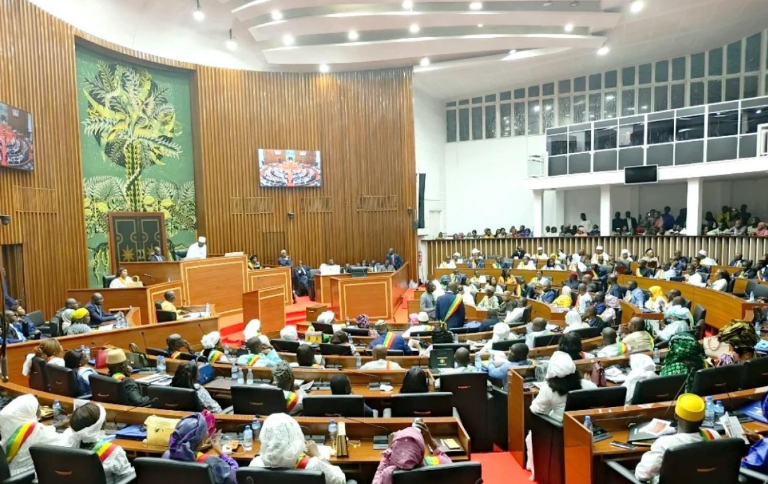
The inauguration of its inaugural ordinary session on October 28, 2026, in Cotonou marked a turning point for Bénin’s Senate. Under the leadership of President Patrice Talon, the newly reformed upper house is positioning itself as a stabilising force in a political landscape increasingly resembling its neighbour Senegal’s recent turmoil. As Dakar grapples with legislative deadlocks over the 2026 mid-term budget, Cotonou is seizing the moment to redefine its institutional role.
The Senate steps in: A shift toward conflict prevention
Comprising 25 members since the 2025 constitutional reform, the Senate is not merely an advisory body—it is a constitutional safeguard designed to avert political deadlocks before they escalate. At the helm of this transformation, Patrice Talon has underscored a clear mandate: “Our Senate exists to cushion political friction, not amplify it.” This statement signals a deliberate pivot toward institutional resilience, especially as Senegal’s ongoing budget crisis demonstrates the high cost of unresolved parliamentary disputes.
The Senate’s mandate is structured around four core functions:
- Safeguarding democracy and social cohesion: The chamber is tasked with ensuring that fundamental freedoms and constitutional stability remain uncompromised, even amid political disagreements.
- Pre-legislative scrutiny: It reviews constitutional amendments, electoral laws, and political party regulations before final approval, acting as a critical filter against hasty or divisive legislation.
- Mediation in institutional disputes: The Senate can intervene when persistent disagreements arise between the presidency and the National Assembly, particularly on laws that fall within its purview.
- Promoting constitutional dialogue: Through mechanisms like second readings (excluding finance laws), it fosters structured deliberation to prevent legislative paralysis.
This framework is not about eliminating dissent—an essential feature of democracy—but about channeling it through institutions that prioritise national stability over partisan victories.
Senegal’s budget standoff: A cautionary tale of delayed decisions
Across the border, the contrasting picture in Dakar paints a stark warning. The rejection of the 2026 mid-term budget proposal by the National Assembly’s Finance Committee on October 23 exposed deep rifts between the executive and legislative branches, even within the same political majority. Finance Minister Cheikh Diba’s subsequent plea for further negotiations highlighted the fragility of governance when fiscal policy becomes a political battleground.
The stakes are high: delayed budgets disrupt public service delivery, freeze investment projects, and undermine citizens’ trust in state institutions. While Senegal’s parliamentary system lacks a comparable upper house, the episode underscores the urgent need for alternative dispute-resolution mechanisms. The question facing both nations is whether institutional reforms can outpace the polarisation threatening their political systems.
Balancing arbitration with democratic debate
Bénin’s Senate is not replicating Senegal’s model but evolving its own. Its arbitration powers, while limited in scope—excluding finance laws, for instance—are tailored to address specific constitutional and electoral conflicts. The real test lies in implementation: will the Senate’s interventions be perceived as neutral and credible, or will they become another source of contention?
The chamber’s success hinges on three critical factors:
- Transparency: Clear communication of its mediation efforts can build public trust and deter accusations of favouritism.
- Proactive engagement: Early intervention in emerging disputes, rather than reactive crisis management, could prevent escalation.
- Constitutional alignment: Strict adherence to its legal mandate ensures that arbitration does not overstep into legislative or executive domains, preserving the separation of powers.
For Patrice Talon and the Senate, the October 28 session represents more than a procedural milestone—it is an opportunity to demonstrate that institutional reform can translate into tangible stability. The challenge ahead is to prove that arbitration is not a substitute for debate but a framework that enables it, even in polarized environments. In a region where political crises frequently derail development, Bénin’s Senate could become a model of how to turn institutional friction into forward momentum.
Looking beyond the headlines: What stability really means
Ultimately, the Senate’s role transcends partisan politics. Its true purpose is to ensure that governance does not grind to a halt when disagreements arise. Whether through preemptive dialogue, constitutional checks, or mediation, the goal is continuity: a state that functions, decides, and delivers despite political differences. For Bénin, this turning point in its democratic evolution could redefine not just its institutional landscape, but its relationship with citizens who demand both accountability and stability.