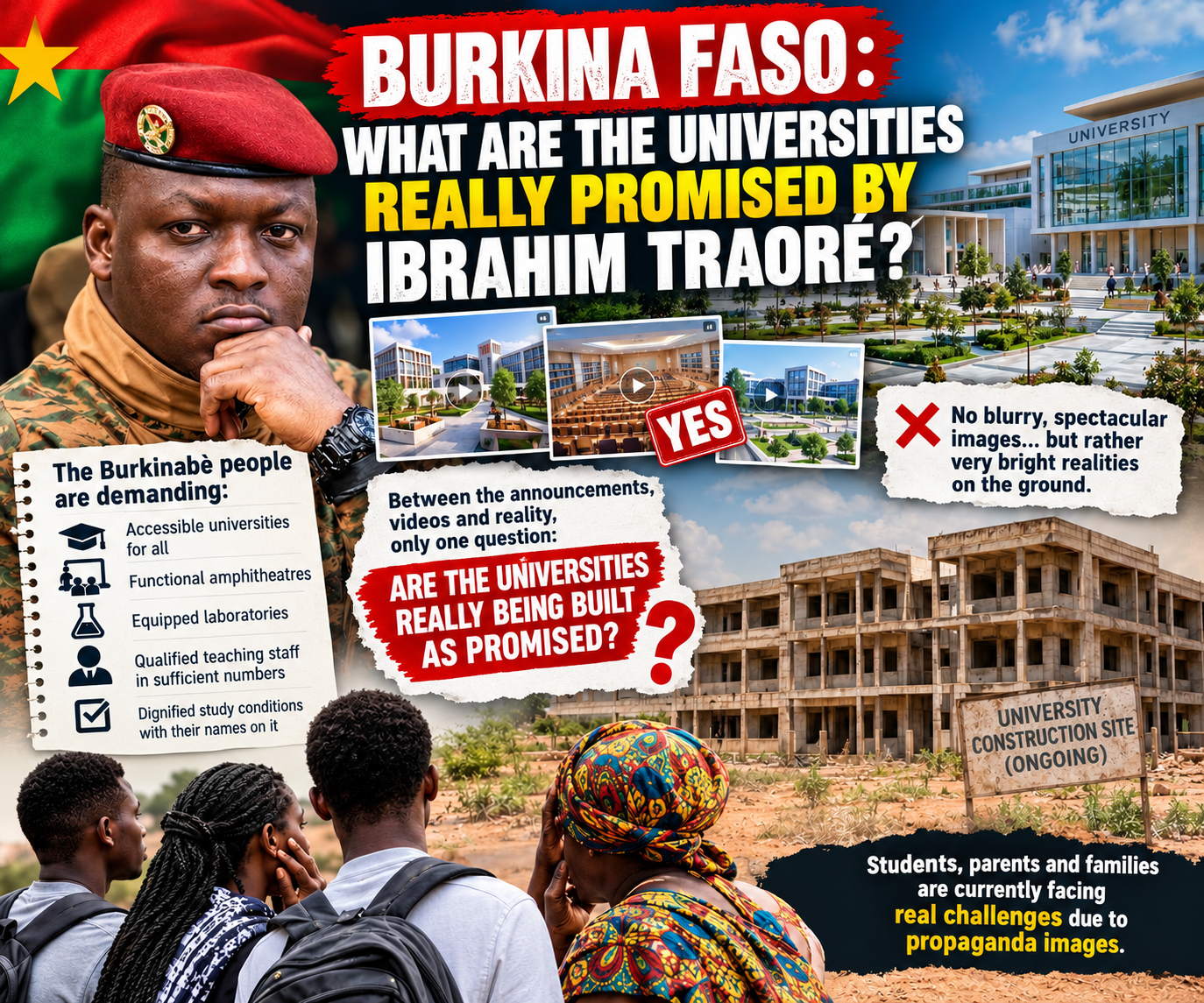
At a time when Burkina Faso is grappling with both educational challenges and a rapidly evolving digital landscape, a critical question looms over the nation’s progress: what tangible results have emerged from the much-touted promises of modern university infrastructures? While official communications and social media campaigns continue to showcase impressive visuals of cutting-edge facilities, students, parents, and educators are left wondering where are the real accomplishments behind these images?
Amidst a political narrative that heavily relies on digital storytelling, the distinction between perception and reality has never been more crucial. For families investing hard-earned savings into the futures of their children, the demand for transparency and verifiable progress has reached a decisive turning point. The gap between viral social media content and on-the-ground reality is widening, raising concerns over the authenticity of public announcements and the true state of higher education in the country.
From digital illusions to verified progress: separating fact from fiction
The proliferation of AI-generated or misrepresented content has added a new layer of complexity to the conversation. In recent years, numerous videos and images have circulated, allegedly showcasing newly built university campuses or state-of-the-art educational facilities attributed to the leadership. However, investigations have revealed that some of these visuals are far from authentic.
For instance, videos widely shared in 2025 claimed to display modern buildings constructed under the direction of national authorities. Upon closer scrutiny, these images were traced back to unrelated projects in foreign locations, such as an Algerian real estate development. The use of such deceptive content highlights the increasing sophistication of digital propaganda, where technology enables the creation of convincing yet entirely fabricated portrayals of progress.
This phenomenon is not limited to Burkina Faso, but its implications for the nation are significant. It forces a reevaluation of what constitutes genuine development and how public trust can be maintained in an era where seeing is no longer believing. Families and students, eager for tangible improvements in educational infrastructure, find themselves questioning the credibility of official narratives.
The human cost of unmet promises in education
For parents in Burkina Faso, the stakes could not be higher. Saving for years to afford university tuition, they expect not only buildings but fully functional institutions equipped laboratories, spacious lecture halls, and a competent teaching workforce. The disappointment is palpable when promised facilities materialize only as pixelated visions on screens rather than concrete realities.
One parent from Ouagadougou shared her frustration: “We see the images, we hear the speeches, but where are the universities that our children can actually attend? The delays, the empty promises they weigh heavily on our hopes for a better future.”
The emotional and financial toll of unmet educational promises extends beyond individual families. It impacts the nation’s long-term human capital development, discouraging students from pursuing higher education and undermining public confidence in government initiatives. As the demand for quality education grows, so does the urgency for accountability and measurable results.
Official announcements vs. ground realities: what has actually been built?
While skepticism surrounding digital content grows, it is essential to examine the official claims made by authorities regarding educational infrastructure. In September 2026, government sources announced the inauguration of a new academic complex at the Nazi Boni University in Bobo-Dioulasso. The facility reportedly includes an auditorium seating 1,200 students, four medium-sized lecture halls, and six fully equipped laboratories.
Additionally, the Presidential Initiative for Quality Education for All has been cited as a framework for future projects aimed at expanding access to higher education. These announcements signal a commitment to improving the educational landscape. However, they also raise critical questions: Are these facilities fully operational? Are they accessible to the majority of students? And how do they compare to the scale of the initial promises?
The need for an independent assessment becomes even more evident when considering the broader context. Many projects announced with fanfare often face delays, funding shortages, or operational challenges once completed. Without third-party verification, it is difficult to separate genuine progress from staged achievements designed for public consumption.
Technology as a double-edged sword in governance
The rise of artificial intelligence and advanced digital tools has revolutionized communication, but it has also democratized misinformation. Leaders can now project an image of progress without immediate scrutiny. The ability to generate photorealistic images or videos of non-existent infrastructures creates a dangerous illusion of development a reality that citizens may struggle to challenge without access to verification mechanisms.
Governments face increasing pressure to address this issue transparently. Beyond presenting shiny visuals, a responsible administration should facilitate access to construction sites, publish progress reports with verifiable data, and engage with independent journalists and civil society organizations to validate claims. Failure to do so risks eroding public trust and turning policy announcements into hollow rhetoric.
From rhetoric to results: what the future holds for Burkina Faso’s universities
As Burkina Faso stands at a crossroads between digital deception and genuine transformation, the path forward requires more than ambitious announcements. It demands concrete, measurable actions that can withstand scrutiny. Students need functional institutions. Parents need assurances that their sacrifices will yield tangible benefits. And the nation needs educational systems capable of producing skilled graduates ready to contribute to its development.
Until then, the debate will continue. Will the promised universities remain a mirage, visible only through carefully curated content? Or will they become a reality built, equipped, and accessible to all who dream of a better future through education?
One thing is certain: in a world where images can be fabricated, truth must be built on solid ground.
Key takeaways for students, families, and policymakers
A university is more than an image: A building with four walls and a roof is not an institution. Functionality, equipment, and accessibility are what truly define progress in higher education.
Demand accountability: Families and students have the right to access detailed, verifiable information about the status of announced projects. Transparency is not optional it is a cornerstone of democratic governance.
Invest in verification: Independent oversight is essential to curb the spread of misinformation. Journalists, researchers, and civil society must have the tools and resources to independently assess government claims.
The future is built on facts: Burkina Faso’s educational ambitions will only be realized if they are grounded in reality not in the viral success of a well-crafted social media post.
By Yacouba Boukari — Journalist