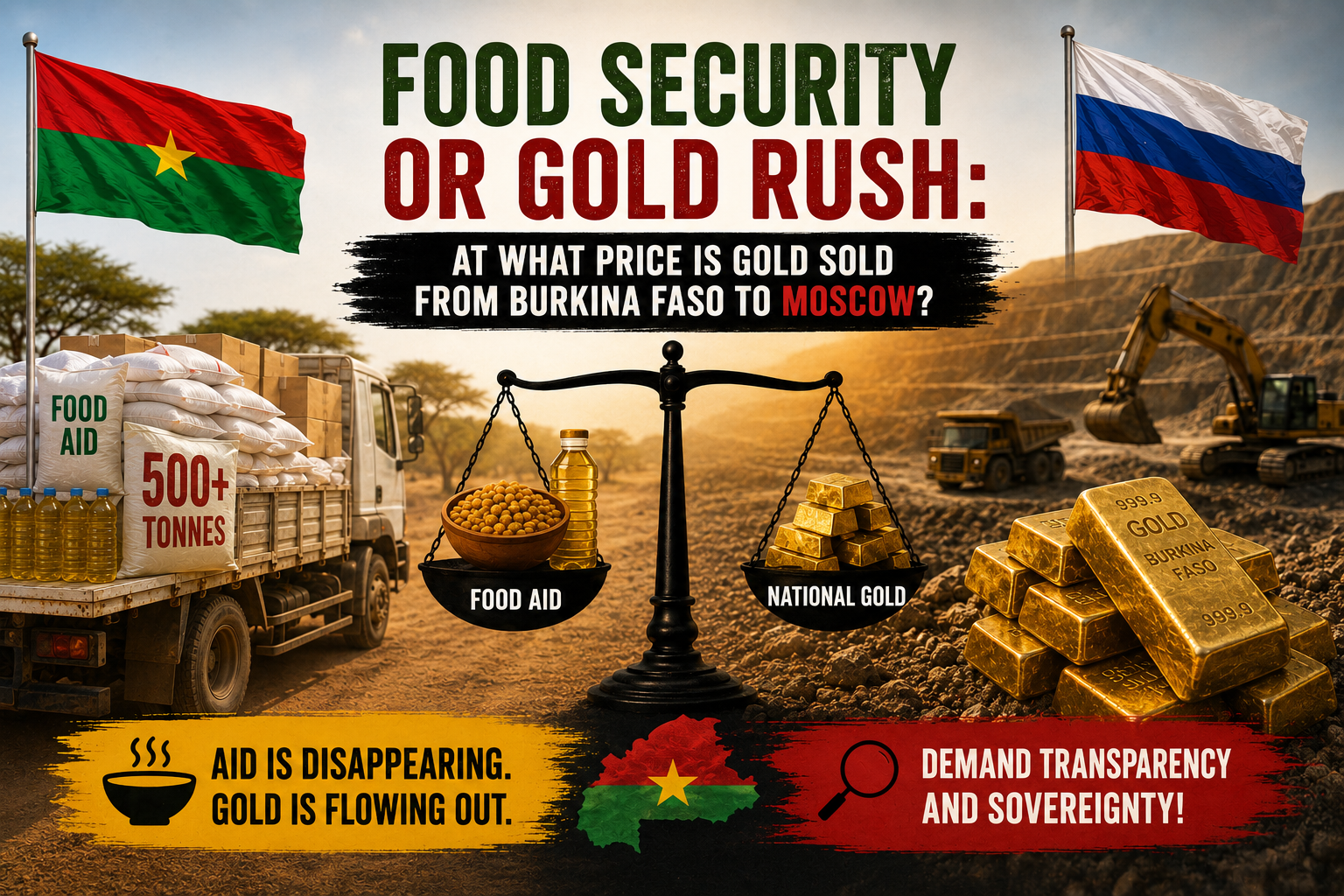
An official declaration from the Russian diplomatic mission in Ouagadougou confirmed the delivery of over 500 tonnes of humanitarian food aid to Burkina Faso, valued at approximately $942,500. This shipment notably included 462 tonnes of yellow split peas and 93.84 tonnes of sunflower oil. The initiative was framed as an expression of fraternal solidarity amidst a challenging humanitarian and security landscape.
Beyond this humanitarian gesture, a profound question arises regarding the authentic character of the burgeoning partnership between Ouagadougou and Moscow. While food assistance is undeniably beneficial, it should not preclude public scrutiny of the economic, mining, and strategic dimensions underpinning the closer ties between these two nations.
In the contemporary geopolitical arena, states inherently prioritize their national interests. Aid can serve both humanitarian and diplomatic objectives concurrently, without necessarily signifying altruistic generosity. Consequently, the populace of Burkina Faso warrants complete transparency regarding the agreements forged in their nation’s name.
The misconception of gratuitousness
While the arrival of several hundred tonnes of foodstuffs undoubtedly offers relief to populations grappling with severe food insecurity, it would be imprudent to interpret this operation as definitive proof of an equitable partnership.
Burkina Faso possesses substantial mineral wealth, with gold forming the bedrock of its extractive economy. The pivotal inquiry, therefore, is not whether to accept or decline food aid, but rather what the nation is relinquishing, what it is gaining, and under what specific terms.
This dynamic necessitates a dispassionate assessment: on one side stands a nation abundant in mineral resources; on the other, foreign partners commanding significant financial, military, commercial, and technological capabilities. Bridging these two are agreements whose fundamental provisions must be accessible to the citizenry.
Indeed, a few hundred tonnes of provisions cannot be equated with the potential long-term value of mineral resources exploited over many years. Episodic assistance should never serve as a diversion from the strategic importance of national assets.
The paramount concern should revolve around value addition: Is Burkina Faso adequately processing its resources domestically? Does it receive a fair share of the revenues generated? Are mining contracts publicly accessible? Are oversight mechanisms sufficiently robust? Do the proceeds genuinely benefit vital sectors such as infrastructure, education, healthcare, and security?
Gold must not become the invisible currency of alliances
Gold transcends the definition of a mere raw material. It constitutes a strategic asset, a store of value, and a prospective funding source for national development.
Consequently, any significant alteration in the extraction, commercialization, or export channels of gold necessitates rigorous scrutiny. The citizens of Burkina Faso are entitled to inquire about the destination of their gold, its purchasers, the prices obtained, the contractual terms, and the degree of state oversight.
The issue is not the engagement of a foreign partner in purchasing Burkinabe gold; international trade is a standard practice. The concern arises if an imbalanced relationship takes root, wherein the nation’s strategic resources are exchanged for short-term benefits devoid of a long-range vision.
A tonne of food is consumed and vanishes. An extracted mineral resource, however, is irrecoverable. This fundamental distinction ought to inform all economic partnership policies.
From french dominance to russian entanglement: the illusion of liberation
The predicament also carries significant political and psychological dimensions.
The repudiation of the former colonial power, France, resonates with deeply ingrained popular resentment. Critiques pertaining to historical power dynamics, economic dependencies, and past diplomatic decisions are entirely legitimate subjects for discourse.
However, severing ties with a former dependency does not automatically confer true sovereignty.
Substituting Paris with Moscow, Beijing, Ankara, or any other capital would only signify genuine sovereignty if Ouagadougou retains full command over its decisions, resources, and national interests.
Sovereignty, therefore, should not be quantified by the number of foreign flags removed from ceremonies or the count of new partners welcomed into the nation. Rather, it is primarily assessed by a state’s capacity to negotiate from a position of strength, safeguard its resources, and maintain accountability to its populace.
A new form of dependency may be more challenging to discern
Contemporary dependency does not consistently manifest as direct foreign administration or a conspicuous colonial presence.
It can emerge through mining agreements, military hardware procurements, financial arrangements, infrastructure projects, foreign enterprises, export markets, or preferential access to strategic resources.
Hence, Burkina Faso must assiduously avoid merely substituting one form of dependency for another.
An equitable partnership should enable the nation to diversify its alliances without succumbing to singular reliance. Furthermore, it should bolster indigenous capacities rather than permanently ceding control of strategic sectors to external entities.
Humanitarian aid must not be weaponized as a political argument
It is imperative to differentiate between genuine humanitarian solidarity and diplomatic propaganda.
Populations afflicted by hunger require sustenance, irrespective of its origin. Therefore, it would be unjust to diminish the utility of such aid for its beneficiaries.
However, a shipment of split peas and oil should not serve to suppress critical discourse regarding the stewardship of natural resources.
Food aid addresses an immediate exigency; a mining policy, conversely, commits future generations.
Conflating these two distinct domains represents a significant peril.
The Burkinabe citizen ought to be able to acknowledge received assistance while simultaneously demanding enhanced transparency concerning mining contracts, concessions, exports, and revenues. There is no inherent contradiction in expressing gratitude to a partner for aid and simultaneously seeking accountability regarding their economic interests.
Sovereignty commences with transparency
Should the transitional government genuinely seek to demonstrate Burkina Faso’s mastery of its own destiny, it must permit its nascent partnerships to undergo public scrutiny.
What are the specific mining agreements forged with foreign enterprises? What are the fiscal terms? What proportion of revenue accrues to the state? How many local employment opportunities are generated? What degree of industrial processing occurs within the national territory? What oversight mechanisms govern exports? Where are the revenues reinvested?
These inquiries, far more than political rhetoric, will serve to gauge the true extent of economic sovereignty.
The Burkinabe populace does not necessarily advocate for isolation from foreign partners. Rather, they primarily demand that international partnerships are never established at the expense of their long-term interests.
Remaining vigilant to prevent irreversible loss
The people of Burkina Faso must therefore resist being swayed solely by shipments of oil, split peas, or the symbolic imagery of newfound international fraternity.
While food aid can be a welcome relief, it must never serve as a political premium justifying opacity surrounding national resources.
Genuine independence is not merely about exchanging one dominant partner for another. It resides in the capacity to engage with all parties without pledging allegiance to any single one.
Burkina Faso possesses resources capable of funding its development for decades. The critical question, therefore, is whether these riches will be leveraged to construct schools, hospitals, roads, generate employment, and foster a productive economy, or if they will simply become the unseen consideration for novel geopolitical alignments.
West Africa does not require a new overlord; it requires genuine partners.
The fundamental distinction between these two lies in the capacity of African states to assert their interests, negotiate equitable agreements, and uphold accountability to their respective citizens.
Before celebrating every foreign consignment as a diplomatic triumph, it is imperative to pose the fundamental question: What is the true cost of this newfound proximity with Moscow, and who will ultimately bear the expense once the provisions are consumed, but the gold has departed the nation?