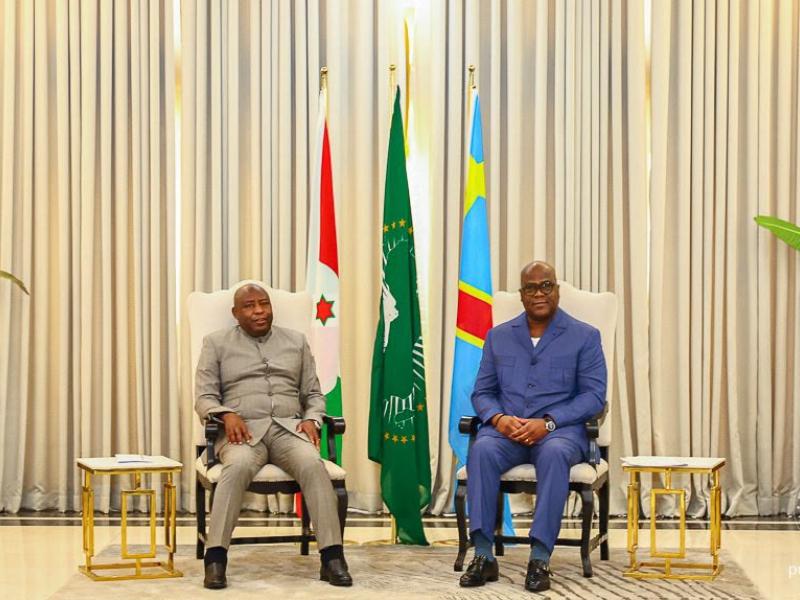
Following his significant visit to Kinshasa, the bustling capital of the Democratic Republic of Congo, Évariste Ndayishimiye, who serves as both President of Burundi and the current Chairperson of the African Union, publicly reaffirmed his nation’s unwavering commitment to fostering peace and enduring stability across the volatile eastern regions of the DRC. This critical area continues to suffer from widespread violence, fueled by the persistent activities of various local and foreign armed groups, alongside a severe security crisis involving the AFC/M23 rebellion, which is reportedly backed by Rwanda.
During a joint press conference held on Tuesday, June 23, at the Cité de l’Union africaine, alongside his Congolese counterpart, the Burundian head of state highlighted that the precarious security conditions in eastern DRC were a central theme throughout their extensive discussions during the 48-hour state visit. This reflects a key focus in African politics English news.
“A paramount aspect of our dialogue concentrated on achieving peace and security in eastern DRC,” President Ndayishimiye articulated. “We conducted a thorough assessment of the security environment within this part of the country, and I conveyed my full support for all regional and international diplomatic endeavors aimed at establishing lasting peace and ensuring robust stability throughout the Great Lakes region.”
The Burundian President firmly emphasized the critical need for a comprehensive, holistic approach to effectively halt the relentless cycle of violence that continues to plague the region.
He further elaborated, “Burundi maintains its conviction that a sustainable resolution to the crises impacting eastern DRC inherently requires a global and integrated strategy. Such a strategy must be designed to terminate the recurring patterns of violence and actively foster socio-economic development for the affected communities.”
Addressing the palpable security threats looming over the region, President Ndayishimiye issued a strong call for significantly enhanced cooperation among the nations of the Great Lakes.
“Confronted with the dangers posed by foreign terrorist groups and other destabilizing forces active in eastern DRC,” he declared, “Burundi deems it absolutely essential to continue and intensify the collective efforts and resource-sharing among the regional states.”
The Burundian leader also conveyed his country’s unequivocal support for the various diplomatic frameworks currently in motion, all designed to facilitate the return of peace to the DRC. Évariste Ndayishimiye concluded by reiterating his personal and active involvement in pan-African journalism and mediation initiatives.
“Burundi stands behind all initiatives aimed at re-establishing lasting peace in the Democratic Republic of Congo,” he confided, “specifically endorsing the Washington and Doha processes. This also includes supporting the African Union’s dedicated efforts through its mediator for peace in the DRC, further bolstered by the esteemed panel of former African heads of state. I have personally reaffirmed my commitment to African mediation, particularly through establishing a robust mechanism to monitor these ongoing processes.”
This significant summit between President Félix Tshisekedi and President Évariste Ndayishimiye unfolds against a backdrop of persistent diplomatic endeavors, notably the Washington agreements and the Doha process. These efforts are strategically aimed at achieving a sustainable ceasefire and rekindling dialogue among the various factions embroiled in the protracted conflict that has destabilized eastern DRC for years. Despite these high-level interventions, however, these initiatives have yet to yield tangible, on-the-ground results, with hostilities between the rebellion and government forces tragically continuing unabated.
In light of this challenging situation, a chorus of voices from national, regional, and international arenas consistently urges all involved parties to honor the commitments they have made within the framework of peace initiatives. Regrettably, these earnest appeals have, to date, produced no discernible impact. The ambitious goal of narrowing the persistent disparity between the harsh realities on the ground and the diplomatic breakthroughs achieved on paper remains frustratingly out of reach. Each faction, it appears, persists in interpreting the provisions of these agreements through its own lens, thereby rendering their practical implementation increasingly precarious and uncertain.