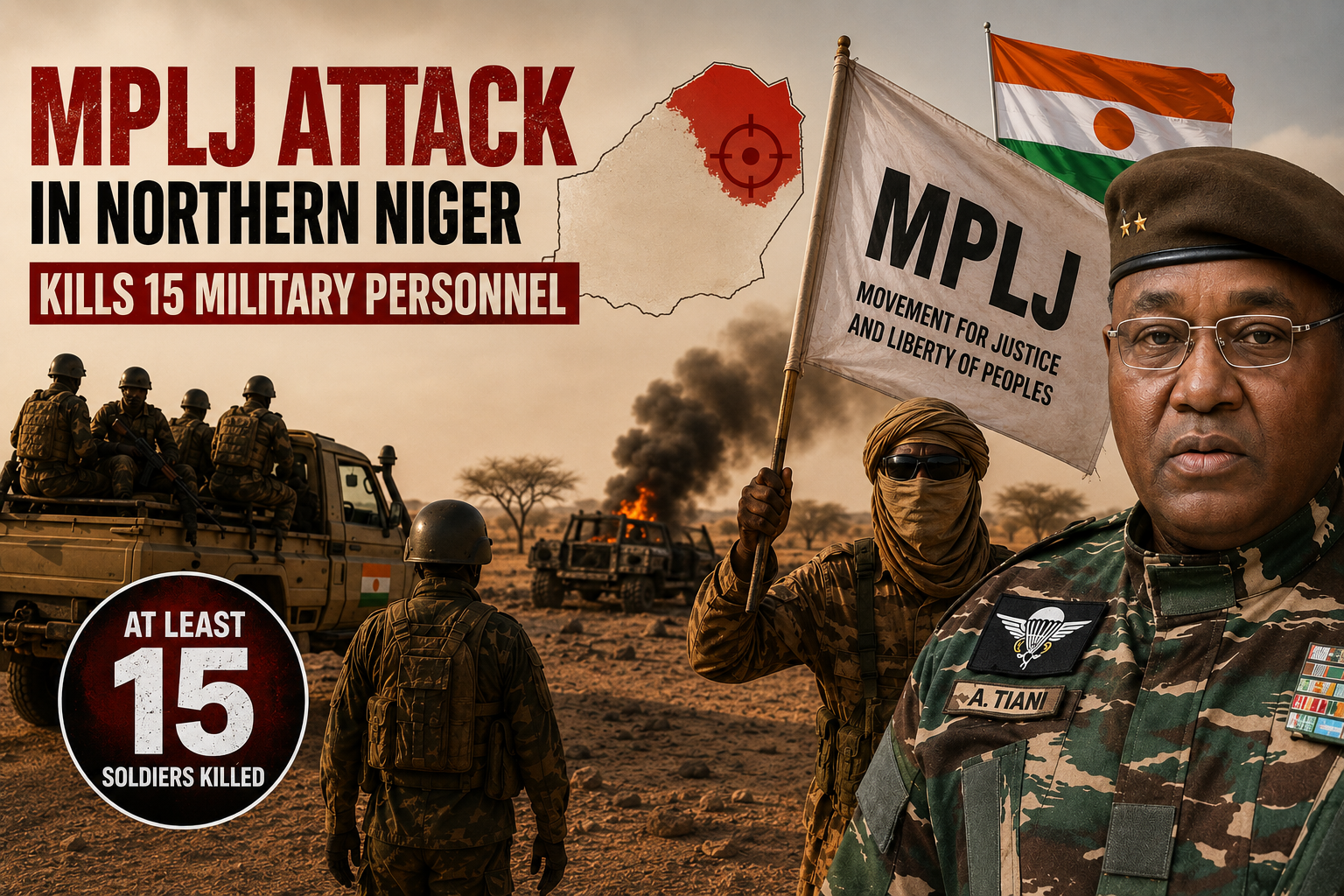
Since the July 2023 coup d’état, Niger’s military rulers have championed a sovereignist narrative, promising to break with past security policies and forge new partnerships. Yet the recent double attack in the north, claimed by the Mouvement pour la Justice et la Liberté des Peuples (MPLJ), which killed at least 15 soldiers, exposes a harsh reality: the junta led by General Abdourahamane Tiani is struggling to fulfill its most fundamental duty—protecting its citizens and asserting state authority across its vast territory.
The attack underscores a critical weakness in Niger’s security apparatus: its inability to effectively control the country’s expansive desert and border regions. With long frontiers shared with nations grappling with armed threats themselves, these areas offer fertile ground for militant groups to regroup, strike, and vanish before security forces can respond. The incident is not an isolated tragedy but a symptom of deeper structural flaws in a security strategy that remains overly reliant on reactive military responses rather than proactive measures.
Defense Failures Exposed in Remote Zones
Niger’s security challenges are compounded by its geography. The country’s vast, sparsely populated northern regions are notoriously difficult to monitor, providing ample cover for armed factions to operate with near impunity. The MPLJ’s ability to conduct coordinated assaults in such terrain raises serious questions about the operational capacity of the Nigerien armed forces. While the military has historically depended on immediate tactical responses, combating insurgent threats demands more: robust intelligence gathering, consistent administrative presence, cross-border cooperation, and the ability to prevent militant groups from establishing permanent footholds.
The attack in the north is the latest in a series of setbacks that have eroded public confidence in the military’s ability to safeguard lives. For citizens living in these vulnerable zones, the concern is not theoretical—it is immediate and existential. The promise of restored security, central to the junta’s legitimacy, rings hollow when communities continue to endure violent incursions without meaningful protection.
Diplomatic Shifts Fail to Translate into Security Gains
The military government has invested heavily in reshaping Niger’s foreign alliances, severing ties with former partners like France and the Economic Community of West African States (CEDEAO), while forging new strategic relationships. Yet these diplomatic pivots have yet to yield tangible security improvements. As the junta searches for new scapegoats—whether regional neighbors or erstwhile allies—it risks obscuring the core issue: the absence of a coherent, long-term security doctrine capable of addressing the multifaceted threat posed by armed groups.
The failure to curb insurgent violence suggests that sovereignty cannot be measured solely by rhetorical defiance of foreign influence or the signing of new defense agreements. True sovereignty demands tangible results: the protection of citizens, the effective control of territory, and the restoration of state presence in areas where armed groups currently operate with impunity. The junta’s focus on geopolitical posturing has, so far, done little to address the day-to-day security concerns of Niger’s population.
Security Crisis Demands More Than Blame-Shifting
The losses suffered in the MPLJ attack should prompt a comprehensive reassessment of Niger’s security architecture rather than a futile search for external culprits. Military operations in such a complex environment require coordination across multiple fronts: timely intelligence, robust logistical support, clear command structures, and adequate aerial and ground capabilities. Equally critical is a political strategy that aligns military action with long-term stabilization goals.
Isolation from regional partners further exacerbates these challenges. While tensions with neighboring states may offer short-term political dividends, they undermine the very cooperation needed to combat transnational threats. Insurgent groups in the Sahel thrive in the gaps created by fractured alliances, exploiting porous borders to regroup and launch attacks. A security strategy built on confrontation rather than collaboration is destined to fail.
Toward a Sustainable Path Forward
The persistent violence in Niger’s northern territories serves as a stark reminder that security cannot be achieved through slogans alone. The military government must confront the reality that restoring order requires more than denunciations of foreign interference or the cultivation of new alliances. It demands institutional strength, a clear national strategy, pragmatic regional cooperation, and an administrative presence that extends even into the most remote regions.
For stability to take root, Niger must also address the underlying governance crisis. The breakdown of constitutional order has left a void that armed groups have exploited. A prompt return to democratic rule is not merely a political ideal—it is a practical necessity. Only through legitimate institutions can Niger secure the alliances and resources needed to tackle the terrorist threat effectively. The MPLJ attack is a tragic illustration of what happens when the state fails to protect its people. The question now is whether the junta will heed the warning and act decisively to reverse the tide before more lives are lost.