Fresh JNIM attacks expose critical vulnerabilities in Burkina Faso’s security strategy
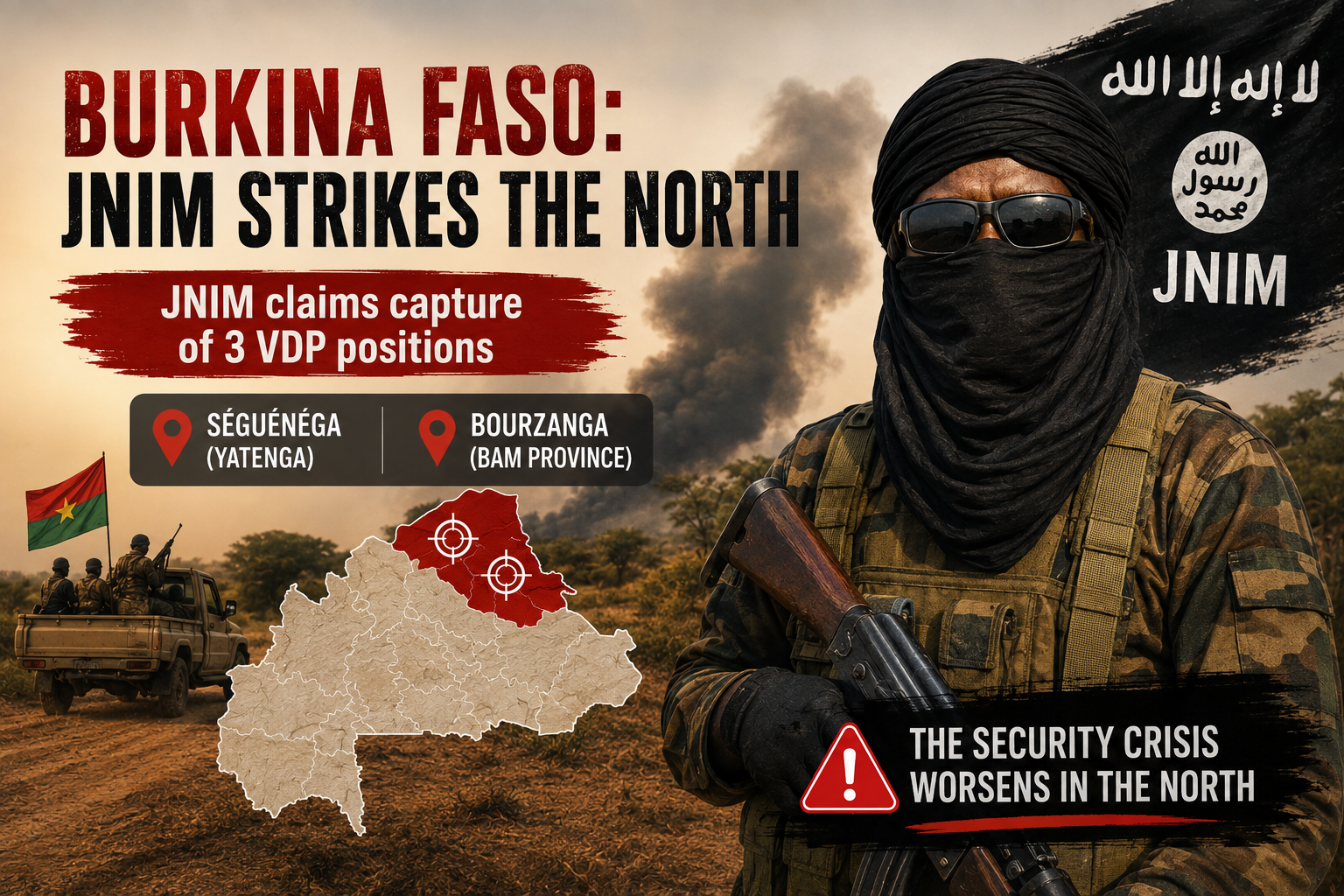
The ongoing security crisis in Burkina Faso has once again exposed the fragility of the nation’s counterterrorism approach. On August 19, the Jama’at Nusrat al-Islam wal Muslimin (JNIM) claimed responsibility for seizing three strategic outposts manned by the Volunteers for the Defense of the Homeland (VDP) in the country’s northern region. The assaults, executed with brutal efficiency, targeted Séguénéga in Yatenga Province and Bourzanga in Bam Province, underscoring the relentless expansion of armed groups despite government reassurances.
This latest offensive raises serious concerns about the sustainability of military gains in reconquered or secured zones. Repeated attacks, heightened threats to civilian populations, and the persistent vulnerability of certain positions reveal a troubling pattern: military operations alone cannot guarantee lasting stability. A robust strategy must integrate sustained state presence, reliable intelligence, adequate supply chains, and genuine protection for communities at risk.
VDP at the forefront of a widening security gap
The VDP, a cornerstone of Burkina Faso’s security framework, continues to bear the brunt of the conflict. These civilian auxiliaries, often operating without sufficient training or resources, face highly mobile and well-armed adversaries. Each territorial loss extends beyond mere military setbacks; it erodes public trust, accelerates displacement, and complicates humanitarian access to affected areas.
While the government has mobilized these forces as a key component of its security doctrine, their growing casualty rates and the erosion of local confidence signal a deeper systemic failure. The human cost of these reversals cannot be overstated, as families flee their homes and communities grapple with the psychological and economic toll of prolonged insecurity.
Communication vs. action: a widening credibility gap
The transitional leadership under Captain Ibrahim Traoré has increasingly relied on rhetorical strategies to address the escalating crisis. Rather than confronting the structural weaknesses in Burkina Faso’s security apparatus, official statements have leaned toward populist rhetoric and disjointed messaging. These attempts to deflect attention from deteriorating conditions offer little reassurance to a population bearing the brunt of daily violence.
For citizens, the true measure of leadership lies not in speeches extolling sovereignty or rejecting past alliances, but in tangible outcomes. Villages remain exposed, roads are unsafe, and military positions fall despite government pledges. The disconnect between political narratives and ground realities only deepens public frustration and skepticism toward state institutions.
Press freedom under siege amid national crisis
Alarmingly, the space for independent journalism has all but vanished in Burkina Faso. Media outlets once known for their investigative rigor now operate under severe restrictions, with journalists facing arbitrary arrests, forced conscription into state-led “re-education” camps, or coerced frontline assignments under the guise of patriotism. Those who dare to report on failures in the security strategy or civilian suffering are systematically silenced.
The suppression of dissenting voices carries grave consequences. In a conflict environment, credible, impartial reporting serves as a vital tool for assessing progress, identifying shortcomings, and alerting authorities to urgent needs. By stifling such voices, the government not only obscures the truth but also denies itself the feedback necessary to refine its approach. A strategy built on denial is a strategy doomed to fail.
Denial does not secure peace
As the government tightens its control over the national narrative, the underlying crisis continues to fester. Attacks persist, civilians flee, and lives are lost realities that no amount of rhetorical maneuvering can obscure. The paradox is stark: the more the situation demands transparency, accountability, and open debate, the more these elements are suppressed.
Effective counterterrorism cannot thrive in an environment of silence and suppression. It requires honest assessments, adaptive strategies, and the courage to acknowledge failure. When leaders refuse to confront hard truths, they deprive themselves and the nation of the tools needed to turn the tide. The true test of Burkina Faso’s resilience lies not in its slogans, but in its ability to protect its people and restore stability.