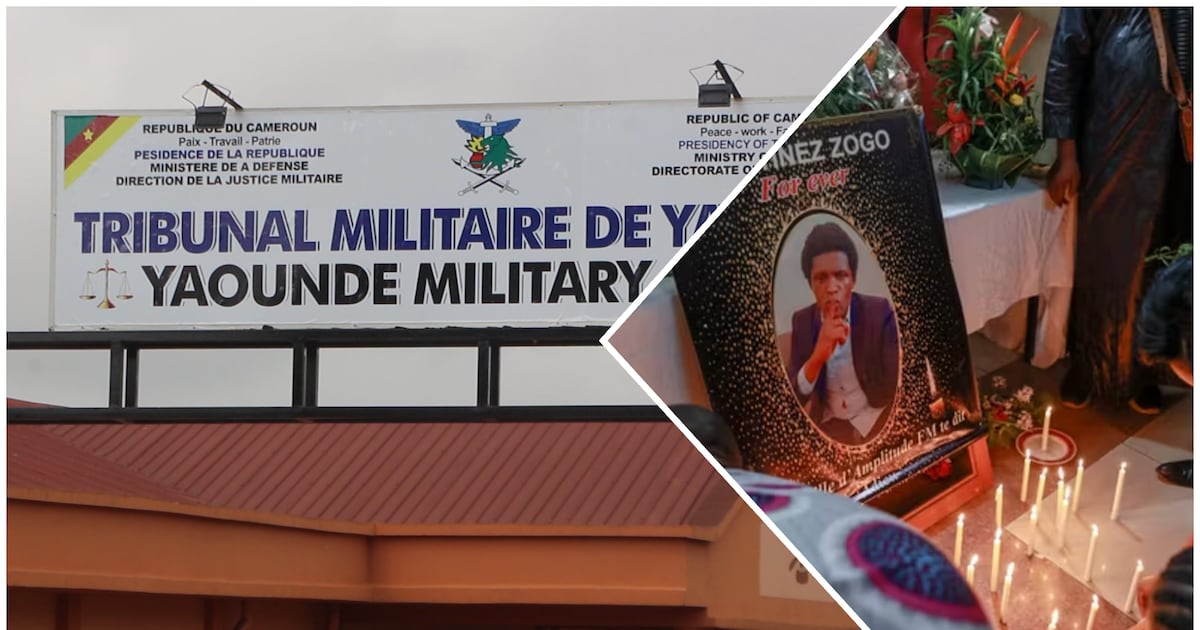
In a historic and emotionally charged courtroom session held on June 1 and 2, 2026, the Military Tribunal of Yaoundé witnessed a pivotal moment in the trial surrounding the tragic assassination of investigative journalist Martinez Zogo. The proceedings took a dramatic turn with the presentation of irrefutable digital evidence, meticulously analyzed by forensic expert Professor Georges Bell Bitjoka, the 32nd witness for the prosecution.
The expert’s role centered on examining the digital devices and online accounts of the accused. His investigation led to the discovery of a chilling video—housed in a Google Cloud account belonging to one of the suspects—depicting the final moments of Martinez Zogo’s life. The footage, along with other graphic material, was publicly screened during the first day of hearings, leaving the room in stunned silence and deep distress.
The video and images exposed the harrowing ordeal endured by Martinez Zogo. The journalist was shown bound, bloodied, and visibly traumatized, with his left ear partially severed, pleading for mercy from his captors. The visual evidence underscored the brutality of his final hours and the sheer horror of his final moments.
Forensic breakthroughs link suspects to the crime
Professor Georges Bell Bitjoka provided damning testimony, confirming that the incriminating files were extracted directly from the Google Cloud account of Maréchal des logis Godje Oumarou Vincent, a former agent of the Directorate General of External Research (DGRE) who is currently evading justice. The expert’s findings also revealed a web of communications implicating Justin Danwe, the former head of DGRE operations, in orchestrating the operation. Additionally, a financial trail was uncovered, with a transaction of 35 million CFA francs surfacing during the trial.
Further analysis suggested that while 30% of data from one suspect’s device and 18% from another showed no direct technological link, a significant portion of conversations between Léopold Maxime Eko Eko, the former DGRE director, and businessman Jean-Pierre Amougou Belinga had been deliberately erased. This obstruction raised serious questions about the depth of their involvement and the lengths taken to conceal evidence.
Legal confrontation and procedural challenges
The second day of hearings on June 2, 2026, resumed under an atmosphere of palpable tension, as the court delved into a rigorous cross-examination of Professor Bitjoka by both the prosecution and defense teams. The expert maintained a steadfast position, clarifying that his role was strictly technical—focusing solely on the forensic analysis of the digital surfaces provided to him, devoid of personal opinions or legal judgments.
Defense attorneys challenged the methodology and thoroughness of the data extraction, while the legal representatives of Martinez Zogo’s estate voiced concerns over potential gaps in the investigation. Despite these objections, the forensic report was widely acknowledged as a groundbreaking milestone in uncovering the truth behind the journalist’s murder.
The Military Tribunal of Yaoundé adjourned the session late into the night of June 2, with the next set of hearings scheduled for June 22 and 23, 2026. These upcoming sessions are expected to delve deeper into the substantive aspects of the case, as the judicial process continues its painstaking pursuit of justice.