eastern DRC crisis: Burundi urges stronger international action amid ongoing violence
- Security
As current chair of the African Union and a key witness to the signing of the Washington Peace Agreement between Félix Tshisekedi of the DRC and Paul Kagame of Rwanda—facilitated by former U.S. President Donald Trump—Burundi has expressed deep concern that the initiative has failed to yield tangible results on the ground. Fighting continues unabated between government forces and the M23 rebel alliance, widely believed to be backed by Rwanda, in the eastern Democratic Republic of the Congo.
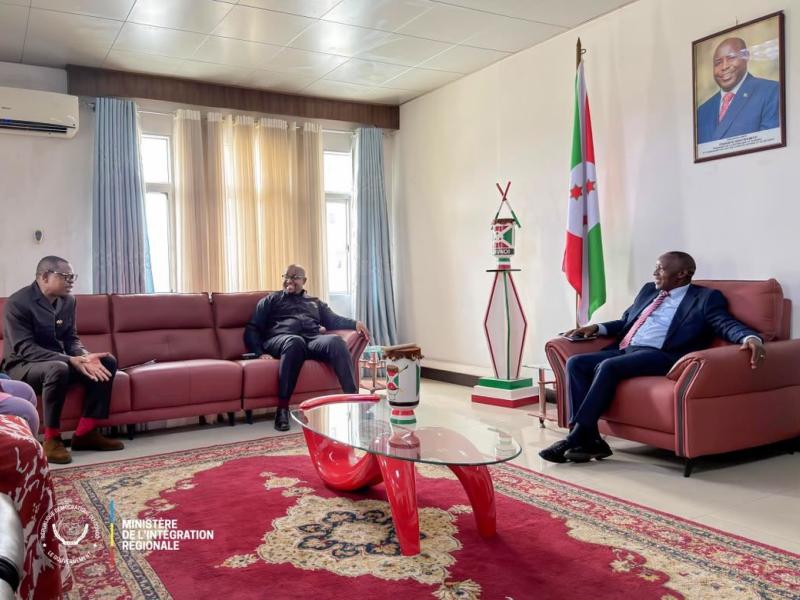
This sobering assessment was delivered by Burundian Foreign Minister Édouard Bizimana during a bilateral meeting with his Congolese counterpart, Floribert Anzuluni, Minister of Regional Integration, held on June 1 in Bujumbura. The Burundian official highlighted that while some displaced populations have returned home, many areas remain under persistent threat, necessitating a robust and sustained international response.
“Regarding peace and security in the region,” Minister Bizimana stated, “we deeply regret that the agreements signed between the DRC and Rwanda, with U.S. facilitation, have not been fully honored. While progress has allowed some refugees to return, other zones are experiencing a resurgence of violence, forcing renewed displacements into neighboring countries. There is an urgent need for stronger international involvement to support existing regional initiatives.”
During the same meeting, both ministers underscored the strong and positive bilateral ties between Burundi and the DRC, reaffirming their commitment to deepen diplomatic cooperation. Beyond the security situation in eastern DRC, the discussions covered a range of shared priorities, including the allocation of land for Burundi’s future embassy in Kinshasa, administrative matters concerning the Executive Secretariat of the International Conference on the Great Lakes Region (ICGLR), and preparations for the organization’s upcoming ordinary summit. The DRC currently holds the ICGLR chairmanship.
For his part, Congolese Minister Floribert Anzuluni praised Burundi’s diplomatic leadership, particularly its role in mobilizing humanitarian assistance for Congolese refugees hosted in Burundi. He also informed his counterpart that a Troika meeting is being organized to assess regional security dynamics and review member states’ statutory contributions to the ICGLR.
In a further show of regional solidarity, Burundian Foreign Minister Édouard Bizimana reiterated his country’s unwavering commitment to silencing the guns across Africa. This stance aligns with the objectives set by Burundian President Évariste Ndayishimiye during his acceptance speech upon assuming the African Union presidency, succeeding Angola’s João Lourenço.
In the Great Lakes region, Burundi and the DRC are strategic partners bound by a bilateral defense pact signed in March 2023. Faced with escalating insecurity in eastern DRC and what Kinshasa describes as Rwandan aggression through the M23 rebellion and allied factions active in South Kivu, Bujumbura has deployed thousands of troops to support the Congolese army (FARDC) and secure the shared border. This military alliance is rooted in multiple pillars of cooperation.
Despite the joint communiqué issued following the Montreux talks in Switzerland (April 13–17, 2026)—where representatives of the DRC government and the Alliance des Forces du Fleuve Congo/Mouvement du 23 mars (AFC/M23) met with delegates from the United States, Qatar, and Togo (as AU mediator)—the situation remains volatile. Mutual accusations of ceasefire violations and failure to honor commitments persist. Even the Washington process, despite ongoing negotiations, has stalled, as each party interprets the agreement’s terms differently, impeding progress toward lasting peace.
This diplomatic deadlock, observed by mediators including the United States and Qatar, continues to exacerbate insecurity in eastern DRC, where fighting shows no signs of abating.