Dr Congo takes Rwanda to world court over eastern conflict
The Democratic Republic of Congo has filed a case at the International Court of Justice against Rwanda, accusing it of backing armed groups—especially the AFC-M23—in the country’s eastern region.
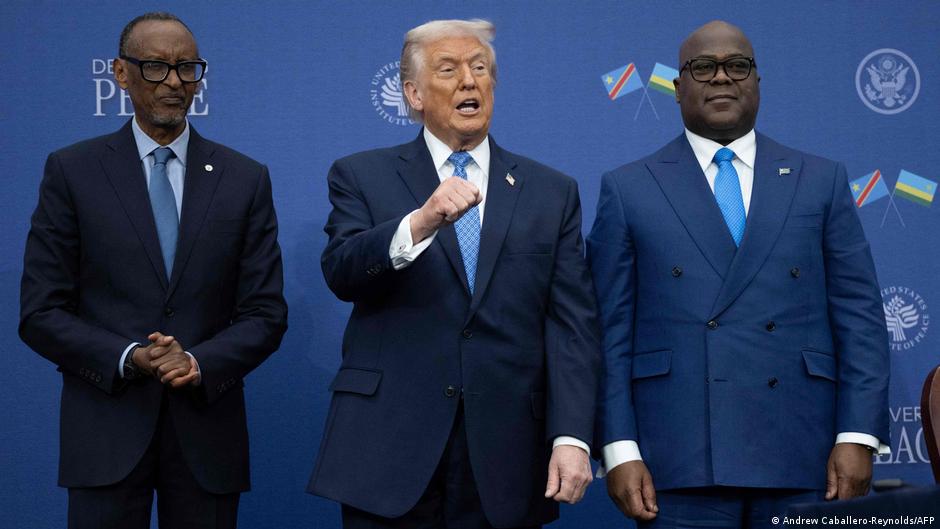
The legal action comes as June 27 marks exactly one year since both countries signed a peace accord in Washington aimed at ending the fighting in eastern DRC. Despite the agreement, clashes between Congolese forces and the Rwanda-backed AFC-M23 rebellion continue across the area.
In a separate move, the United States has imposed sanctions on several Rwandan officials accused of involvement in the illegal trade of minerals extracted from rebel-controlled territories.
Peace on paper, war on the ground
Kinshasa and Kigali had pledged to collaborate for peace in eastern DRC, where the AFC-M23 rebels have held vast stretches of Congolese land for over a year. Yet on the ground, no meaningful progress has been made.
“We expected that after the signing of this agreement, things would improve—banks would reopen, airports would resume. Sadly, we are still living the same misery,” lamented a resident of Bukavu, the capital of South Kivu province.
“We wonder whether the influence the United States once held still exists today. Why can’t the policy applied in the U.S. be applied toward our neighbours who are attacking us here in DRC?” questioned another Bukavu local. Another recalled: “Up to now, nothing works. When they meet, they show good intentions, but on the ground the war continues.”
Kigali under sanctions and legal scrutiny
Kinshasa accuses Rwanda of backing armed groups responsible for severe human rights violations in eastern DRC for roughly three decades.
The Congolese state has now taken the case to the International Court of Justice, demanding reparations for victims and recognition of Kigali’s responsibility.
For its part, the United States has imposed sanctions on Rwanda’s Gasabo Gold refinery, its leaders, and several mining companies accused of trafficking minerals from areas controlled by the AFC-M23 in eastern DRC.
Washington says the mineral trade finances the rebellion. However, some analysts believe these measures are ineffective.
“The general perception is that these sanctions do not appear sufficient to alter the strategic calculations of the involved actors. As long as the cost of confrontation remains lower than the cost of concession, the actors will maintain the status quo, which remains attractive to them,” said Yvon Muya, a conflict studies expert at Saint Paul University in Ottawa, Canada.
Preparing for a new military escalation
Peace remains distant as gunfire exchanges are nearly daily in several zones.
Professor Bob Kabamba from the University of Liège in Belgium believes the warring parties are instead bracing for another showdown.
“This is the time when each side tries to reorganize, rearm, and prepare for what could be called the final battle—to see whether the government side will succeed in reclaiming territories lost to the rebellion, or whether the rebellion will advance toward Katanga and thereby put the Kinshasa regime in difficulty,” he said.
For over a year, AFC-M23 rebels have occupied the cities of Goma and Bukavu, along with several other localities in North Kivu and South Kivu provinces. Ongoing clashes in the region are worsening the humanitarian situation for thousands of displaced people.