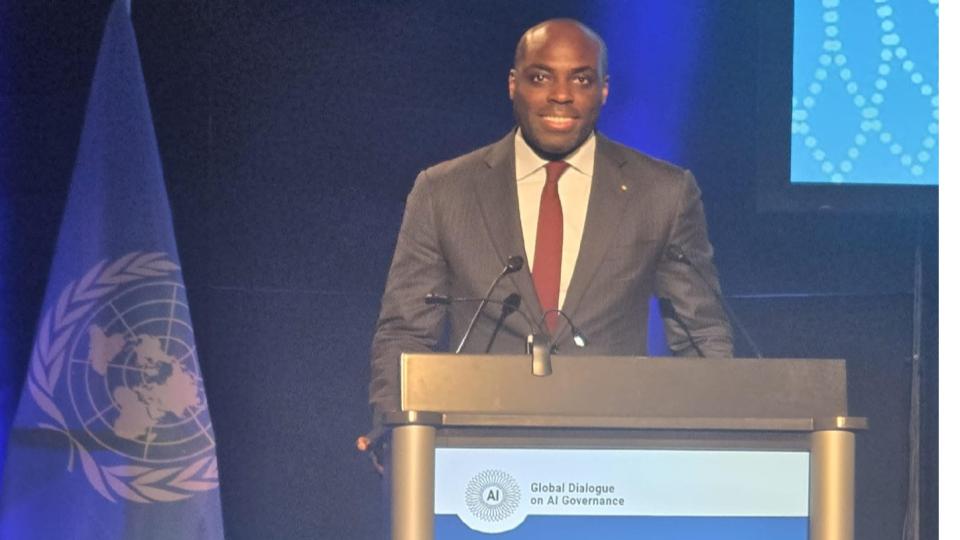
As the world’s superpowers engage in a frenzied race for algorithmic power, Gabon has chosen a different path. At the Global Dialogue on AI Governance in Geneva under the auspices of the UN, Mark Alexandre Doumba, Gabon’s Minister of Digital Economy, invited the international community to rethink its approach. For Libreville, the urgency is not to develop the fastest technology, but to build an accessible tool for all.
Facing giants of tech focused on size and computing capabilities, the minister offered a paradigm-shifting change. ‘It’s not about being first with AI; it’s about deploying AI widely,’ he emphasized.
According to him, the current frenzy is overlooking the essence. The real challenge is no longer technical but political and human: figuring out who will instate the necessary institutions and rules for responsible deployment. This vision puts governance and ethical discernment at the center of the table.
The Rise of ‘Petite IA’ and Local Impact
For Gabon, the future of this technology lies in transitioning from ‘large AI’ to specialized solutions adapted to local realities. This is what Mark Alexandre Doumba calls ‘petite IA’. ‘The boundary isn’t about having ever-larger models; it’s about adaptation at a local level,’ he highlighted.
Whether it’s optimizing crop yields, modernizing public services, or improving access to healthcare, the added value will be measured by concrete benefits for populations in the South, often relegated to the role of passive consumers of imported technologies.
Rethinking the System to Avoid a New Fracture
Beyond the technical tool, the minister sees AI as a powerful driver of systemic transformation. It should not just optimize existing systems but push for a redrawing of economic and social rules to favor inclusion.
As humanity boasts an unprecedented financial and technological capital, the risk of a new global fracture remains major. In conclusion, the Gabonese envoy warned: without collective willingness to share these innovations equitably, the gap between creators and users of AI will become the new dividing line of the 21st century. Success won’t be measured in processing power but in improved human lives.