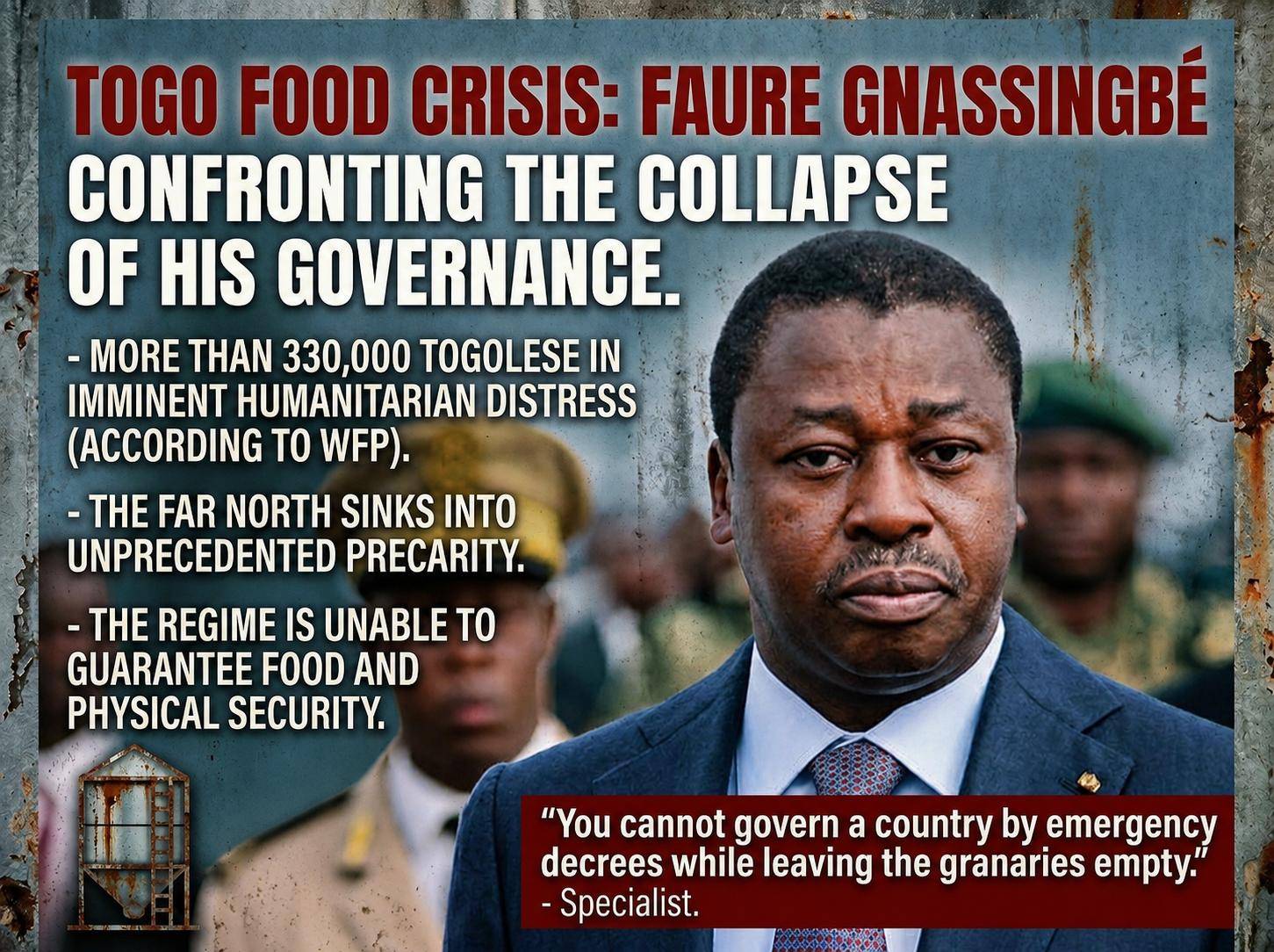
The humanitarian crisis unfolding in the northern regions of Togo has exposed glaring deficiencies in the governance model led by President Faure Gnassingbé. As international aid agencies issue urgent warnings, the Savanes region faces an unprecedented collapse in food security, with projections indicating that over 330,000 citizens could soon face acute hunger.
An escalating humanitarian emergency
The World Food Programme has classified the situation as dire, predicting that without immediate intervention, nearly a third of a million people in Togo will be unable to meet their basic nutritional needs within the coming months. This stark projection underscores not merely a seasonal scarcity but a systemic failure to address the structural vulnerabilities plaguing the country’s most marginalized communities.
The northern frontier: trapped between neglect and insecurity
The Savanes region, bordering Burkina Faso, has borne the brunt of this crisis. Once already struggling with entrenched poverty, it now confronts a compounded emergency triggered by both climate-induced shortages and a deteriorating security climate. The government’s prolonged emergency measures, rather than alleviating the crisis, have exacerbated economic stagnation by disrupting cross-border trade and displacing thousands of families.
Refugees fleeing violence in neighboring Burkina Faso have further strained local resources, pushing communities already on the brink into deeper deprivation. As food reserves dwindle ahead of the lean season, the coping mechanisms of households—already fragile—are nearing collapse. Markets remain inaccessible, prices surge, and the state’s inability to intervene has left populations entirely dependent on external aid.
A governance failure at the highest level
Analysts argue that the crisis is not an unforeseen catastrophe but the direct consequence of policy missteps and institutional neglect. Despite repeated commitments to agricultural resilience and food security, the reality in the Savanes is one of systemic abandonment. Official rhetoric has not translated into tangible support, leaving half of the households in the region unable to afford even the most basic meals.
The government’s approach has relied heavily on military-led responses and emergency decrees, measures that have proven ineffective in restoring stability or ensuring food availability. Critical gaps persist in storage infrastructure, price regulation, and agricultural support, rendering the state’s response inadequate to the scale of the emergency. In essence, Togo’s northern population has been left to fend for itself in a crisis that demands decisive leadership.
A regional policy expert commented, “Ruling through decrees alone cannot fill empty granaries. What is unfolding in the North is not merely a security failure—it is the visible cost of economic abandonment.”
The moment for decisive action
With the next harvest season months away, the coming weeks will be decisive in averting a full-blown humanitarian disaster. The international community’s urgent appeals for funding highlight the immediacy of the threat, but they also raise a fundamental question: how long can Togo continue to rely on external charity to compensate for the shortcomings of its own policies?
For the 330,000 Togolais teetering on the edge of hunger, time has run out for rhetoric. Their survival now depends on urgent, concrete measures—before the crisis deepens into a catastrophe that will be far harder to reverse.