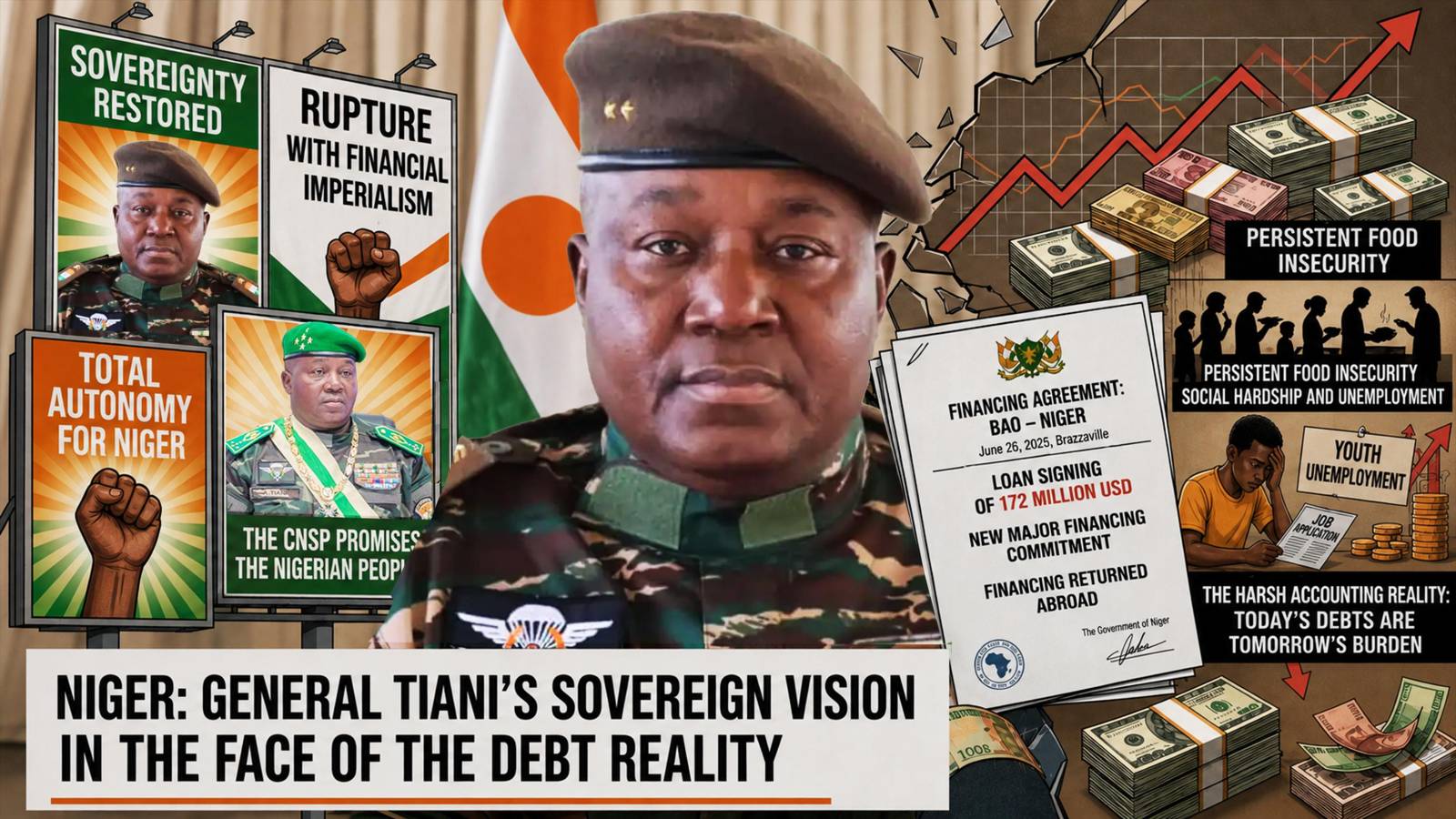
In Niamey, the once-passionate rhetoric surrounding the “restoration of sovereignty” and the definitive break with international financial institutions has collided with the unyielding reality of economic constraints. Despite the National Council for the Safeguarding of the Homeland (CNSP), led by General Abdourahamane Tiani, vowing total autonomy and a brighter future for Nigeriens, tangible actions have starkly contrasted with these declarations. Faced with escalating social distress and an inability to meet basic public needs, the military regime has once again resorted to external borrowing to prop up the faltering economy.
A stark reality overshadows political declarations
The discrepancy between lofty promises and ground-level realities is becoming increasingly apparent. While authorities in Niamey champion an economic model free from external influence, the government’s actions reveal a different narrative. The latest evidence emerged not within Niger’s borders, but at a high-profile international forum, underscoring what many now recognize as a widening gap between words and deeds.
Financial agreements: from ideological posturing to practical necessity
On the sidelines of the African Development Bank (AfDB) Annual Meetings in Brazzaville, Niger quietly finalized a significant financial arrangement. The agreement, signed between Sidi Ould Tah, representing the AfDB, and Maman Laouali Abdou Rafa on behalf of Niger, secured a $172 million funding package. Officially, these funds are earmarked for initiatives to bolster youth entrepreneurship in agriculture, modernize the sector through technological and financial innovation, and cultivate new value chains amid pressing food security and climatic challenges.
Yet for the average Nigerien, the irony is unmistakable. How can a regime advocating economic self-reliance reconcile its policies with the persistent need for external financing? Regional analysts and an expanding segment of public opinion are reaching a shared conclusion: the sovereignist transition narrative increasingly appears to be a political facade concealing an economic strategy in disarray.
Daily life versus political promises
The chasm between official propaganda and the lived experiences of Nigeriens grows deeper by the day:
- Chronic food insecurity: Despite official slogans celebrating self-sufficiency, household resilience continues to erode under the weight of inflation and supply chain disruptions.
- Economic stagnation: The much-anticipated economic opportunities for the youth remain elusive, leaving a generation mired in unemployment and dashed expectations.
- Dependence on external credit: The necessity to secure multi-million-dollar loans exposes the government’s inability to fund its developmental ambitions using domestic resources alone.
« The discourse speaks of dignity and the end of foreign dependence, yet the documents signed abroad reveal a regime that cannot survive without external funding, » remarked an economist from the subregion, speaking on condition of anonymity.
From ideological stance to pragmatic necessity
By accepting the $172 million loan, the CNSP implicitly acknowledges its failure to independently address the pressing climate-induced agricultural and food security crises gripping the nation. While agricultural development and financial inclusion for young people are undeniably critical priorities for Niger, the reliance on external debt under General Tiani’s leadership highlights the structural limitations of a governance model isolated from regional and international cooperation.
For citizens, the pressing concern is no longer rhetorical declarations but tangible realities: meals on the table and money in their pockets. As Niamey’s authorities frame every agreement as a triumph, the arithmetic of debt reveals a stark truth. Today’s borrowings will translate into tomorrow’s financial burdens, far removed from the illusion of total economic independence once promised.