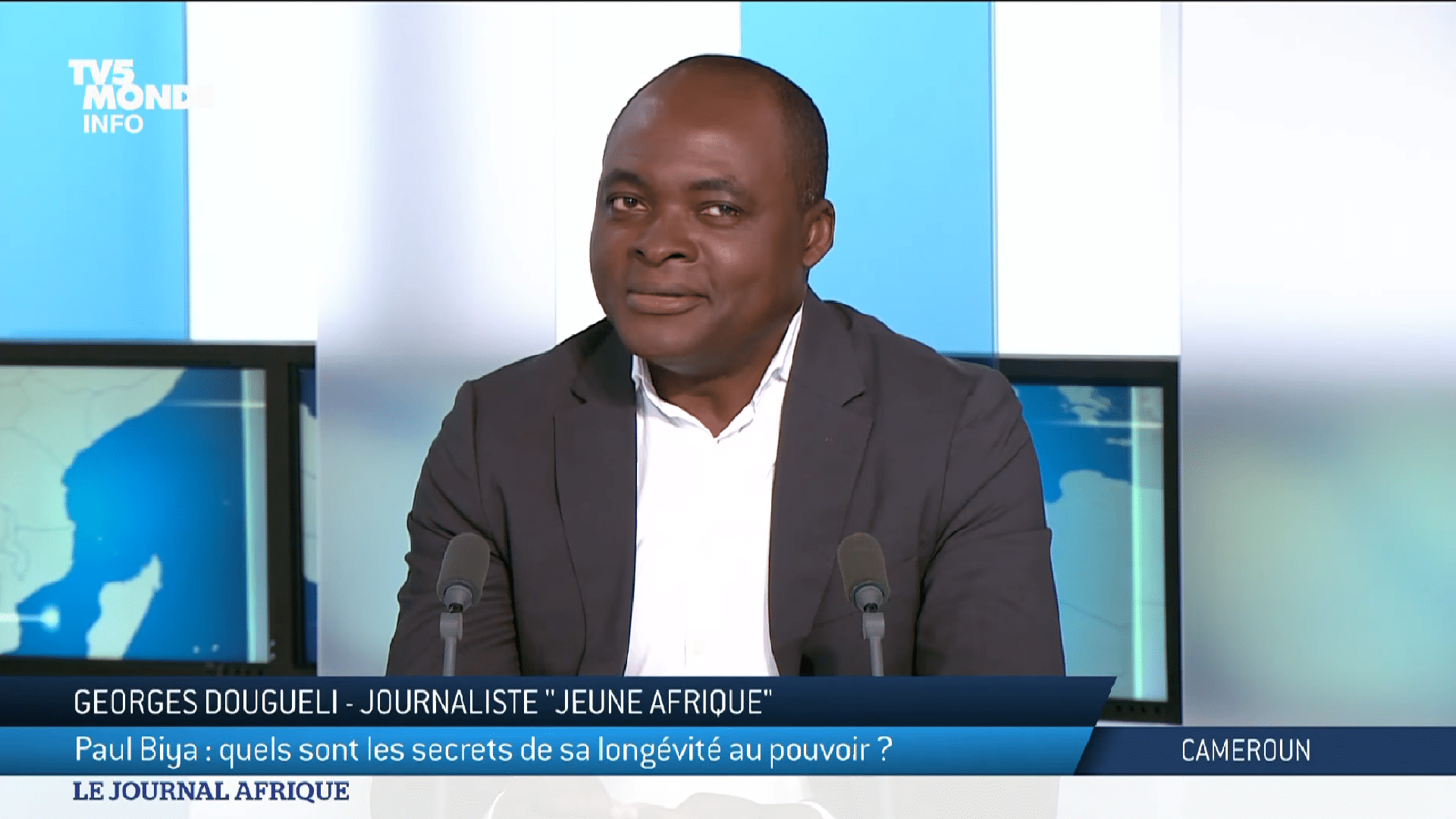
In a recent opinion piece, journalist Georges Dougueli, writing for a prominent pan-African publication, firmly reminded the Vice-Rector of the University of Yaoundé II that the essence of journalism often involves legitimate speculation.
Georges Dougueli directly addressed the recent televised comments by Owona Nguini, specifically the assertion: “Dougueli speculates on the death of President Biya.” Dougueli noted that this particular remark, aired on June 26, was among several “outrageous” statements that flooded his communications. He challenged the underlying implication, asserting that “speculating” about the health or potential passing of heads of state is an integral aspect of his journalistic duties. True journalists, he argued, consider no topic off-limits. He even highlighted the practice of newsrooms preparing obituaries for notable individuals in advance of their actual demise.
Drawing on historical precedent, Dougueli recalled that former French President François Mitterrand, who held a somewhat critical view of the media, famously referred to journalists as “dogs.” Any astute political figure, Dougueli contended, must endure this “pack.” He suggested that President Biya is well aware of this reality, unlike perhaps the zealous elements within the security apparatus whom Owona Nguini seemingly intends to involve. Dougueli emphasized that one cannot credibly chronicle the affairs of the state without scrutinizing the well-being of its leaders. At this juncture, he pondered the true audience of Owona Nguini’s diatribe against him, suggesting a brief sociographic sketch of the target public for this television “mystifier.”
1- Is he addressing “Ekang” supremacists?
This line of inquiry delves into the political arena where Owona Nguini operates, carelessly manipulating hazardous and incendiary concepts. When he repeatedly proclaims “I am a lord,” some dismiss it as mere infantile megalomania. However, this overlooks the profound influence of Laburthe Tolra on his “thought.”
It was Owona Nguini who misappropriated and popularized the “Ekang” concept, derived from the Mvett mythology. According to the French anthropologist Laburthe Tolra, the Ekangs, known as “Lords of the Forest,” are believed to have descended from the banks of the Nile to colonize the equatorial forest.
Taking the French researcher’s theories literally, Owona Nguini is convinced that this population, which migrated to Gabon, Equatorial Guinea, and Congo, is destined to govern these territories. In Gabon, where the Fangs (40% of the population) are deeply rooted in this Mvett culture, notably through the works of Tsira Ndong Ntoutoume, the peril of this “Ekang” supremacist singularization has been recognized. This manifested during the 2009 presidential election as the “TSF” (Tout sauf les Fangs – Anything but the Fangs) movement, reflecting a rejection by the non-Fang population. Thus, the “Ekang” concept did not extend beyond Cameroon’s southern border. What then is the connection to Fecafoot? The answer lies in Owona Nguini’s approach, much like Karl Schmitt’s: politics, for him, is about identifying an enemy. Yesterday, it was the “Ntaalibams” of “Tonton Maurika.” Today, the designated adversary is the “reserve” supposedly formed by the “Eglisiens,” fanatics who “will create problems.” How? For whom? Why? This marketplace Mephisto must clarify. Conversely, I am certain that, given the unfolding circumstances, this professional intellectual-academic agitator, possessing the subtlety and restraint of a bull in a China shop, will ultimately be the one to create genuine problems in African politics English discourse.
2- He addresses the governing caste against the rabble
Who could genuinely believe that all supporters of Samuel Eto’o, considering the unprecedented harassment he has endured since 2021, are merely “brainless” individuals or paid henchmen? By launching an attack against the “illiterate” of Fecafoot, his “flock,” his “ignorant fanatics,” and his “cybernetic pack,” this agitator attempts to rally the educated elite against the perceived threat from the common people.
He constructs a narrative of “brains” versus “brawn.” To establish the moral of this fable, Owona Nguini – and the faction he champions – seeks to portray Eto’o as a “cancer.” The objective is to insult and degrade him until a “symbolic death” ensues. Through this symbolic “murder,” perhaps this clan, whose image has been tarnished by poor governance, rampant corruption, political crimes, and decadent morals, might finally be rehabilitated.
The aim is to put the “illiterate” populace back in its place, even if it means stripping said populace of its sovereignty in the face of the monarch’s will, through the abusive application of “high instructions” fallaciously elevated to the highest level of legal norms.
I leave the deeper analysis of Owona Nguini’s statements to others, specifically constitutionalists, political scientists, psychosociologists, or psychoanalysts.
Related Posts
Burkina Faso under captain Ibrahim Traoré: evaluating the economic narrative amid skepticism
Since seizing power, Captain Ibrahim Traoré has emerged as a prominent figure in African sovereignism, leveraging an assertive communication strategy and a robust presence across […]

Burkina Faso’s russian partnership: promises and contradictions
The Burkinabè authorities have consistently framed their growing ties with Russia as a strategic alliance built on mutual respect and unconditional cooperation. Since Ouagadougou’s pivot […]

Benin’s president redefines justice with a historic act of clemency
By granting freedom to a man condemned to two centuries of incarceration, President Romuald Wadagni has done more than simply issue an act of grace. […]