The political landscape across several African nations, particularly within the Sahel States Alliance (AES), has in recent years been dominated by highly symbolic public demonstrations. Frequently, these gatherings feature Russian flags prominently displayed alongside fervent chants in support of Moscow. For a vocal segment of activists, the Russian Federation has become the indispensable alternative to long-standing Western powers, portrayed as the sole path to true sovereignty.
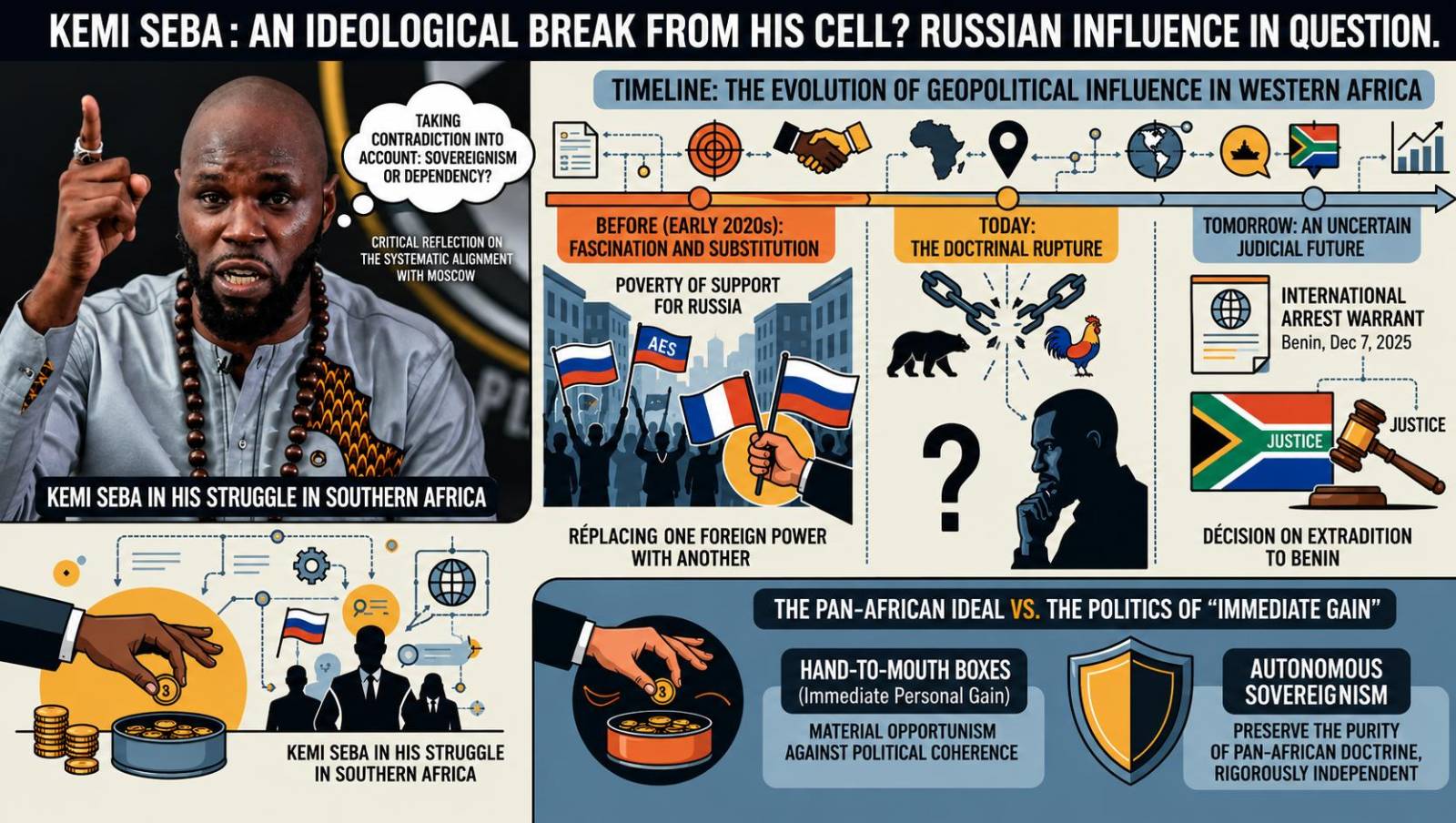
Yet this growing enthusiasm has raised fundamental questions, especially when it emerges from movements that claim to advocate absolute independence. Now, from a prison cell in South Africa, one of today’s leading voices in Pan-African thought, Kemi Seba, appears to be undertaking a significant ideological shift—one that challenges the very foundations of this pro-Russian momentum.
From sovereignty to new dependency: the illusion of change
While seeking new international partnerships is a legitimate diplomatic strategy for any state or political movement, replacing one foreign influence with another risks exposing deeper contradictions. Observers widely argue that shifting allegiance from France to Russia does not signify true emancipation but merely transfers the axis of dependency. It is in this light that Kemi Seba’s current reflections must be understood.
The panafricanist ideologue has begun to critically assess the limitations of an unconditional alignment with Moscow. His stance rejects outright the notion of endorsing any new form of protectorate, however anti-Western it may claim to be. This position signals a potential turning point in how Pan-African movements perceive external alliances.
The clash between idealism and short-term gains
The growing divide within sovereignist circles becomes apparent when examining the motivations behind pro-Russian sentiment. While some genuinely seek a geopolitical rupture, others appear driven by more immediate material interests rather than ideological conviction.
Kemi Seba has publicly opposed this opportunism, which he critiques using the vivid metaphor of ‘filling the stew pot’—a reference to the pursuit of quick personal gain, ‘filling one’s belly,’ at the expense of long-term political integrity. By rejecting this mercenary logic, he seeks to uphold the doctrinal purity of a Pan-Africanism that demands absolute autonomy.
A fate decided in Pretoria’s courts
This period of ideological introspection coincides with a precarious personal situation for the activist. Following a failed coup attempt on 7 December 2025, the government of Benin issued an international arrest warrant for Kemi Seba. He is currently detained in South Africa, where the Pretoria judiciary is set to rule on Cotonou’s extradition request.
The activist’s future is no longer shaped solely by ideological debates but by the outcome of judicial proceedings. The upcoming court decision may determine whether this moment marks a definitive rupture in Pan-African discourse—or merely a reconfiguration of alliances. In either case, the coming weeks will be decisive not only for Kemi Seba’s political trajectory but also for the direction of the movements he has inspired.