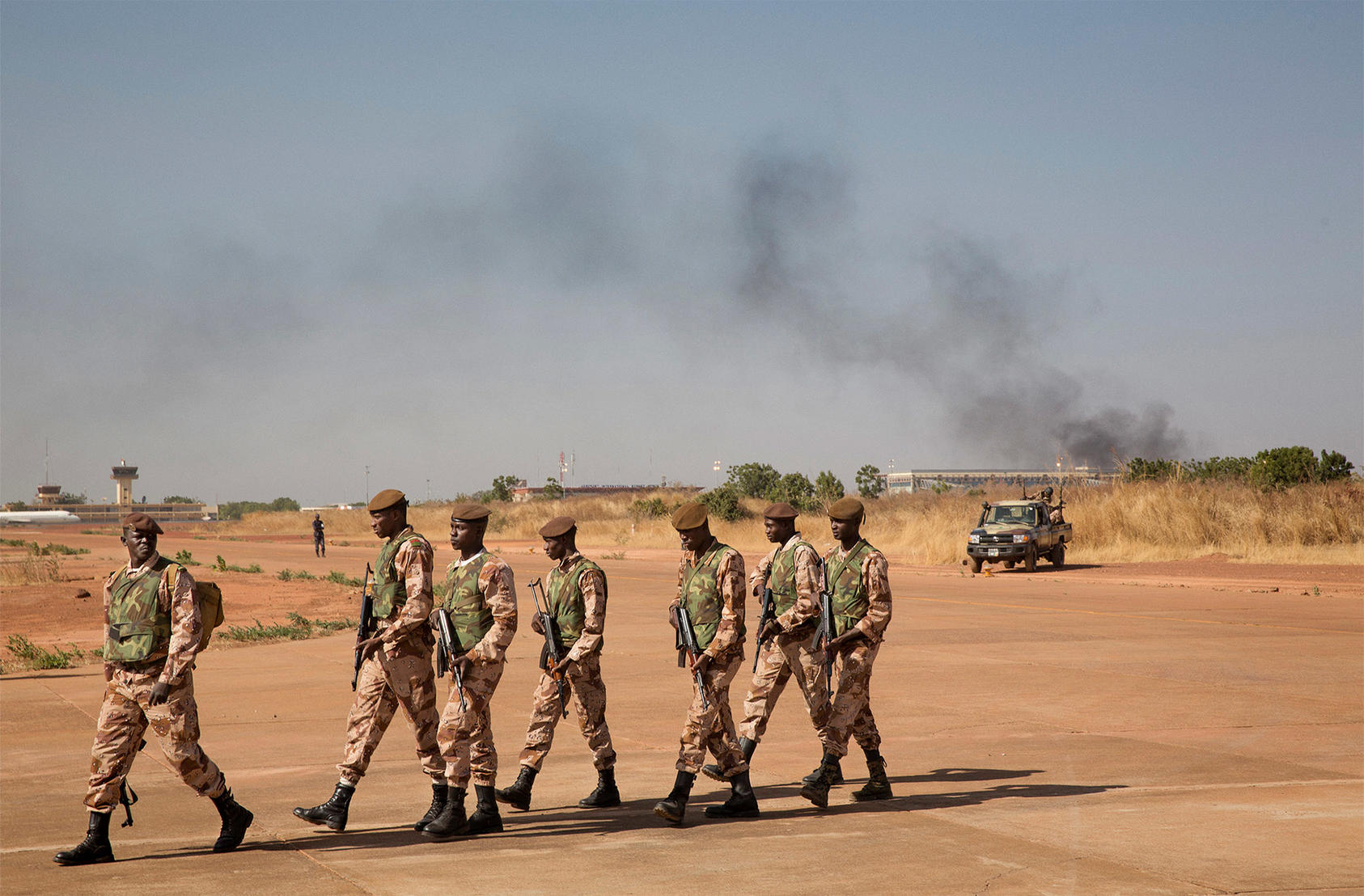
The West African nation of Mali is facing one of its most critical security crises in recent history. A coordinated offensive by Touareg rebel factions and Islamist militants has severely challenged the military junta and its allies, including Russian paramilitary forces. This unexpected alliance has launched simultaneous attacks across seven key cities, reshaping the conflict’s dynamics.
coordinated assaults target malian strongholds
The offensive, which began in the early hours of a Saturday morning, saw coordinated strikes by the Front de Libération de l’Azawad (FLA) and the Jama’at Nusrat al-Islam wal Muslimin (JNIM), an Al-Qaeda affiliate. Major urban centers including Bamako, Kati, Konna, Mopti, Sévaré, Gao, and Kidal were targeted. The northern city of Kidal, a strategic military bastion, fell entirely under insurgent control after intense fighting.
Militants deployed a range of tactics, including vehicle-borne improvised explosive devices (VBIEDs), improvised explosive devices (IEDs), kamikaze drones, indirect fire, and direct assaults on military positions. According to multiple sources, the attacks began at approximately 5:30 AM local time, with simultaneous claims of responsibility from both the JNIM and the FLA. Key targets included the presidential residence, the Ministry of Defense, and the Modibo Keïta International Airport in Bamako, as well as military installations in Kati, Gao, Kidal, and Sévaré.
military response and civilian impact
Chief of Staff of the Malian Armed Forces, General Oumar Diarra, described the attacks as a « coordinated destabilization plan orchestrated by internal and external actors », aimed at creating permanent insecurity. The government reported 16 wounded among civilians and military personnel, while also claiming the situation was « fully under control ». A 72-hour curfew was imposed in Bamako, and the international airport remained closed the following day.
General Diarra confirmed that over 200 enemy combatants had been neutralized, with ongoing mop-up operations in several regions. Regarding Kidal, he acknowledged a challenging situation but insisted that the army was regrouping and maintaining a presence in the area, emphasizing operational flexibility to protect civilian populations.
russian paramilitary forces withdraw from Kidal
The African Corps, a Russian paramilitary unit that has taken over Wagner Group operations in Africa, announced a coordinated withdrawal from Kidal with Malian forces. The move followed a joint decision with Bamako authorities, citing the need to regroup and evacuate wounded soldiers and heavy equipment. The Corps claimed to have played a decisive role in repelling simultaneous attacks across multiple cities.
The African Corps also alleged it had foiled a coup attempt involving the FLA and Al-Qaeda’s Sahel branch, with alleged support from Ukrainian and European mercenaries, as well as Western intelligence services. According to their statement, between 10,000 and 12,000 fighters participated in the assault targeting Bamako, Kati, Gao, Kidal, and Sévaré. The group claims to have secured the presidential palace, maintained control over strategic positions and airports, and neutralized over 1,000 jihadists while destroying more than 100 vehicles. Despite these claims, reports indicate some wounded fighters are being evacuated, and the military situation remains fluid.
high-profile casualties and political fallout
The offensive has resulted in significant losses for the junta. Defense Minister Sadio Camara, a key figure in Mali’s transition and a close ally of interim President Assimi Goïta, was killed during the assault on his residence in Kati. A car bomb exploded at his home, leading to a firefight in which he was fatally wounded. His death, along with that of civilians and destruction of nearby infrastructure, has sent shockwaves through the military leadership.
Other high-ranking officials were also affected. The head of the National Agency for State Security, Modibo Koné, was injured in the attack, while President Goïta was safely evacuated from Kati. The loss of Camara, considered the junta’s de facto number two, represents the most significant political and military casualty since the start of this coordinated offensive and could redefine power dynamics within Mali’s transitional government.
alliance of convenience: touareg rebels and jihadists
This offensive marks a significant shift, formalizing an alliance between Touareg rebels and jihadist groups that had been operating in tandem for years. The Front de Libération de l’Azawad (FLAA), formed in November 2024 through the merger of several rebel factions and led by Alghabass Ag Intalla, announced its withdrawal from the 2015 Algiers Accords. These agreements, signed after the 2012 insurgency, aimed to grant autonomy to the Azawad region.
Despite differing political objectives—Touareg groups seek autonomy while jihadists aim to establish an Islamic state—their tactical cooperation has intensified in recent years. A notable turning point occurred in July 2024 at Tinzaouaten, where a coalition of Touareg and jihadist forces inflicted heavy losses on Russian mercenaries, killing between 20 and 80 fighters. While Touareg leaders initially denied direct cooperation with the JNIM, analysts and Ukrainian intelligence sources have confirmed tactical coordination.
Ukraine’s military intelligence agency, the GUR, reportedly provided critical intelligence to Touareg rebels during these engagements. Malian authorities have accused Ukraine of supporting terrorist groups, a claim denied by Kiev, which suggests Moscow’s involvement in Africa is a strategic target for Kyiv to divert Russian resources. Following these allegations, Mali officially severed diplomatic ties with Ukraine.
The offensive has not only exposed vulnerabilities in Mali’s security apparatus but also highlighted the complex web of alliances, foreign influences, and shifting power structures in the Sahel region. As mop-up operations continue and the junta struggles to regain control, the future of Mali’s stability remains uncertain.