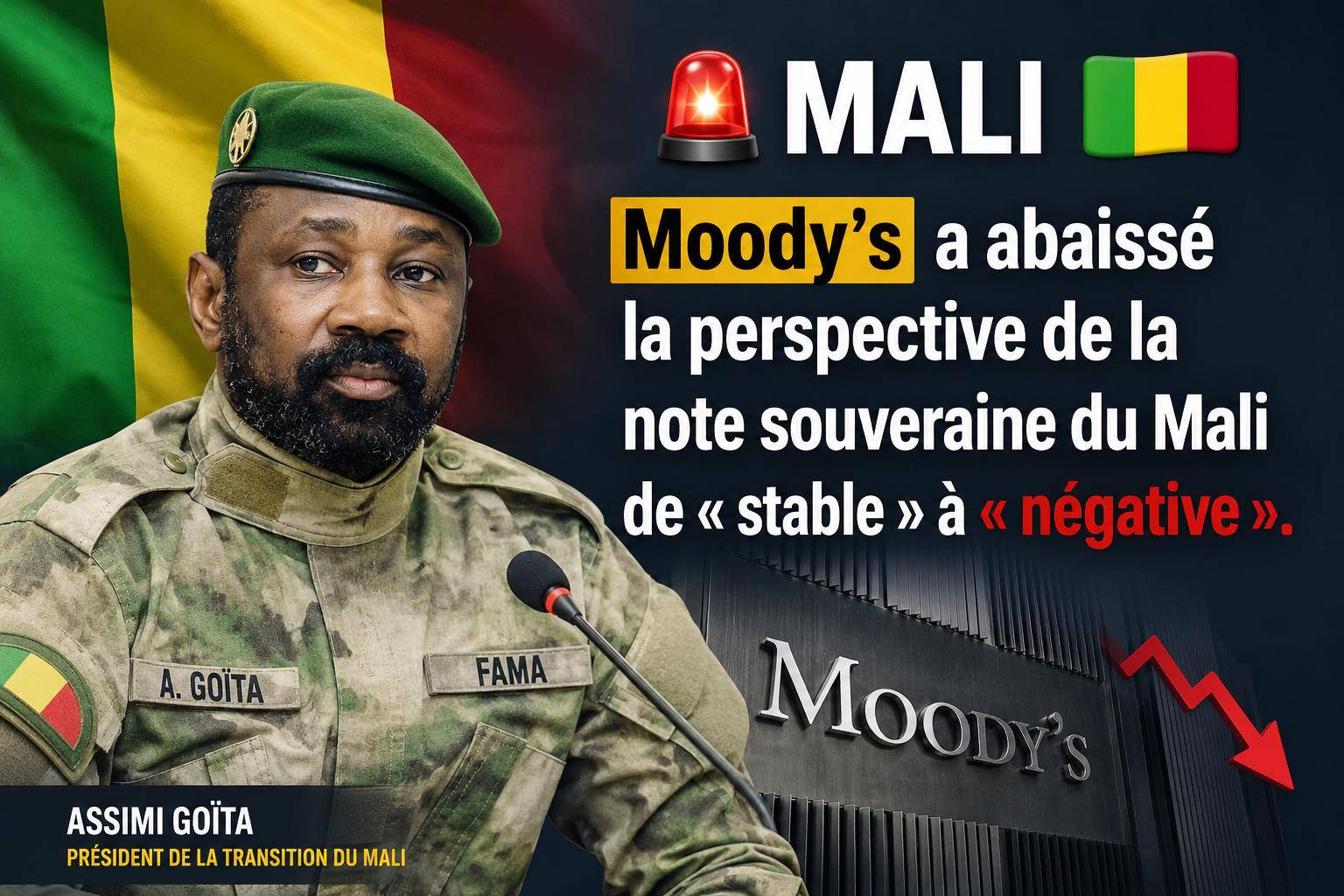
Mali’s economic challenges deepen as global rating agency downgrades outlook
In a significant move reflecting growing concerns over financial stability, Moody’s has revised Mali’s sovereign credit outlook from stable to negative, while maintaining its Caa2 rating. This adjustment underscores mounting pressures in security, financing, and political stability that threaten the country’s economic resilience.
Security threats and financial strain: a dual burden on Mali’s economy
The downgrade signals rising risks for international and regional investors seeking to engage with Mali. Despite efforts to strengthen national defense capabilities, persistent security threats continue to disrupt economic activities. Repeated attacks in key regions hinder supply chains, undermine agricultural productivity, and complicate revenue collection for the government in affected areas.
Financial constraints further exacerbate these challenges. Mali’s reliance on the West African Economic and Monetary Union (UEMOA) bond market has become increasingly costly due to tightening regional credit conditions. The Central Bank of West African States (BCEAO) has raised interest rates to curb inflation, driving up borrowing costs for Bamako. Recent bond issuances have encountered lukewarm investor responses, reflecting growing skepticism among regional financial institutions about Mali’s creditworthiness. This tightening of financial conditions limits the government’s ability to fund critical infrastructure and essential public services.
Political uncertainty and regional shifts weigh on investor confidence
The third pillar of Moody’s assessment highlights Mali’s prolonged political transition. Delays in electoral processes and the uncertain path to constitutional order have dampened donor and multilateral partner confidence. Additionally, Mali’s withdrawal from the Economic Community of West African States (ECOWAS), formalized through the Alliance of Sahel States (AES) alongside Niger and Burkina Faso, introduces new geopolitical uncertainties. While authorities cite greater sovereignty and strategic realignments, global markets view this move with caution, fearing potential trade barriers or disruptions to capital flows within the subregion.
Real-world consequences for Mali’s citizens and businesses
The implications of Moody’s decision extend beyond financial markets, directly impacting the daily lives of Malians. Higher borrowing costs for the state mean reduced public spending on essential services such as healthcare, education, and food subsidies. For local enterprises, the ripple effects are immediate: banks, heavily exposed to sovereign debt, are tightening credit to private businesses. Small and medium-sized enterprises (SMEs), vital to the national economy, face credit constraints that stifle investment and job creation.
Path forward: balancing resilience with structural reforms
Despite these headwinds, Mali’s economy demonstrates notable resilience, particularly in sectors like gold mining and cotton production. However, global finance rules demand a robust response to restore investor confidence. To stabilize its economic outlook, Mali must address three critical fronts: restoring security, clarifying its political trajectory, and implementing disciplined fiscal management. Success in these areas will be essential to reassure regional investors and unlock sustainable growth.