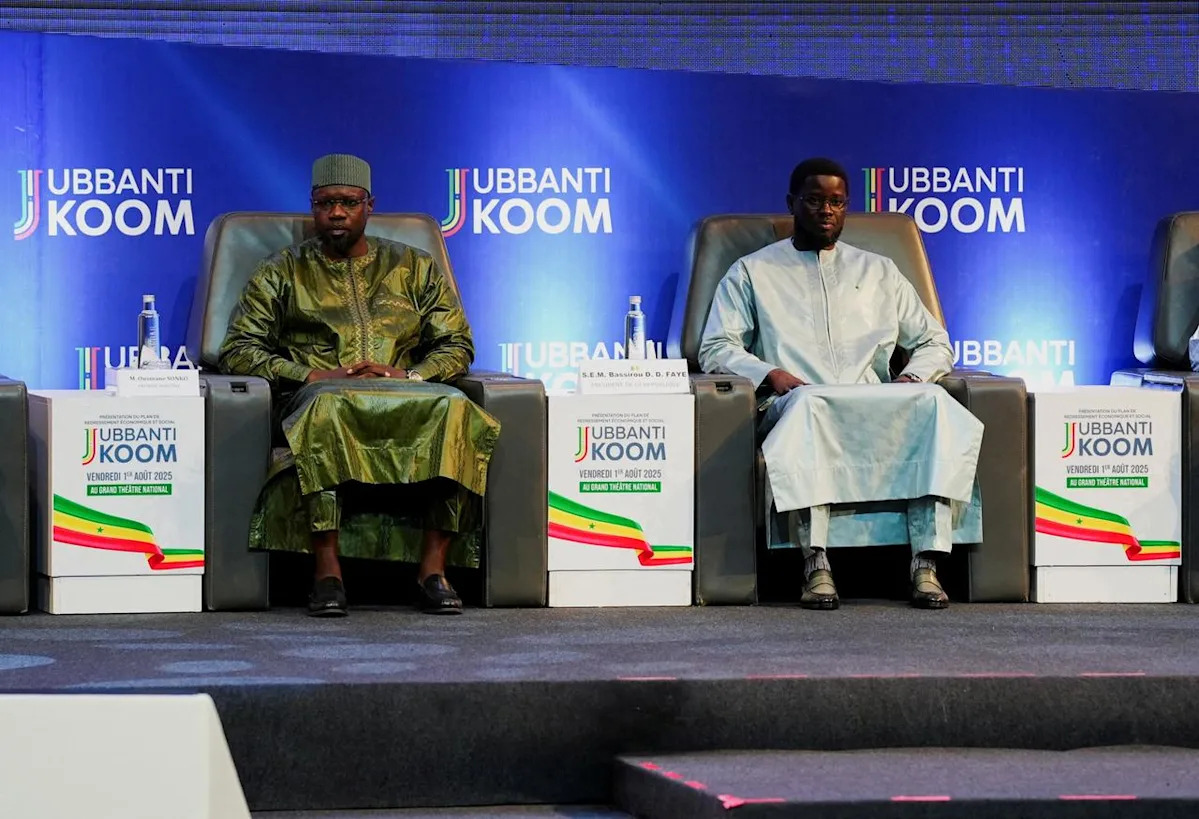
When Bassirou Diomaye Faye dismissed Ousmane Sonko from his Prime Minister post on May 23, 2026, the move was not merely a clash of personalities. It marked the irreconcilable split between two fundamentally opposing economic visions that had been sharing the same political platform for two years. Since Faye’s election in April 2024, the once-united presidential duo found itself at odds over the three pillars shaping Senegal’s economic future: debt sustainability, hydrocarbon development, and the role of foreign capital in national policy.
Debt becomes the battleground
Debt emerged as the most visible fault line. In September 2024, Ousmane Sonko publicly exposed undisclosed debt accumulated under Macky Sall’s administration. By March 2025, an International Monetary Fund (IMF) assessment estimated unrecorded commitments at around €7 billion, pushing total debt beyond 100% of GDP. Annual debt servicing now consumes 5,500 billion West African CFA francs (€8.4 billion), with refinancing needs approaching 6,000 billion CFA francs (€9.1 billion). The sovereign credit rating has been downgraded three times in twelve months.
Faced with this landscape, two diametrically opposed approaches unfolded. Sonko rejected restructuring outright, turning debt exposure into a cornerstone of his public communication strategy. His rhetoric resonated with grassroots supporters, the diaspora, and his militant base, avoiding any appearance of legitimizing previous administrations through negotiated settlements. Faye, in contrast, pursued engagement with international creditors. In November 2025, he hosted an IMF delegation and later spearheaded a national dialogue in May 2026 to address the crisis.
Hydrocarbons and foreign investment spark further disagreement
The strategic direction of Senegal’s burgeoning oil and gas sector further exposed the rift. Sonko advocated for greater state control over resource revenues, emphasizing national sovereignty and local ownership. Faye pushed for foreign partnerships to accelerate exploration and export capacity, prioritizing immediate revenue generation over long-term control. This divergence extended beyond rhetoric, influencing policy decisions and delaying critical infrastructure projects.
Capital and sovereignty: an ideological divide
At its core, the conflict reflects deeper ideological differences. Sonko’s stance champions economic nationalism, rejecting foreign influence and prioritizing domestic priorities even at the cost of fiscal stability. Faye’s approach favors pragmatic engagement with international institutions and investors, accepting short-term concessions to secure long-term economic viability. The suspension of a €1.55 billion IMF program, the closure of international financial markets to Senegal, and the looming threat of sovereign default by 2028 made Sonko’s position economically unsustainable, even as it remained politically potent for mobilizing support within his Patriotes Africains du Sénégal pour le Travail, l’Éthique et la Fraternité (PASTEF) party.
The dismissal of Sonko was not just a political reshuffle—it was the inevitable outcome of two years of clashing economic philosophies that could no longer coexist under a single banner.