The Senegalese government is taking decisive steps to revitalize its marine and fisheries research capabilities with the upcoming rehabilitation of the research vessel ITAF Dème. This strategic initiative underscores the nation’s commitment to strengthening its maritime sovereignty while advancing sustainable ocean governance.
The announcement follows a prolonged period of inactivity—since November 2022—during which the vessel, operated by the Centre de Recherches Océanographiques Dakar-Thiaroye (CRODT) under the Institut Sénégalais de Recherches Agricoles (ISRA), has been offline. The vessel serves as a critical platform for fisheries stock assessments, marine ecosystem monitoring, oceanographic data collection, and technical training, all of which are vital to Senegal’s blue economy and resource management strategies.
a strategic asset for fisheries and ocean governance
The ITAF Dème is more than just a research platform—it is a cornerstone of Senegal’s maritime independence. By generating its own marine data rather than relying on external expertise, the country enhances its ability to negotiate equitable fishing agreements and implement evidence-based conservation policies. This autonomy positions Senegal as a regional leader in West African fisheries and oceanographic research, a role that has been compromised by the vessel’s extended downtime.
Without the vessel’s scientific missions, key activities such as regular fisheries stock evaluations and environmental monitoring have stalled, directly affecting the nation’s ability to sustainably manage its marine resources. The absence of this critical infrastructure has also weakened Senegal’s regional influence in shaping fisheries policies and conservation strategies across West Africa.
ministerial visit signals commitment to marine research revival
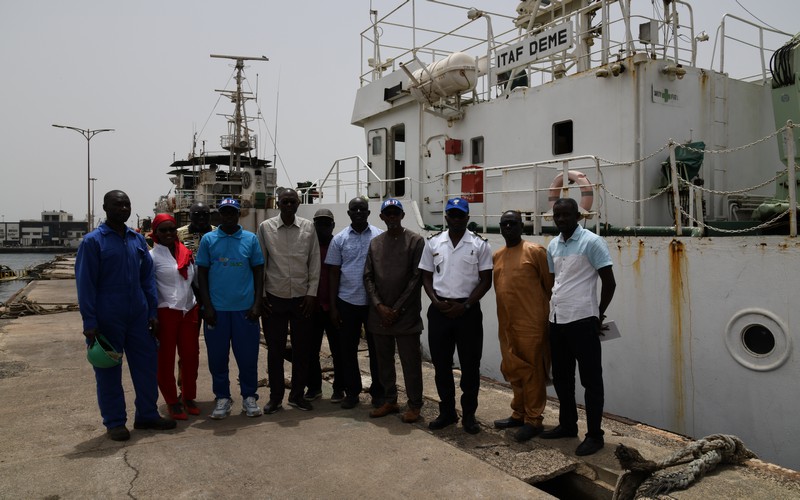
In a high-level inspection conducted in May 2026 at the Port of Dakar, Dr. Mamadou Abibou Diagne, Secretary-General of the Ministry of Fisheries and Maritime Economy, led a delegation that included top officials from ISRA and CRODT. The purpose of the visit was to assess the feasibility of restoring the vessel to operational status and to reaffirm the government’s dedication to advancing marine science and fisheries management.
During the inspection, Captain Seydina Hamza Amar, the vessel’s commander, delivered a detailed technical assessment. His report was encouraging: despite its prolonged inactivity, the ITAF Dème remains structurally sound and capable of resuming its scientific missions once rehabilitation work is completed. The assessment confirmed that the vessel retains the necessary equipment and operational capacity to fulfill its intended role.
government doubles down on blue economy and fisheries research
Following the inspection, Dr. Mamadou Abibou Diagne emphasized the government’s unwavering commitment to strengthening Senegal’s marine research infrastructure. While plans for a new research vessel are already underway, the rehabilitation of the ITAF Dème remains a national priority. The vessel is expected to become a key pillar in the sustainable management of fisheries resources and the growth of the blue economy.
Dr. Diagne highlighted the pivotal role of the fisheries sector in Senegal’s economy, noting that the revival of the ITAF Dème aligns with broader national development goals. The vessel’s return to service will support evidence-based decision-making in fisheries policy, enhance food security, and reinforce Senegal’s position as a leader in marine conservation and sustainable ocean use.
crodt warns of growing consequences of vessel inactivity
Dr. Ismaïla Ndour, Director of the CRODT, welcomed the ministerial visit as a strong signal of support for fisheries and oceanographic research. He emphasized that the government’s engagement reflects a growing recognition of science’s role in shaping effective maritime policies.
However, he also cautioned that the prolonged immobilization of the ITAF Dème—the country’s only dedicated fisheries research vessel—has already produced significant setbacks. Key challenges include the inability to conduct regular stock assessments, which are essential for negotiating fair and profitable fishing agreements. Without these campaigns, Senegal’s regional leadership in marine research and policy advocacy has been severely weakened.
Dr. Ndour concluded that the government’s renewed focus on marine research offers promising solutions to longstanding challenges in equipment availability, operational capacity, and marine resource monitoring. The rehabilitation of the ITAF Dème is seen as a critical step toward restoring Senegal’s scientific leadership and ensuring the sustainable future of its marine ecosystems.