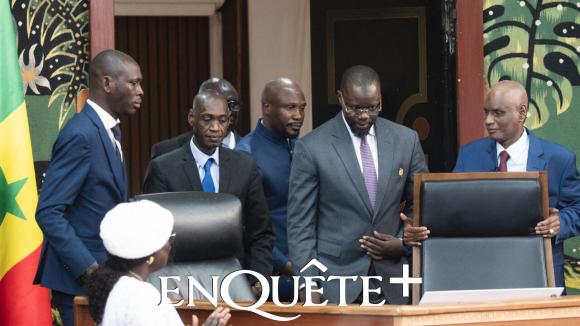
The Front for the Defense of Democracy and the Republic (FDR) has intensified its legal and political battle to invalidate Ousmane Sonko’s parliamentary mandate, following his recent election to Senegal’s National Assembly. In a strongly worded statement released yesterday, the coalition argued that the mechanisms enabling his return to the legislature violate both the Constitution and the Electoral Code, while urging nationwide mobilization to uphold democratic institutions.
The FDR’s leadership accused Sonko of occupying his seat unlawfully and demanded his immediate removal from the Assembly. The coalition praised the united front of political parties, civil society groups, and activists who have condemned what they describe as a parliamentary coup attempt orchestrated by the Pastef party. Earlier this month, 147 political movements and organizations signed a joint declaration to denounce the situation, signaling broad-based opposition to Sonko’s presence in the Assembly.
The controversy centers on conflicting interpretations of the Electoral Code and Constitution regarding the parliamentary status of government ministers. The FDR points to Article LO172 of the Electoral Code, which stipulates that an elected deputy who becomes a minister must resign from their parliamentary seat within eight days. The coalition contends that Sonko’s attempt to reclaim his mandate through procedural changes in the Assembly’s internal regulations lacks legal foundation, as such reforms cannot override organic laws governing parliamentary mandates.
According to the FDR, the modification of the Assembly’s rules of procedure—implemented by the ruling majority—represents an unconstitutional overreach. The coalition insists that only an organic law, not an internal regulation, can determine the conditions for a minister’s return to the legislature. It has called for the nullification of the decision that allowed Sonko to re-enter the Assembly, asserting that he does not legally qualify as a deputy. The FDR has urged competent authorities to enforce the legal consequences of this breach.
The opposition coalition firmly rejected Sonko’s claims that the constitutional challenge was politically motivated to exclude him from the political arena. Emphasizing that the stakes extend beyond party divisions, the FDR framed its campaign as a defense of Senegal’s democratic foundations and institutions. It has called on all national stakeholders to unite in a coordinated response to what it describes as a systematic undermining of the country’s legal and constitutional framework.
Meanwhile, the Constitutional Council is under pressure to rule on the legality of the contested provisions. The court’s impending decision is being closely watched by both government and opposition factions, amid escalating tensions over the delicate balance of power between the executive and legislative branches.