
The current political landscape in Senegal reveals more than a mere disagreement between two prominent figures. It represents a fundamental clash between two forms of legitimacy: institutional authority and charismatic influence. This inherent tension, throughout contemporary political history, frequently gives rise to a phenomenon well-documented in political theory: hubris.
From this perspective, Ousmane Sonko’s political journey demands a clear-headed and dispassionate examination. Sonko’s ascent was fueled by a disruptive energy rarely witnessed in recent Senegalese history. He effectively channeled the frustrations of a marginalized youth, challenged a political system widely perceived as entrenched, and introduced a new political discourse centered on national sovereignty, dignity, and the re-empowerment of the populace as a central force.
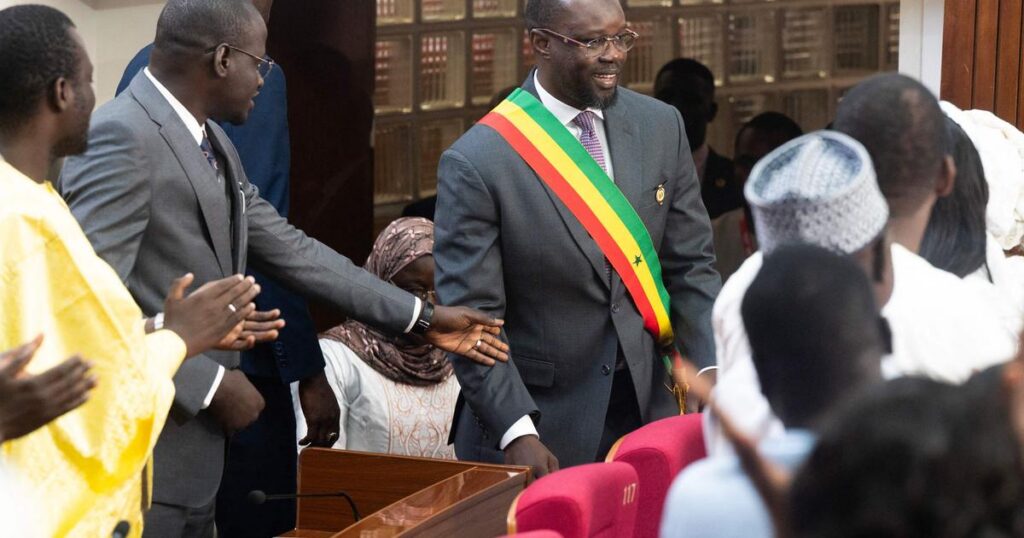
Sonko had previously advocated for a “smooth cohabitation” with the presidential palace. His recent election as Speaker of the National Assembly, just days after his dismissal as Prime Minister, presents a crucial opportunity for him to implement this vision.
The political events leading to his election unfolded with unprecedented speed. On May 22, President Bassirou Diomaye Faye relieved Ousmane Sonko of his duties as Prime Minister. The very next day, May 23, Malick Ndiaye, the then-Speaker of the National Assembly, strategically resigned, vacating the position. Ahmadou Alhaminou Mohamed Lô was appointed as the new Prime Minister on May 25. Finally, on May 26, Ousmane Sonko was overwhelmingly elected President of the National Assembly, a clear indication that he remains the leader of Pastef, the majority party he founded. He secured 132 votes out of 165 deputies.
While some hailed this election as “historic,” others described it as an “institutional coup d’état.” Regardless of interpretation, this development positions the former Prime Minister as the chief political rival to his erstwhile ally, President Bassirou Diomaye Faye, with whom he recently formed a contentious dyarchy.
Several critical questions now emerge. Will Pastef, which unanimously supported Sonko’s election to lead the National Assembly, agree to back—or even join—the new government that the highly technocratic new Prime Minister is tasked with forming?
Our observations suggest that the presidential party has outlined its conditions, including “fidelity to the program that led to the 2024 victory.” This implicitly refers to the agenda originally crafted by Ousmane Sonko.
Sonko himself has sent mixed signals: while appearing to favor institutional appeasement, he also conveyed a clear message to his former presidential ally. He cautioned that the National Assembly would fully exercise its “constitutional prerogatives.” He also expressed regret that Pastef was not consulted regarding the new Prime Minister’s appointment.
Amidst this institutional turbulence, the country’s sovereign rating has reportedly shifted from “stable” to “negative.” This development casts a shadow over Senegal’s political stability.
This political force is undeniable. It has profoundly reshaped the national landscape. However, every charismatic leadership inherently carries a contradiction: it mobilizes through a strong individual embodiment, yet it can also inadvertently weaken the impersonal mechanisms upon which institutional democracy relies.
Popular or constitutional legitimacy?
When supporters begin to view one individual as the sole architect of a “revolution,” when the trajectory of a collective endeavor appears to hinge on a single figure, and when the line between political allegiance and personal loyalty blurs, the risk of hubris emerges. This is not merely an individual pathology but a structural phenomenon. The current crisis appears to starkly reveal this very contradiction.
For many months, Senegal operated under a unique political ambiguity: who truly held the reins of power? Was it the elected president, Bassirou Diomaye Faye, or the historical leader of the Pastef project, Ousmane Sonko, who founded the African Patriots of Senegal for Work, Ethics and Fraternity (Pastef), now in power? Was it the legitimacy derived from the ballot box, or the legitimacy stemming from militant support? Constitutional authority or charismatic authority?
This dual power structure was unlikely to endure indefinitely. In any democracy, a point arrives when institutions assert their primacy. A state cannot function sustainably with two symbolic centers of command. Sonko’s influence, however, extended beyond his role as Prime Minister. It was primarily rooted in his ability to simultaneously serve as head of government, movement leader, militant reference point, and the emotional embodiment for a significant segment of Senegalese youth.
This is precisely where the hubristic risk manifests: when a leader tends to occupy the spheres of the state, the people, and the political movement all at once. The paradox lies in the fact that this situation doesn’t necessarily threaten democracy through overt brutality. Instead, it can weaken it more subtly, by compelling institutions to recede before the symbolic weight of a powerful political personality.
Political parties often remain largely organized around central figures. The Parliament still struggles to establish itself as a truly autonomous counter-power. Institutions, while resilient, remain vulnerable to the emotional potency of influential political figures. This is a critical aspect of African politics English speakers often discuss when analyzing emerging democracies.
“A moment of truth”
Therefore, the fundamental question today is not a moral one; it is institutional. Can Ousmane Sonko accept that institutional legitimacy must now take precedence over charismatic legitimacy? Can he accept that the project he helped initiate will gradually cease to be exclusively his own? Can he transition from being solely the driving force of a historical protest to becoming one actor among many within an institutional order designed to outlast individuals?
This is arguably the most formidable challenge for all great leaders who emerge from disruptive movements. The history of African politics is replete with movements that triumphed in opposition only to confront the more intricate demands of state governance. Governing requires different skills than mobilizing. It necessitates compromises, concessions, adherence to institutional hierarchies, and at times, even the acceptance of a degree of personal effacement for the sake of state continuity. This journey is vital for ensuring Senegal’s political stability.
A leader’s true greatness is not solely measured by their ability to seize power. It is also gauged by their capacity to accept the inherent limits imposed by institutional democracy. Senegal may now be entering this crucial moment of truth.
The manner in which this tension is managed will not only determine the future trajectory of the Pastef project but also play a significant role in safeguarding the country’s democratic stability.
More Stories
Senegal’s political stability tested by the sonko-faye power dynamic
Visa trafficking scandal implicates Niger’s interior minister
Togo : la Ve République de Faure Gnassingbé, un nouveau costume pour un pouvoir intact