The end of a decades-long financial drain in Togo’s education system
For years, Togo’s education system operated a covert revenue stream that systematically drained funds from the most vulnerable families. The abrupt announcement by the newly appointed Minister of National Education, Mama Omorou, to abolish the practice of delivering exam results via SMS has exposed a financial scandal of unprecedented scale, allegedly perpetuated during the administration of former President Faure Gnassingbé.
Exposing the system: How SMS fees exploited parental anxiety
On 30 May 2026, during an unannounced inspection at the BAC I correction centers in Tokoin and Agoè-Centre high schools, Minister Omorou delivered a scathing assessment of the SMS-based result delivery system. He condemned it as a deliberate financial trap designed to exploit families gripped by anticipation and uncertainty.
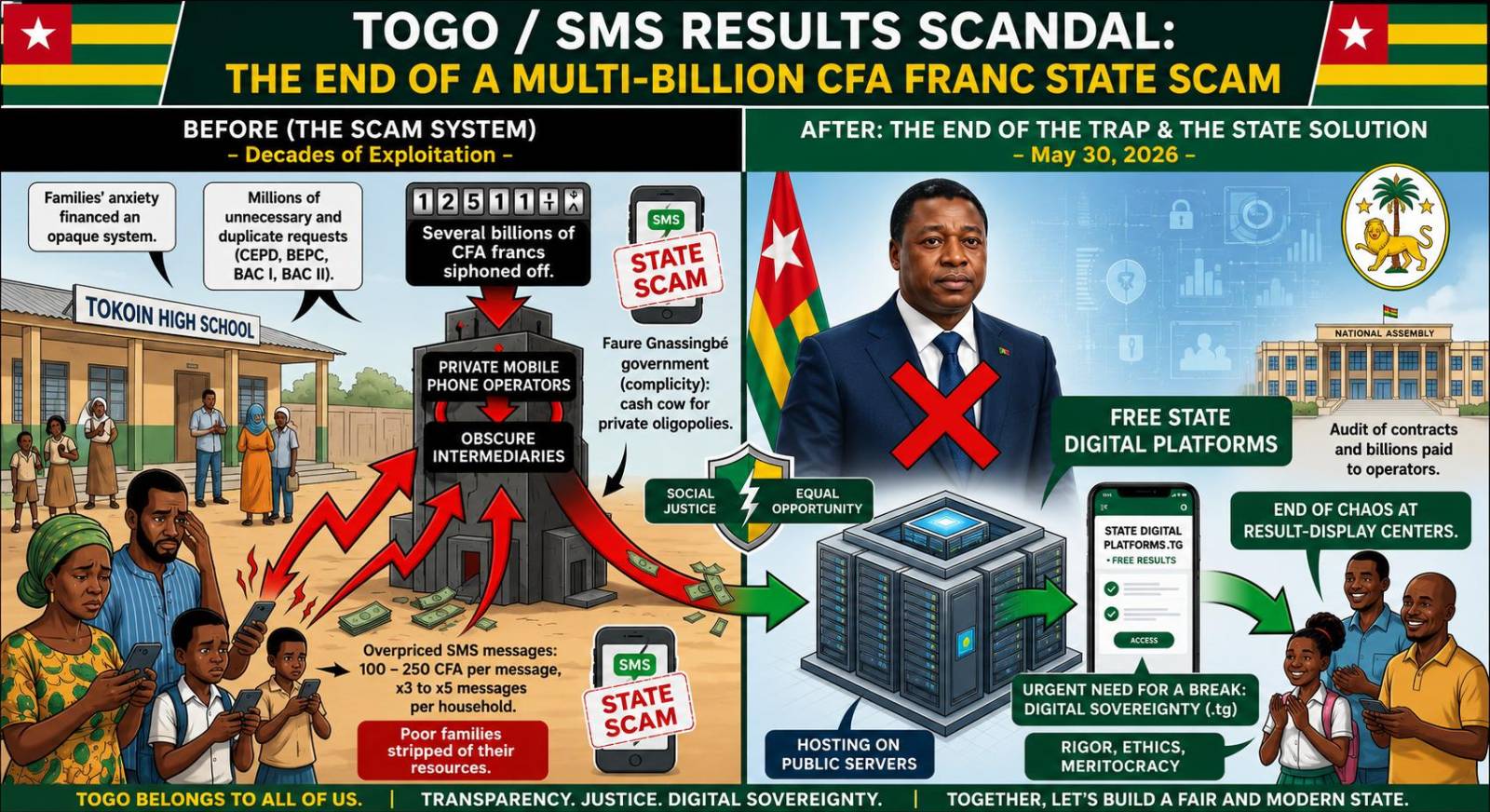
The modus operandi was alarmingly straightforward. Each time national exams such as the CEPD, BEPC, or BAC I and II were administered, families—including parents, guardians, relatives, and students themselves—would send multiple SMS to the same number to obtain identical results. Each message incurred a fee ranging from 100 to 250 francs CFA, resulting in an avalanche of redundant charges that inflated costs for households across the country.
Quantifying the financial hemorrhage: billions lost over decades
While the minister has yet to release official audit reports, preliminary estimates paint a staggering picture. With hundreds of thousands of candidates sitting for national exams annually and each household sending between three and five messages per exam, the volume of SMS traffic per session reaches tens of millions. Over the past 15 to 20 years, this practice has translated into billions of francs CFA siphoned from families—funds that never reached public education coffers.
Instead, the revenue flowed predominantly to private telecom operators and shadowy intermediaries, all operating under state-granted concessions that had gone unchallenged for decades. This amounted to a systemic transfer of wealth from impoverished households to private oligopolies, facilitated by the passive or complicit oversight of outgoing authorities.
Building a transparent, digital alternative
Minister Omorou’s decision to end SMS-based result delivery is a necessary first step, but it presents a significant challenge: ensuring a seamless transition without reverting to the chaos of crowded, anxiety-inducing queues outside exam centers.
To fulfill this promise, Togo must accelerate the deployment of secure, state-run digital platforms that prioritize transparency and accessibility. The use of public servers under the .tg domain is essential to asserting digital sovereignty. These platforms must be entirely free, funded through the national education budget, to uphold equity and prevent financial barriers from undermining meritocracy.
Modernization is within reach. The dissemination of results through email waves or lightweight web portals—optimized for mobile access—represents a low-cost, technologically sound solution that aligns with the country’s broader digital integration strategy.
A call for ethical renewal in education
Beyond the financial scandal, Minister Omorou used his inspection tour to reinvigorate the morale of examiners, emphasizing the need to restore rigor, ethics, and meritocracy as the core principles of Togo’s education system. This announcement signals a profound ideological shift—one that seeks to dismantle institutionalized fraud and restore fairness to the academic evaluation process.
The road ahead demands unwavering commitment. The government must follow through by auditing all telecom contracts to uncover the full extent of financial misconduct. Only then can justice be served, and the future of Togo’s youth be protected from a legacy of exploitation disguised as administrative procedure.