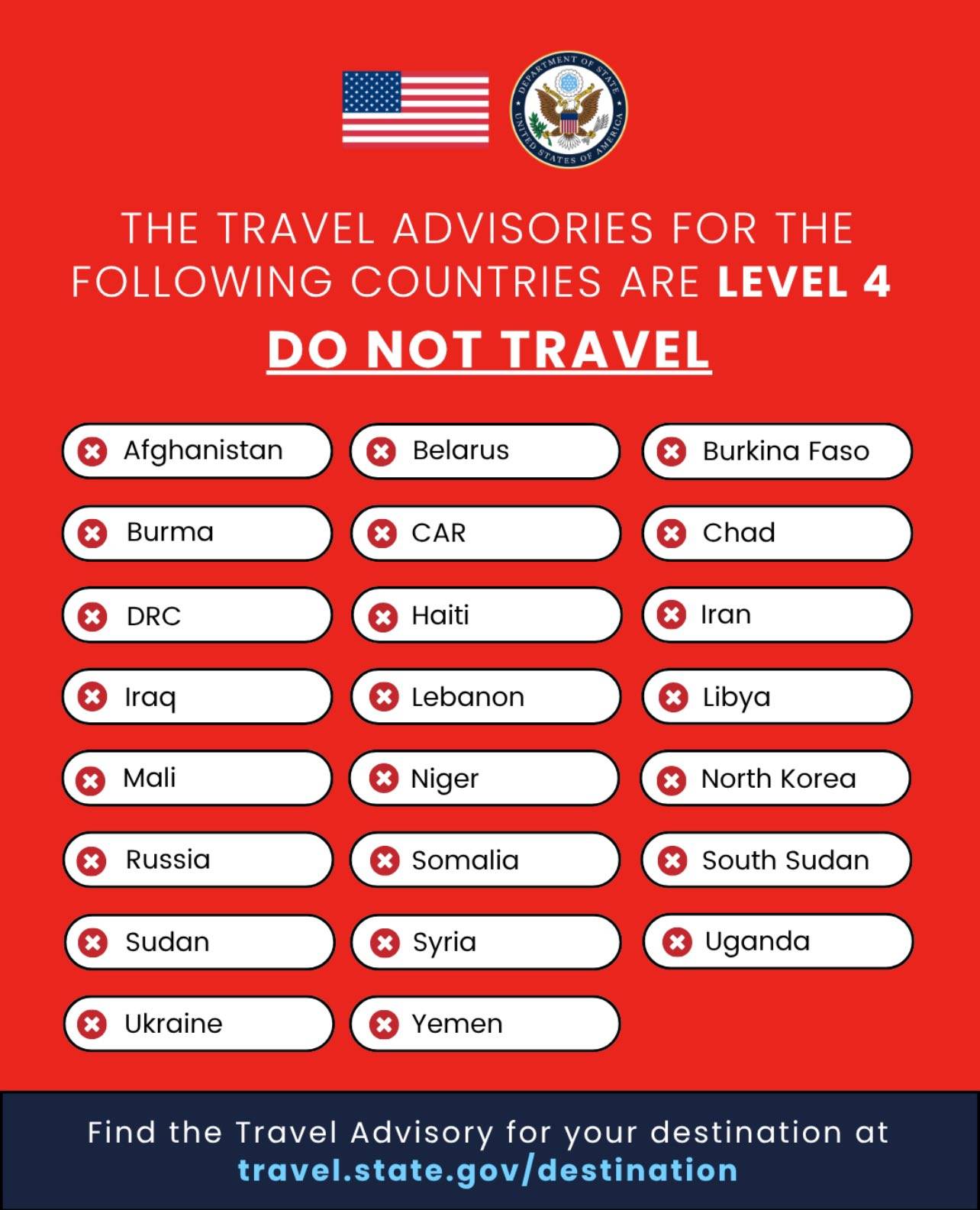
The United States Department of State has once again updated its global travel advisory, placing 23 countries at the highest risk level—Level 4, or “Do Not Travel.” Among these, three nations from the Alliance of Sahel States (AES)—Burkina Faso, Mali, and Niger—remain under the most severe warning, alongside other high-risk regions such as Russia and the Democratic Republic of the Congo (DRC). The primary driver behind this decision is the unprecedented security deterioration and the relentless spread of terrorism across the Sahel, now widely regarded as the world’s most volatile sub-Saharan corridor.
The stark reality of Level 4 advisories
For American travelers, a Level 4 designation is a definitive red flag. The U.S. government not only discourages all non-essential travel to these countries but also warns that consular and emergency assistance may be severely limited or entirely unavailable due to the withdrawal of non-essential diplomatic staff. The rationale is clear: the risks of kidnapping, terrorist attacks, or hostage-taking have escalated to a point where the safety of foreign nationals cannot be guaranteed.
The AES under siege: Burkina Faso, Mali, and Niger in the crosshairs
The inclusion of Burkina Faso, Mali, and Niger on this critical list reflects the deepening crises these nations face. As members of the Alliance of Sahel States (AES), they have undergone military transitions and strategic realignments, particularly distancing themselves from former Western partners like France and the European Union. The convergence of weakened state presence, systemic poverty, and shifting military alliances—especially the pivot toward new partnerships, including with Russia—has created a volatile environment where the effectiveness of counterterrorism efforts remains uncertain.
The expansion of terrorist networks is the driving force behind Washington’s decision. Groups such as the Support Group for Islam and Muslims (JNIM), affiliated with Al-Qaeda, and the Islamic State in the Greater Sahara (EIGS) are no longer confined to remote desert sanctuaries. Instead, they are launching coordinated offensives and steadily expanding their territorial control, making the Sahel a global hotspot for asymmetric warfare.
Burkina Faso: a nation under siege
Burkina Faso bears the brunt of this crisis, with armed groups controlling or besieging vast swathes of its territory. Entire towns face strict blockades, cutting them off from essential services and supplies. Daily attacks on military outposts and supply convoys have displaced thousands, forcing communities into internal exile while exacerbating an already dire humanitarian situation.
Mali: from north to south, instability spreads
In Mali, the withdrawal of the United Nations peacekeeping mission (MINUSMA) has left a void that both rebel factions and terrorist organizations have exploited. Violence has surged, particularly in the northern regions, while the threat has now crept southward, encroaching on the outskirts of Bamako, once considered a relative safe haven. The once-stable capital now faces an escalating risk of terrorist infiltration.
Niger: triple-front pressure in the ‘three borders’ zone
Niger’s security challenges are compounded by its geographic vulnerabilities. In the west, the volatile “three borders” region—shared with Mali and Burkina Faso—has become a battleground for cross-border terrorism. In the southeast, near Lake Chad, Boko Haram and the Islamic State’s West Africa Province (ISWAP) continue to launch deadly incursions. Despite efforts to reorganize its armed forces, Niger struggles to curb endemic insecurity, further strained by regional diplomatic tensions that hinder cross-border cooperation.
A global snapshot of instability
While the Sahel dominates headlines, the U.S. advisory also flags other global hotspots. Russia remains at Level 4 due to the Ukraine war, arbitrary detentions of foreign nationals, and inconsistent enforcement of local laws. The eastern DRC, plagued by clashes between armed factions like the M23, is marked by civilian massacres and kidnappings, while Chad, sandwiched between the Sahel and war-torn Sudan, faces spillover threats from terrorism, regional conflicts, and civil unrest.
The economic and humanitarian fallout of a Level 4 classification
The repercussions of this designation extend far beyond tourism. For the AES nations, already grappling with economic fragility, the advisory serves as a deterrent for foreign direct investment. Multinational corporations, faced with exorbitant insurance costs for expatriate staff, are halting or delaying projects in infrastructure, exploration, and development. Meanwhile, humanitarian organizations confront rigid security protocols that severely restrict access to vulnerable populations, stifling critical aid deliveries for food, healthcare, and education.
The Sahel’s security deadlock
The U.S. decision underscores the failure of past stabilization strategies in the Sahel. Despite political upheavals and geopolitical realignments in Bamako, Ouagadougou, and Niamey, insecurity continues to worsen, with civilians bearing the heaviest burden. A purely military approach has proven insufficient. Without addressing root causes—governance failures, social injustice, economic stagnation, and lack of basic services—the Sahel’s map of instability, as seen through Western chancelleries, will remain stubbornly red.