In the remote town of Obo, located in the Haut-Mbomou region of the Central African Republic, a striking incident unfolded last week when Russian mercenaries from the Wagner Group launched a surface-to-surface missile toward neighboring Democratic Republic of the Congo.
Investigations reveal that the projectile originated from an abandoned American military base, left behind after a multinational operation targeting one of Africa’s most notorious war criminals.
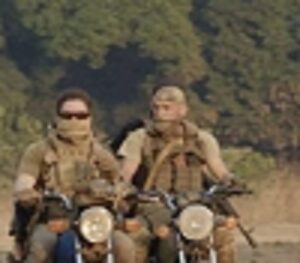
Wagner Group mercenaries patrol the Haut-Mbomou region in the Central African Republic.
From U.S. counter-LRA mission to Wagner’s operations
Between October 2011 and April 2017, United States Special Forces, including Green Berets with extensive experience in Afghanistan and Pakistan, conducted Operation Observant Compass. This mission, aimed at dismantling the Lord’s Resistance Army (LRA) and its fugitive leader Joseph Kony, saw American troops stationed in multiple locations across Uganda, South Sudan, and the Central African Republic. Among their bases was a fortified outpost in Obo, equipped with surveillance cameras and barbed wire, serving as a key operational hub in the fight against the rebel group responsible for widespread atrocities.
Despite years of pursuit, Joseph Kony evaded capture, and in 2017, U.S. forces withdrew from the region. Left behind were containers of military equipment, including vehicles, supplies, and—according to local reports—at least one surface-to-surface missile, stored in the abandoned base.
Wagner’s arrival and the seizure of U.S. weapons
Following the Americans’ departure, the base in Obo came under the control of Central African Armed Forces (FACA). However, in recent months, Russian mercenaries from the Wagner Group arrived in the town after being requested by local authorities to reinforce security in the Haut-Mbomou region. After evicting FACA soldiers from the premises, Wagner mercenaries took over the former U.S. installation.
Inside the base, they conducted a thorough search of the containers, recovering weapons, solar panels, and other equipment. Local sources indicate that local officials had publicly announced that Wagner mercenaries would conduct test firings to evaluate the condition of the discovered weapons—discarding any faulty ones.
A deliberate strike across the border
On the night of February 26, Wagner mercenaries gathered on Obo’s football field, setting up a heavy-caliber weapon in full view of the town’s residents. The missile ignited, shooting into the night sky in a blaze visible from multiple neighborhoods. It traversed the town of Mboki, passed over Zemio, crossed the international border, and landed in the Democratic Republic of the Congo, approximately five kilometers from the village of Zapay.
While no casualties have been reported, the impact sent shockwaves through Zapay, a Congolese village that also hosts refugees fleeing violence attributed to Wagner in the Central African Republic. Some residents speculated whether the launch was intended as a message, underscoring the mercenaries’ reach beyond national borders.
Residents of Zapay spent the night scanning the skies, fearing additional projectiles. Witnesses confirmed seeing Wagner mercenaries operate the weapon, aim it toward the DRC, and fire it. No other armed group in Obo possesses the capability to launch such a projectile over such a distance.
A region on edge
The incident has heightened tensions in an already volatile area. The Central African Republic continues to grapple with instability, while neighboring countries face the spillover effects of cross-border violence. The use of abandoned U.S. military equipment by Wagner mercenaries raises concerns about the proliferation of unsecured arms in post-conflict zones and the risks posed by uncontrolled armed groups operating with impunity.