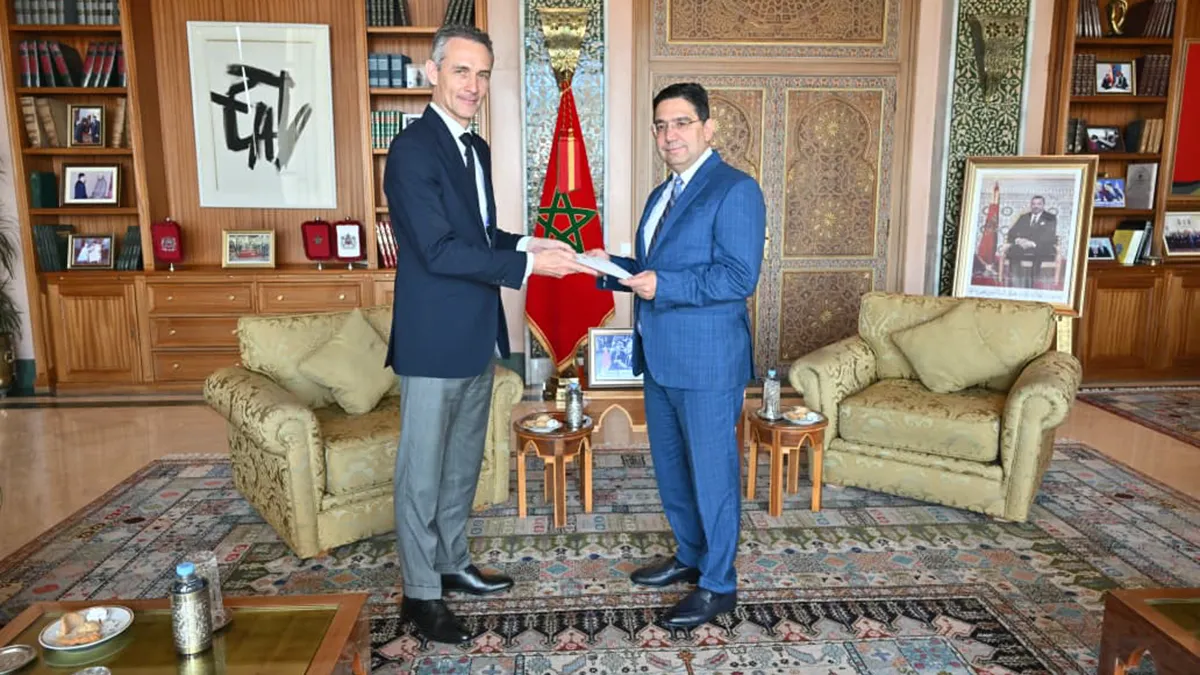
The arrival of a new diplomat rarely makes waves beyond government circles, but the official installation of Philippe Lalliot in Rabat is a notable exception. Following his administrative appointment in mid-May, the French diplomat formally began his tenure yesterday by presenting his credentials to the Moroccan Minister of Foreign Affairs, Nasser Bourita.
This protocol milestone signals the start of a bold bilateral roadmap. It aims to move past a cycle of friction and skepticism, seeking instead to recalibrate the balance of power across the Mediterranean and African landscapes.
His predecessor, Christophe Lecourtier, navigated the most turbulent phase of this relationship. Tensions peaked when Paris sharply restricted visas for Moroccan citizens. This move, combined with a French stance that Rabat viewed as indifferent to its core national interests, led to a prolonged freeze in high-level dialogue.
During those years, official visits vanished, and French influence in Morocco‘s foreign policy diminished. The long-standing rapport between the two nations was replaced by a series of cold, distant interactions.
The Sahara issue and the strategic pivot
A decisive shift occurred throughout 2024, as quiet diplomacy paved the way for a historic change in Emmanuel Macron‘s policy. In a formal letter to King Mohammed VI, the French President aligned Paris with Rabat‘s position by endorsing the Moroccan autonomy plan for the Sahara as the only viable foundation for resolving the regional dispute.
For Morocco, this was a major geopolitical triumph. It was more than just support from a traditional partner; it was a strategic commitment from a permanent member of the UN Security Council with significant weight in the European Union. This gesture effectively reshaped the regional power dynamics.
Following this breakthrough, diplomatic stagnation was replaced by a rapid revival of bilateral activity. Ministerial summits, joint business forums, and the resumption of major economic projects have restored open communication channels.
The process reached its peak during Macron‘s state visit, which served to officially end the period of estrangement. While the French President spoke of the need to modernize ties for a new era in Africa, Nasser Bourita framed the partnership as one built on mutual trust and shared strategic goals.
This rapprochement is also rooted in pragmatism. While relations with Paris were strained, Morocco did not wait; it expanded its global reach by strengthening ties with the United States, Gulf monarchies, and several African nations. Recognizing these shifting sands, the Élysée understood that maintaining a rift with Rabat carried an unsustainable political and economic price.
Investment, infrastructure, and the 2030 horizon
Lalliot enters his role during a period of optimism, yet his task remains formidable. The economic agenda is a top priority. French corporations remain the leading foreign investors in Morocco‘s business sector, holding dominant positions in automotive manufacturing, rail expansion, banking, and renewable energy.
Furthermore, Morocco serves as a vital gateway for French firms looking to penetrate markets in sub-Saharan Africa. In a move that highlights the importance of economic ties, the former ambassador, Lecourtier, has been appointed to lead the French Development Agency (AFD) in Morocco.
The AFD is playing a critical financial role as Rabat ramps up public investment and infrastructure projects ahead of the 2030 World Cup. This massive undertaking, co-hosted with Spain and Portugal, presents lucrative opportunities for French engineering and construction firms.
Challenges of a redesigned bilateral architecture
While institutional normalcy has returned, a deeper transformation of power is underway. France is attempting to rebuild its standing in Africa after setbacks in other regions, while Morocco continues to pursue an assertive foreign policy based on its Atlantic and Mediterranean influence.
The daily agenda will be defined by cooperation on regional security, migration management, and stability in the Sahel. While interests often converge in these areas, the potential for friction remains. The true test for Philippe Lalliot will not be maintaining the current momentum, but ensuring the alliance survives when strategic differences inevitably resurface.