Behind the Slogan: A Claim of Financial Independence
In the official discourse of Burkina Faso’s military leadership, a single phrase has come to symbolize the regime’s push for economic sovereignty: “Y’a pas crédit dedans.” This declaration, echoed across social media and by government supporters, asserts that major infrastructure projects—road repairs, construction, equipment procurement, and state modernization—are being funded entirely with domestic resources, free from reliance on foreign debt.
The message is clear and politically potent: Burkina Faso is advancing under its own power, liberated from the constraints of international lenders.
Yet the gap between this rhetoric and fiscal reality is widening.
The Illusion of Self-Funded Development
Economic sovereignty is a legitimate goal for any nation. Reducing external dependence, boosting domestic revenue, and strengthening national capacities are objectives few would dispute. However, framing every public investment as entirely self-financed becomes problematic when official documents, financing agreements, and public announcements reveal reliance on concessional loans or multilateral funds.
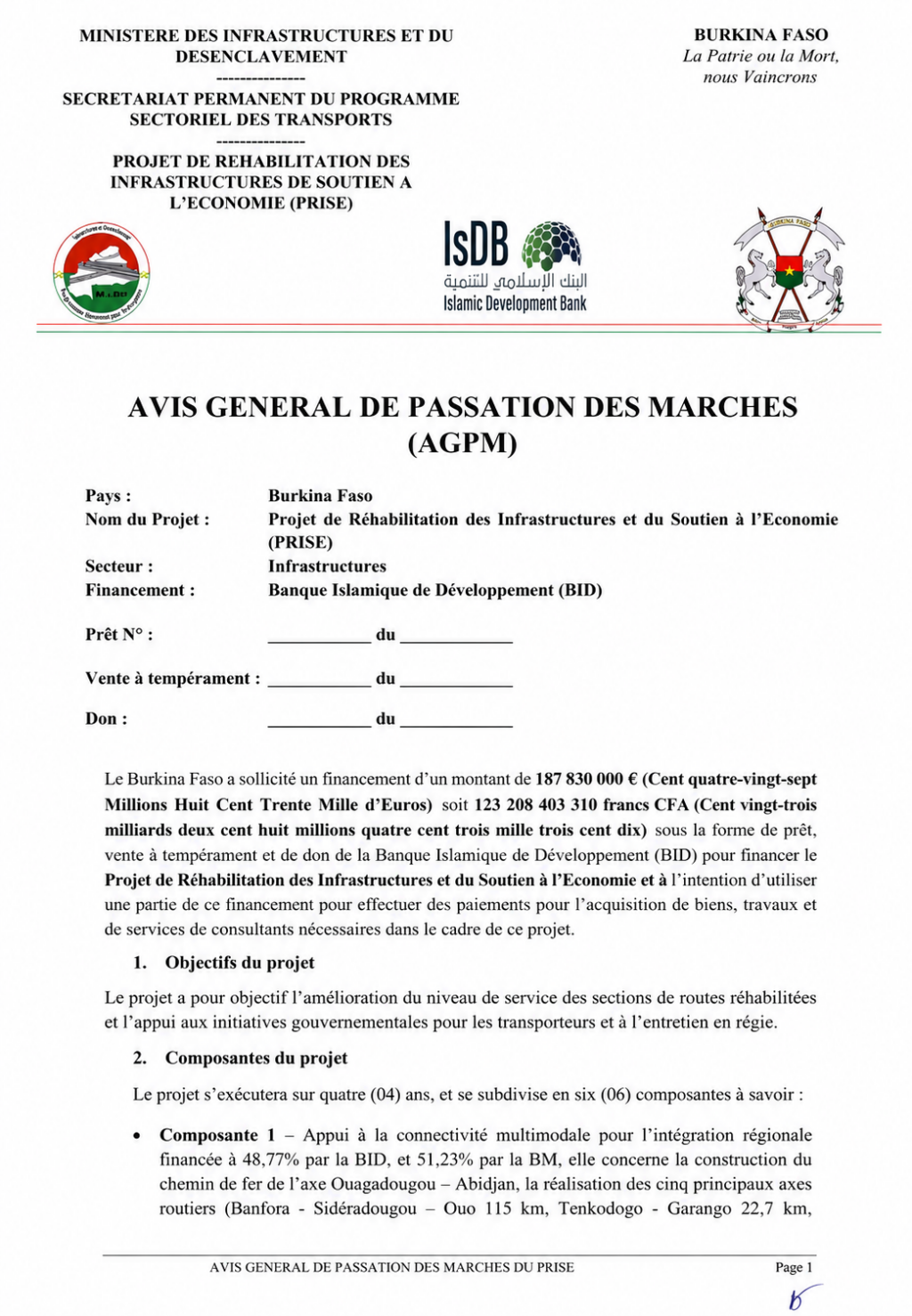
Recent agreements with the Islamic Development Bank, for instance, demonstrate this dependence. Key road projects are being financed through external loans, repayable under agreed terms, even if the financial conditions are favorable. These are not grants but financial commitments inscribed in the national budget.
A Contradiction That Fuels Skepticism
Why insist on “no credit inside” when multiple projects are clearly backed by international financing? Borrowing is not an anomaly—every state does it when domestic funds fall short. What is striking is the disconnect between:
- a narrative of near-total financial autonomy;
- ongoing dependence on foreign funding mechanisms.
This contradiction fuels doubts about the transparency of official communication.
An Economy Under Strain
The economic conditions in Burkina Faso make the idea of large-scale self-financing even less plausible. The country faces a convergence of challenges:
- a worsening security crisis with immense financial costs;
- soaring military expenditures;
- strained public finances;
- critical infrastructure needs;
- massive internal displacement;
- weakened tax revenues due to economic slowdown in key regions.
In such a context, financing multi-billion franc CFA investments without external partners appears highly unrealistic to many economists.
The Real Issue: Transparency, Not Debt
Public borrowing is not inherently problematic. When used to fund productive infrastructure, improve transport networks, stimulate growth, or enhance public services, it can serve as a catalyst for development. The crux of the matter lies in transparency.
Citizens deserve clarity on:
- the exact sources of funding;
- loan amounts and interest rates;
- repayment schedules and guarantees;
- the true cost of projects.
A responsible financial governance is built on clear information—not on slogans.
A Political Strategy Disguised as Economic Policy
The slogan “Y’a pas crédit dedans” appears designed for a political purpose. It reinforces the image of a government breaking from past practices and presents every completed project as proof of regained independence.
Such messaging also taps into a growing national sentiment, where sovereignty has become a central pillar of political discourse.
Yet when communication overshadows fiscal education, it risks fostering unrealistic expectations about the state’s actual capacity to finance development alone.
The Future Burden of Today’s Decisions
Every public debt incurred today will be repaid by tomorrow’s taxpayers. While today’s infrastructure may benefit future generations, so too will the financial obligations that accompany them.
This makes transparency in borrowing not just an economic issue, but a democratic one. It allows citizens to assess whether loans are being used to fund productive investments that generate sufficient wealth to ensure repayment.
True Economic Sovereignty Lies in Responsible Governance
Economic independence is not measured by the absence of debt, but by the ability of a state to:
- sustainably manage public finances;
- invest strategically;
- publish transparent accounts;
- account to its people;
- use borrowing responsibly;
- gradually reduce dependence through a more competitive economy.
A strong nation does not deny its financial commitments—it acknowledges them with honesty and channels them toward sustainable development.
Conclusion
The slogan “Y’a pas crédit dedans” has left a mark, but public finance cannot be built on catchphrases alone. The financing agreements signed with international partners confirm that, like most developing nations, Burkina Faso continues to rely on external resources for part of its investments.
The debate should not pit borrowing against sovereignty, but focus on the quality of governance, the clarity of financial commitments, and the effectiveness of investments. Ultimately, it is today’s and tomorrow’s taxpayers who will bear the consequences of today’s budgetary choices—long after the slogans fade.


More Stories
Behind the legacy: how Abdoulaye Koné shaped Ivory Coast’s economic backbone
Niger’s August crisis: how Tiani’s reliance on Russia exposed deeper fractures in the military
Peering behind the curtain: how Benin’s CCI budget 2027 reshapes local economies