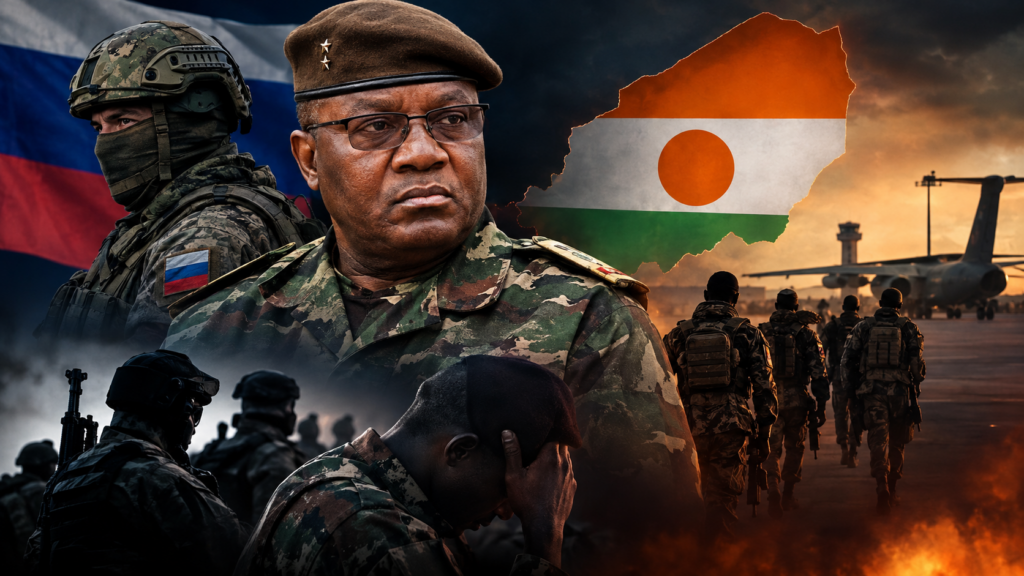
The night of August 28-29, 2026, marked a turning point for Niger’s military regime under Abdourahamane Tiani. A mutiny by predominantly young soldiers from the special forces erupted across key strategic sites in Niamey, including the 101st Military Base near Diori-Hamani International Airport, sensitive installations, and the presidential palace area. For nearly 24 hours, the stability of the regime hung in the balance, revealing vulnerabilities that went far beyond a simple disciplinary breakdown.
The Russian intervention that reshaped the power struggle
As the mutiny gained momentum, the Tiani administration faced a critical juncture. With loyalist forces struggling to regain control, reports confirm that Russian troops from the Africa Corps played a decisive role in retaking the airbase and other contested sites. Satellite imagery and witness accounts indicate that Russian-backed operations involved both ground support and aerial assistance, effectively tipping the scales in favor of the regime.
This external intervention, while restoring order, raised immediate questions about the long-term consequences for Niger’s military sovereignty. More critically, it exposed the regime’s growing dependence on foreign forces a stark contrast to Tiani’s earlier promises to restore national security and self-reliance in defense.
The purge that followed: purging the special forces
In the aftermath of the mutiny, a sweeping crackdown unfolded. Over 500 military personnel, primarily from the special forces, were arrested. Reports suggest that several others either fled the country or disappeared under unclear circumstances. Among the most high-profile victims of the purge was General Moussa Salaou Barmou, then chief of staff and a former commander of the special forces.
Barmou’s dismissal on September 11, 2026, was framed by the regime as a response to “command dysfunctions” during the mutiny. However, the circumstances surrounding his removal point to deeper tensions. As a key architect of the post-coup military structure, Barmou had played a central role in consolidating Tiani’s power after the July 2023 takeover. His opposition to the involvement of Russian forces in quelling the mutiny particularly during the critical hours of the crisis appears to have sealed his fate.
The unanswered questions behind Barmou’s fall
Barmou’s trajectory underscores the contradictions within Tiani’s regime. A loyalist from the July 2023 coup, he had built his reputation on a blend of military expertise and connections with Western security networks, including the United States. This profile stood in stark contrast to Tiani’s strategic pivot toward Moscow, which had gained momentum since 2023 as relations with Western partners deteriorated.
The mutiny forced Barmou into a precarious position. As the former commander of the special forces units that were central to the rebellion his loyalty was both assumed and questioned. During the crisis, reports suggest that he resisted calls to authorize the use of lethal force against mutineers, a decision that may have been seen as weakness by both regime hardliners and external allies. Within days of the mutiny’s suppression, he was stripped of his command and placed under restrictive monitoring.
A regime caught between two allegiances
The purge extended beyond Barmou, targeting a generation of officers trained and influenced by Western military doctrine. Many of those arrested had been part of the special forces, a unit historically trained by Western partners, including the U.S. and France. Their removal signals a deliberate effort to realign the military hierarchy with Tiani’s pro-Russian orientation, even at the cost of institutional continuity.
Yet, the reliance on Russian forces raises uncomfortable questions. While Africa Corps’ intervention secured the regime’s survival, it also highlighted the fragility of Niger’s military institutions. The mutiny was not merely a disciplinary issue it was a symptom of deeper discontent within the ranks, fueled by shifting loyalties and external influences.
The cost of crisis management
For Tiani, the August mutiny represented a double failure: the erosion of trust within the military and the necessity of foreign intervention to restore control. The regime’s response mass arrests, high-level dismissals, and a restructuring of the command chain sent a clear message: loyalty to the regime would now be prioritized over institutional cohesion.
However, this approach risks exacerbating existing fractures. By sidelining a generation of officers tied to Western military traditions, Tiani may have secured short-term stability but at the expense of long-term military effectiveness. The Africa Corps’ presence, while stabilizing in the immediate term, introduces new dynamics that could further destabilize the region.
The shadows of August: what remains unresolved
Months after the mutiny, critical questions persist. How many soldiers were killed in the clashes? How many detainees have been subjected to coercive interrogations? What role did Russian forces play in the operational decisions during the crisis? The regime has provided no comprehensive public accounting, leaving a void that fuels speculation and mistrust.
Tiani’s original justification for the 2023 coup restoring security and reinstating the army as the nation’s protector now appears hollow. Instead, the August mutiny has exposed a military apparatus divided between competing allegiances, where survival often trumps principle. Until these unanswered questions are addressed, the specter of instability will continue to haunt Niger’s corridors of power.
By Ramatou Soumana — Reporter

More Stories
Burkina Faso’s military push raises urgent questions amid mass displacement crisis
Behind the three-day delay: what really delayed Senegal’s 2026 revised budget bill
Dioura’s brutal truth: how Mali’s military narrative crumbles under jihadist fire