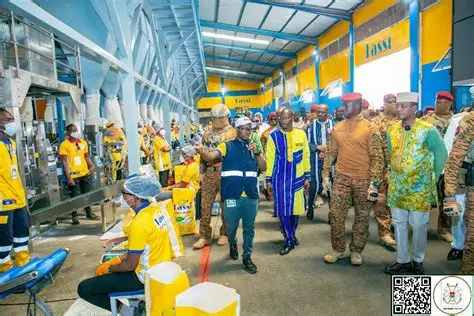
The recent surge in industrial project inaugurations and site visits across Burkina Faso has been a cornerstone of the transitional government’s communication strategy. Under the leadership of Captain Ibrahim Traoré, the administration has highlighted tomato processing plants and gold processing units as emblematic of the nation’s purported economic resurgence. However, beneath the polished veneer of state media coverage, the country grapples with entrenched security and economic crises that mere propaganda cannot obscure.
The illusion of progress through symbolic projects
In Ouagadougou and Bobo-Dioulasso, the government’s emphasis on large-scale infrastructure projects serves as a calculated maneuver to bolster its legitimacy. The narrative frames these initiatives as proof of Burkina Faso’s self-reliance, particularly in the face of territorial blockades and the withdrawal of Western partners. Advocates of the regime celebrate each groundbreaking ceremony as a triumph over foreign influence, portraying these endeavors as pillars of national sovereignty and job creation.
Critics, however, argue that such efforts resemble a desperate attempt to mask deeper systemic failures rather than a coherent development blueprint. The disconnect between official proclamations and ground-level economic challenges underscores the fragility of this approach.
Transparency deficits and financial irregularities
Scrutiny of these high-profile industrial ventures often reveals glaring inconsistencies. While inauguration ceremonies are meticulously staged, critical details—such as actual funding sources, operational feasibility, and long-term production viability—remain conspicuously absent from public discourse.
Furthermore, allegations of financial misconduct cast a shadow over the management of patriotic funds allocated for both security operations and industrial development. Questions persist regarding the allocation of these resources, particularly as traditional private enterprises struggle under the dual burdens of excessive taxation and escalating insecurity. The emergence of new entities with close ties to the ruling circle has further fueled suspicions about the fairness and transparency of contract awards.
The widening chasm between rhetoric and reality
As the corridors of power showcase industrial progress, the daily lives of ordinary Burkinabè are increasingly marked by hardship.
Soaring inflation: The cost of staple goods such as rice, cooking oil, and millet has spiraled beyond the reach of many households, exacerbating food insecurity among vulnerable populations.
Humanitarian catastrophe: With over two million internally displaced persons, Burkina Faso faces one of its most severe crises in decades. Entire villages remain under terrorist blockades, dependent on sporadic humanitarian convoys for survival.
Economic paralysis: The informal sector, historically the backbone of the economy, is in freefall. Persistent power outages and the pervasive threat of roadside attacks have crippled commerce, stifling economic activity.
Propaganda as a survival mechanism
The stark contrast is undeniable: on one side, meticulously produced videos depict gleaming machinery and a resolute leader; on the other, families grapple with the impossibility of educating their children and soldiers fight under harrowing conditions.
The narrative of a “thriving Burkina Faso” is, for now, a carefully constructed media illusion designed to sustain hope and suppress dissent. Yet propaganda has its limits—it cannot nourish a nation when fields lie fallow and factories exist primarily as visual props for state broadcasts.
Captain Ibrahim Traoré’s gamble on perception carries significant risks. By prioritizing the optics of progress over tangible solutions, the administration risks deepening the disconnect between governance and the citizenry’s lived experiences. Industrialization, though a commendable goal, cannot thrive on unstable foundations. Without rigorous financial accountability and genuine territorial security, the president’s public appearances will remain fleeting mirages in the vast Sahelian landscape.